
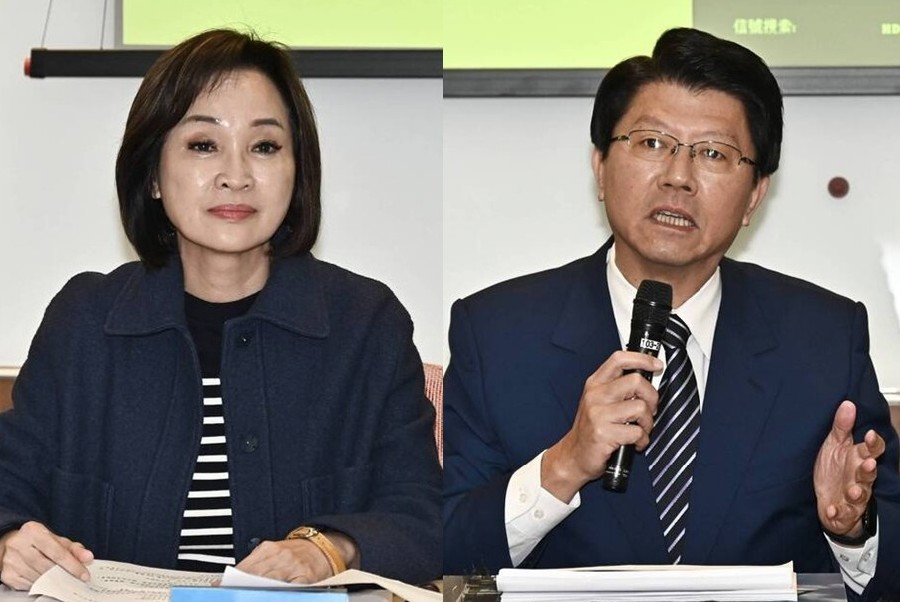
By RK Shih / Staff -Cover image via Liberty Times, and shows the KMT’s Kaohsiung mayoral candidate (left), Ko Chih-en, and the party’s pick for Tainan City (right), Hsieh Lung-chieh
TAIPEI — Kuomintang (KMT) mayoral hopefuls in southern Taiwan downplayed political fallout from an upcoming cross-strait think tank forum in Beijing, arguing that the event should be viewed as a technical and livelihood-focused exchange rather than an ideological signal.
The “KMT–CCP Think Tank Forum” is scheduled for Feb. 2-4 in Beijing and has drawn scrutiny amid heightened cross-strait tensions and the approaching 2026 local elections. Asked whether the forum could affect voter sentiment in southern Taiwan, KMT Kaohsiung mayoral candidate and lawmaker Ko Chih-en (柯志恩) said the meeting should not be over-politicized.
Ko said the forum focuses on professional and livelihood issues and should not be framed as ideological alignment with Beijing. She pointed to the delegation being led by a former government minister, Lee Hong-yuan (李鴻源), now the vice chairman of the KMT think tank. Lee’s background is in disaster prevention, seismic safety, and related public policy fields.
Responding to criticism that participation in the forum may be linked to opposition efforts to block portions of the national defense budget, Ko dismissed the claim as “over-interpretation.” She said Taiwan’s Ministry of National Defense already maintains a regular defense budget of approximately NT$900 billion, and that both the KMT and Taiwan People’s Party broadly support self-defense.
Ko argued that debate has centered on the proposed scale and pacing of additional spending proposed by President Lai, roughly NT$1.25 trillion to be allocated over multiple years, and that those discussions predated the Beijing visit. Framing all KMT reform proposals as tied to China, she said, was a form of political manipulation that does little to improve cross-party relations or cross-strait stability.
KMT Tainan mayoral candidate and legislator Hsieh Lung-chieh (謝龍介) echoed Ko’s remarks, saying southern voters value peace and would accept professional and humanitarian exchanges with China.
“We are pursuing peace, and southern voters will understand that,” Hsieh said. He accused the Democratic Progressive Party of favoring confrontation, while arguing that dialogue and engagement could open pathways to stability.
On defense policy, Hsieh said the KMT has historically prioritized Taiwan’s military capabilities, noting that major weapons systems currently in service, including Mirage 2000 fighters, F-16s, and Patriot missile systems, were procured under past KMT governments.
“The KMT has opposed the Communist Party for more than 80 years and understands it very well,” Hsieh said. He added that the party does not oppose defense spending itself, but what he described as opaque or excessive procurement.
Hsieh said the KMT’s approach to cross-strait relations is based on “seeking common ground while reserving differences,” stressing that advocating peace does not mean abandoning military preparedness. He urged an end to what he called political “red labeling” and called for a pragmatic discussion about Taiwan’s future development.
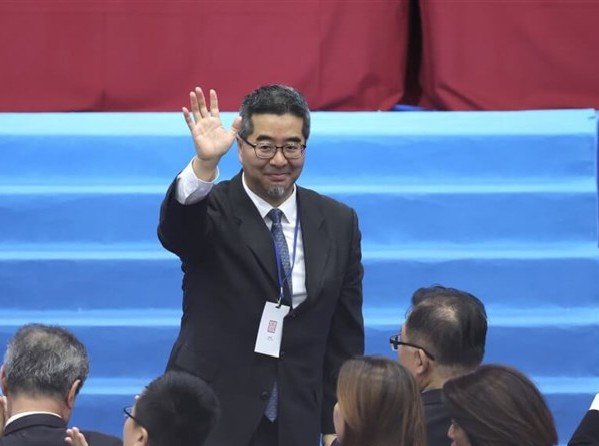
Deputy KMT Chairman Hsiao Hsu-tsen.
What the forum is and why it matters
The meeting has been officially described by China’s Taiwan Affairs Office as the “Nationalist Party–Chinese Communist Party Think Tank Forum” (國共兩黨智庫論壇). It marks a restart of formal dialogue between the Kuomintang (KMT, 中國國民黨) and the Chinese Communist Party (CCP, 中國共產黨) after roughly a decade, focusing on cooperation and exchange rather than overt political negotiation. The forum’s theme is “Cross-Strait Exchange and Cooperation Outlook.” It is jointly organized by the CCP’s Taiwan Affairs Office research arm and the KMT’s policy research foundation. Participants are slated to include representatives, scholars, and experts from across fields such as tourism, industry, technology, healthcare, environmental protection, and sustainable development.
Background and context
This type of forum is connected historically to the Cross-Strait Economic, Trade and Culture Forum, a series of exchanges between the two parties dating back to 2006, designed to facilitate dialogue on economic, cultural, and social topics. That series lapsed after 2016, coinciding with changed political winds in Taiwan.
Taiwanese local reports indicate the forum was initially expected to resume earlier but was likely postponed to early February and reframed primarily as a “think tank” exchange focused on non-political issues such as AI, disaster prevention, and sustainable industrial cooperation. KMT leadership has not confirmed all details publicly, and it remains unclear whether top party figures such as Cheng Li-wun (鄭麗文), the KMT chairperson, will attend in person.
Political sensitivities and reactions
Chinese officials have not publicly addressed whether the forum relates to high-level political meetings such as a prospective summit between Cheng and Chinese leader Xi Jinping (習近平). Taiwanese government and opposition lawmakers have been debating whether the forum’s timing and framing are linked to domestic issues, for example, the opposition’s blocking of portions of Taiwan’s national defense budget, but both sides deny any direct condition linking the two.
Key participants and framing
- The CCP side is represented by the Taiwan Affairs Office and its research center.
- The KMT side reportedly will send a delegation of around 40 experts led by Hsiao Hsu-tsen (蕭旭岑), the party’s vice chairman, along with the think tank’s vice chair Lee Hong-yuan (李鴻源).
Outstanding unknowns
As of now, officials have not confirmed detailed agendas, concrete joint statements, or expected outcomes in terms of policy, and it remains uncertain whether this exchange will influence cross-strait relations beyond technical or academic dialogue. Forums of this kind can become politically sensitive domestically in Taiwan, given differing views on engagement with China, and reporting sometimes reflects partisan frames on both sides.