
By Dr. TUNG Chen-Yuan, Taiwan’s Representative to Singapore
At a time when countries around the world are competing to localize advanced semiconductor manufacturing, TSMC has in recent years significantly expanded its investments in the United States, Japan, and Europe. This has inevitably sparked concerns that its industrial center of gravity may be shifting overseas, even being simplistically labeled as so-called “de-Taiwanization.” However, a comprehensive examination of capacity structure, process nodes, and R&D deployment makes one point clear: while TSMC is extending its global manufacturing network and capabilities, the R&D core, technology development, and advanced-node production capacity that truly determine competitiveness remain firmly anchored in Taiwan.
Overall, TSMC’s global manufacturing system exhibits a pattern of “diversification without symmetry.” The establishment of overseas fabs primarily responds to supply-chain resilience, geopolitical considerations, and regional customer demand. In contrast, the core capabilities related to advanced process R&D are deliberately and highly concentrated in Taiwan, making the island the undisputed center of technology and capacity.
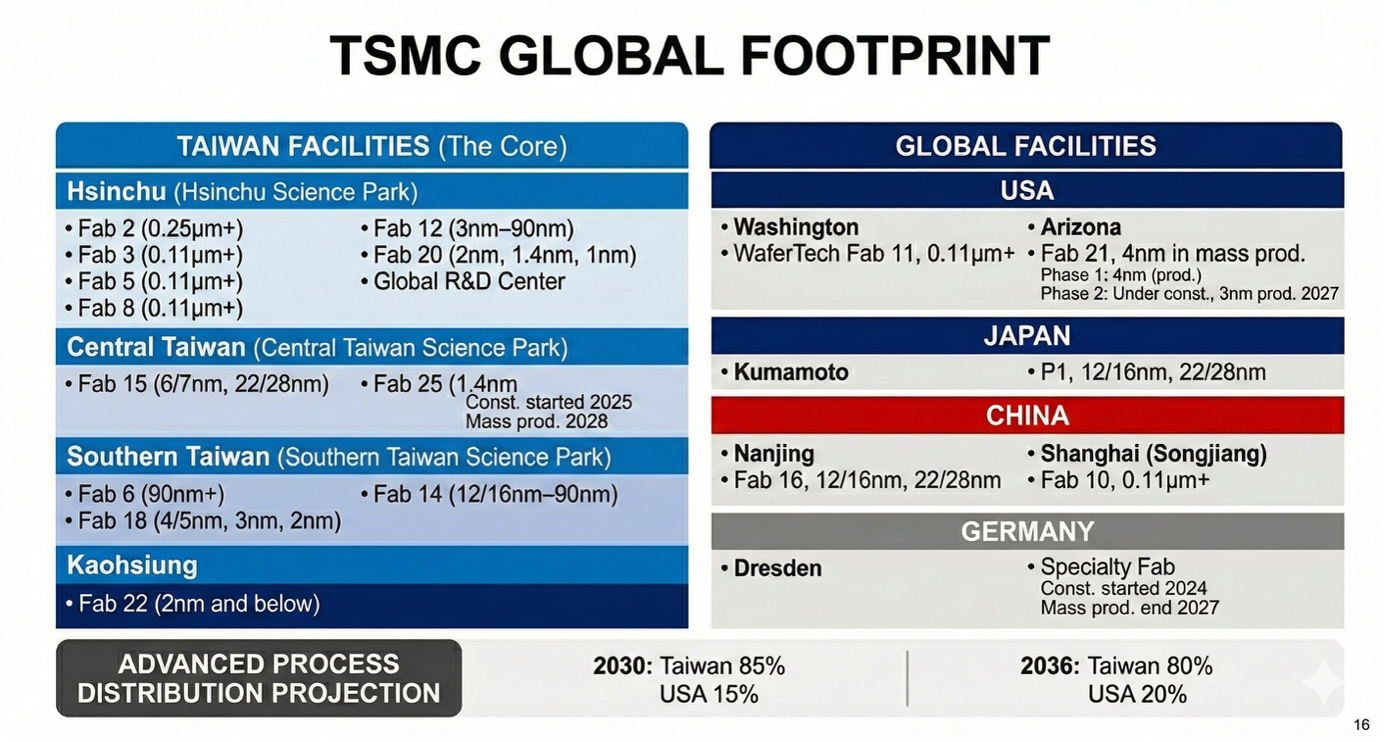
From the perspective of capacity distribution, this structure is unlikely to be fundamentally shaken for more than a decade. According to estimates by Taiwan’s Ministry of Economic Affairs, even after investing up to US$ 165 billion in Arizona to build three advanced fabs, Taiwan will still account for about 85% of TSMC’s total advanced-node capacity by 2030, with the United States at around 15%. Even by 2036, Taiwan’s share is expected to remain close to 80%. This indicates that overseas investment is essentially a form of “strategic extension,” not a replacement of Taiwan’s core position.
Taiwan’s leading role is equally evident in the global allocation of advanced capacity. The Industrial Technology Research Institute estimates that by 2029, Taiwan will account for 61% of global capacity at 6-nanometer and below nodes—well ahead of the United States at 16%, South Korea at 11%, and Japan at 7%, while China is projected to hold only 1%. TrendForce likewise forecasts that Taiwan’s share of global advanced-node capacity will be around 56% in 2030, maintaining its leading position.
Behind these figures lies not merely the scale of capacity, but the ability to set the pace of technological evolution. TSMC’s most advanced process nodes are always first brought into volume production in Taiwan. The 2-nanometer (N2) process is scheduled for mass production in Hsinchu and Kaohsiung in the fourth quarter of 2025, while subsequent A16 and A14 (1.4-nanometer-class) technologies will likewise see their R&D, pilot runs, and initial mass production start in Taiwan.
By contrast, even if TSMC’s Arizona fabs introduce advanced logic processes, their mass-production timelines will still lag Taiwan’s significantly, with 2-nanometer or A16 production not expected until around 2030. This deliberate gap of roughly one to two technology generations is a key design through which TSMC preserves technological sovereignty and long-term competitive advantage.
The concentration of R&D resources further underscores Taiwan’s central role. TSMC has established its global R&D center in Taiwan as the hub for cutting-edge processes and frontier technologies, focusing on nodes below 2 nanometers, new materials, and new transistor architectures, and is expected to bring together nearly 7,000 R&D personnel. This demonstrates that R&D activities have not shifted overseas with fab expansion; instead, the most critical talent and innovation capacity are being further concentrated in Taiwan.
This R&D configuration is built upon Taiwan’s highly mature and difficult-to-replicate industrial ecosystem. The close integration of R&D, pilot production, and large-scale manufacturing enables rapid accumulation along the yield-learning curve and continues to attract leading global equipment and materials suppliers to establish R&D and technical support bases in Taiwan. Even as overseas fabs gradually mature, they remain heavily dependent on process experience and management models that are transplanted from—and repeatedly validated in—Taiwan.
By contrast, TSMC’s investments in Japan and Europe have been assigned different roles from the outset. The Japanese fabs primarily serve image sensors, automotive, and industrial applications, focusing on specialty processes in the 12- to 28-nanometer range. Even with the introduction of 6- to 7-nanometer processes at a second fab in 2027, these will still not represent TSMC’s most advanced nodes.
The European fab, meanwhile, concentrates on 28-, 22-, 16-, and 12-nanometer processes, deeply embedded in local automotive and industrial supply chains, and does not participate in the competition for leading-edge logic chips. The main function of overseas sites is to enhance local supply-chain resilience, not to replace Taiwan’s role at the apex of the technology chain.
Taken together—capacity structure, the cadence of advanced processes, and R&D deployment—TSMC’s global footprint is not a story of “de-Taiwanization,” but rather a Taiwan-centric global expansion strategy. Overseas fabs provide supply-chain resilience and proximity to markets, while Taiwan continues to command the R&D leadership and the vast majority of capacity at 2-nanometer and more advanced nodes, making Taiwan an even more solid—and increasingly irreplaceable—core of the global semiconductor landscape.
About the Author:
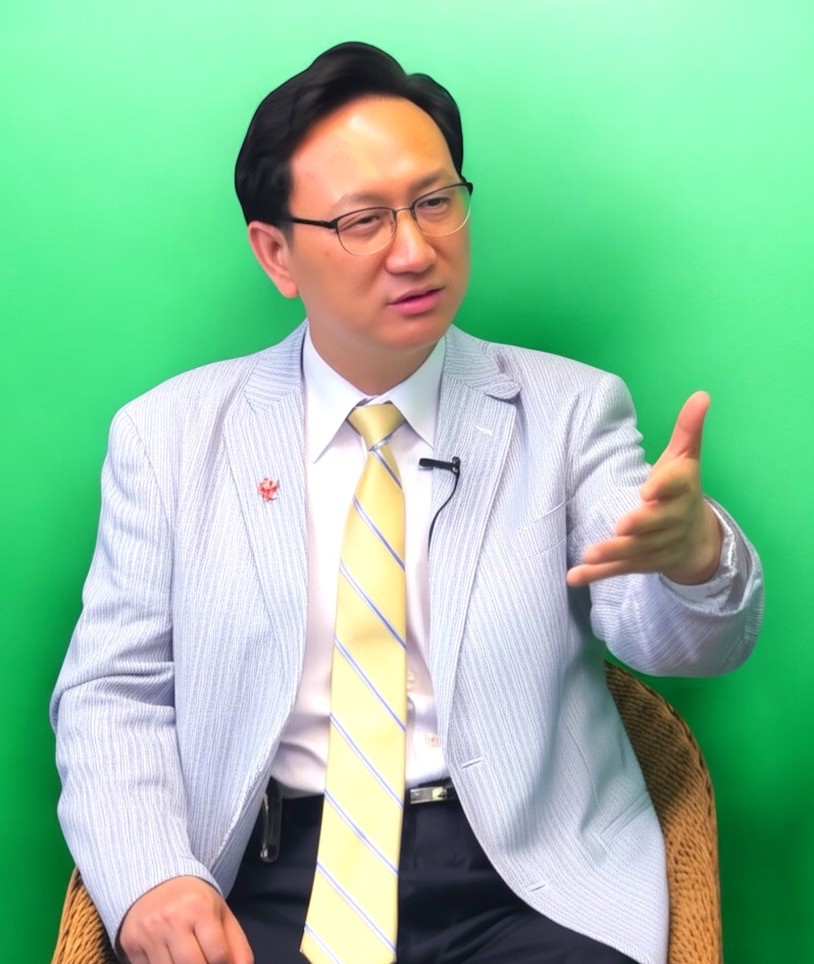
Dr. Tung Chen-Yuan is currently Taiwan’s Representative to Singapore. He was Minister of the Overseas Community Affairs Council of the Republic of China (Taiwan) from June 2020 till January 2023. He was Taiwan’s ambassador to Thailand from July 2017 until May 2020, senior advisor at the National Security Council from October 2016 until July 2017, and Spokesman of the Executive Yuan from May to September 2016. Before taking office, Dr Tung was a distinguished professor at the Graduate Institute of Development Studies, National Chengchi University (Taiwan). He received his Ph.D. degree in international affairs from the School of Advanced International Studies (SAIS), Johns Hopkins University. From September 2006 to May 2008, he was vice chairman of the Mainland Affairs Council, Executive Yuan. His areas of expertise include international political economy, China’s economic development, and prediction markets.