
By Eryk Michael Smith/Staff
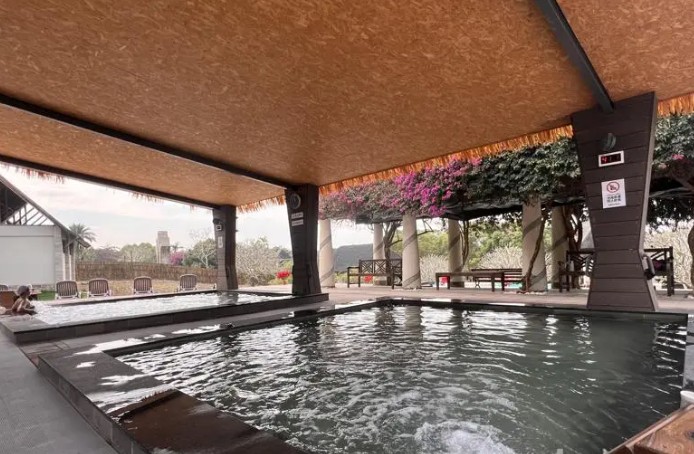
A hotel operator in Gaoshu Township (高樹鄉), Pingtung County, has officially opened northern Pingtung’s first certified natural hot spring resort, marking a major milestone for tourism development in the area.
According to United Daily News, the operator spent three years drilling to a depth of about 995 meters, where workers struck geothermal water measuring 42 degrees Celsius. Laboratory testing confirmed the source as a bicarbonate spring, commonly known in Taiwan as a “beauty spring” due to its mineral content.
Hotel vice general manager Chiu Li-hui (邱麗慧) said the company decided to invest in the project after noticing a post-pandemic decline in domestic tourism, as many travelers chose overseas destinations such as Japan for hot spring trips.
The resort received its official hot spring certification in September 2025, making it the county’s 15th licensed hot spring operator and the first in northern Pingtung. The other 14 licensed sites are located in Checheng (車城) and Mudan (牡丹) townships on the Hengchun Peninsula.
Gaoshu lies at the northern edge of Pingtung County, closest to Dawu Mountain (大武山), and has historically lacked geothermal resources. County officials previously conducted exploratory drilling in nearby Xinfeng Village but only reached water temperatures of 28–29°C, below Taiwan’s legal hot spring threshold of 30°C.
Government oversight
Pingtung County’s Water Resources Department emphasized that all hot spring operators are subject to strict volume controls. Officials cited recent enforcement actions in Sichongxi (四重溪), where several operators were fined last year for illegal over-extraction. Penalties totaled more than NT$1 million.
Authorities say continued monitoring will ensure sustainable use of geothermal resources.
Looking ahead
Gaoshu Township Secretary Liang Da-feng (梁達鳳) said the new attraction complements existing cultural and recreational sites, including Hakka stone lion heritage areas and nearby parks. County tourism authorities say the project demonstrates how private investment can help diversify regional tourism beyond Pingtung’s traditional coastal destinations.