
By KHT Staff
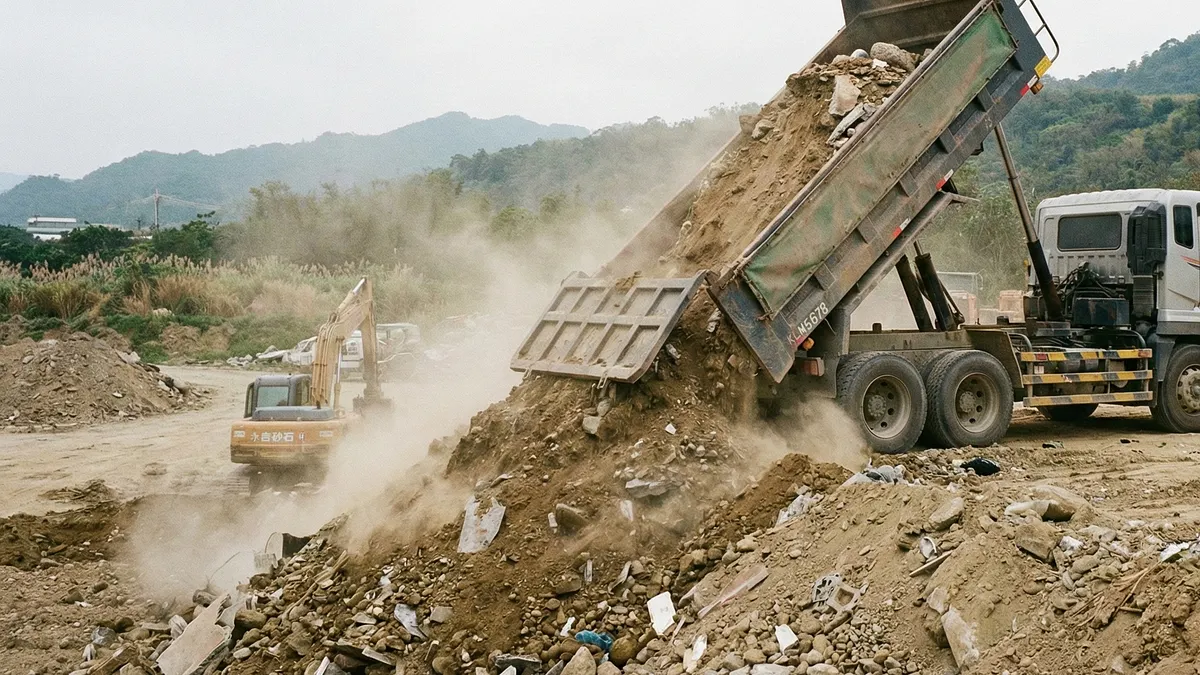
KAOHSIUNG — Taiwan this month began enforcing a new “full flow” tracking system for surplus construction soil, requiring transport vehicles to install certified GPS tracking and file an electronic manifest at each entry and exit point, according to the National Land Management Agency (國土管理署) under the Ministry of the Interior (內政部).
The agency says the system is designed to prevent illegal dumping and false volume reporting—practices tied to longstanding black-market methods such as “looping routes” and forged manifests—by making vehicle routes verifiable via QR-code checks and route-deviation alerts. Officials have said violations can draw administrative fines of NT$60,000 to NT$300,000 under the Waste Disposal Act (《廢棄物清理法》).
The policy’s political and enforcement momentum traces back to an illegal excavation case in Kaohsiung in August 2025, when investigators said a criminal group dug into farmland and state land in Meinong (美濃), in some areas reaching depths of about 20 meters and spanning more than six hectares, removing valuable soil and rock and then backfilling with construction waste.
Since the Jan. 1 rollout, builders and haulers have warned that real-world capacity is lagging behind the policy’s scope, citing shortages of compliant vehicles and limited legal destinations for soil disposal and reuse. The Real Estate Development Association Federation (不動產建築開發公會聯合會) chair criticized the lack of a transition period, while a Kaohsiung developer said disposal costs for soil have surged from effectively zero to roughly NT$3,500–5,000 per cubic meter in some cases—figures industry groups say could force stoppages at excavation-heavy projects and amplify cost pressures across housing and infrastructure.
Implementation has exposed major gaps in infrastructure and readiness. Of roughly 15,000 soil transport trucks nationwide, only about 3,000 had completed system upgrades when the rules took effect, severely constraining logistics capacity.
Disposal sites in short supply
Compounding the problem is a chronic shortage of legal disposal facilities. Taiwan currently has only about 140 authorized soil treatment sites (土資場), far below what is needed to handle current construction demand. Establishing new sites can take two to three years due to environmental impact assessments and zoning reviews.
With soil unable to move, excavation work at many construction sites has stalled, forcing some projects into partial or full suspension.
What changed under the new system?
The updated rules, overseen by the Ministry of the Interior (內政部), introduce several key shifts:
- Digital manifests: Paper forms have been replaced by electronic records accessible via web and mobile apps. Inspectors can scan QR codes to verify vehicle data and transport routes in real time.
- Mandatory GPS tracking: All soil transport vehicles must now install certified tracking systems. Deviations from approved routes trigger automatic alerts.
- No more transfer hubs: Soil processing sites can no longer function as transfer stations. Material must now go directly to final disposal or reuse locations.
- Stricter enforcement: Violators face fines of NT$60,000 to NT$300,000 under the Waste Disposal Act (《廢棄物清理法》).
Impact on housing and consumers
The slowdown has already begun to affect the property market. Construction delays are pushing back delivery timelines for pre-sale homes, raising the risk of contract disputes.
Costs are also rising. Smaller construction firms are considered especially vulnerable, with industry groups warning of potential cash flow crises and unfinished projects.
Renovation work has also been hit, with contractors reporting higher quotes due to disposal bottlenecks.
Government response
In response, the Cabinet (行政院) and the Ministry of the Interior (內政部) have announced emergency measures:
- Expanding disposal capacity: Ports and industrial zones—including Taipei Port (台北港), Taichung Port (台中港), Changhua Coastal Industrial Park (彰濱工業區), and Kaohsiung’s Nansing Project (南星計畫)—will temporarily accept large volumes of soil.
- Temporary storage sites: Local governments are being authorized to establish short-term holding facilities.
- Streamlining transport routes: Some cities will allow direct delivery from excavation sites to final destinations, bypassing processing centers.
- Allowing smaller trucks: Light trucks may now transport soil if they meet safety standards and install tracking systems.
Officials say more long-term solutions are under review, but industry leaders continue to call for a transition period to stabilize the market.