
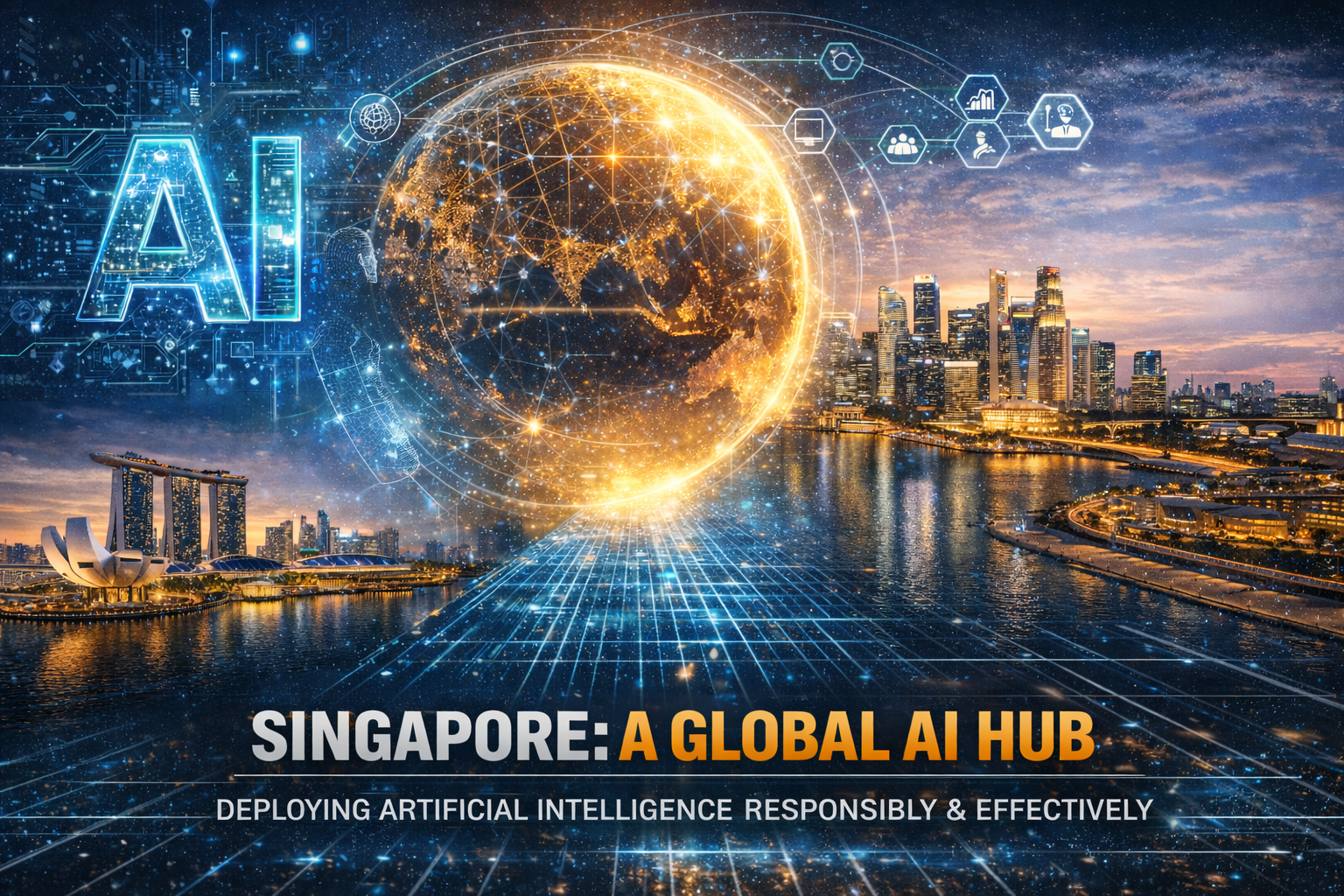
By Dr. TUNG Chen-Yuan, Taiwan’s Representative to Singapore – AI image for illustrative purposes only.
Singapore Prime Minister Lawrence Wong yesterday (February 12) delivered the FY2026 Budget Statement, outlining a pivotal blueprint for the nation’s next phase of economic transformation. In this policy address, artificial intelligence (AI) was no longer treated as a subset of technology policy; it was elevated to a core national strategy directly tied to competitiveness and long-term development.
Prime Minister Wong stated candidly that Singapore’s ability to navigate global uncertainty will hinge on how effectively it harnesses emerging technologies—foremost among them AI, the most disruptive force of our time. The package of policies introduced makes clear the government’s determination to move AI from isolated pilot initiatives to comprehensive deployment, guided by top-level design, industry incentives, and a robust talent strategy.
Strategically, Singapore has chosen a pragmatic and clear-eyed path. The Prime Minister acknowledged that Singapore lacks the scale to compete with major powers such as the United States and China in developing foundational AI models. Instead, its comparative advantage lies in deploying AI “effectively, responsibly, and swiftly.” This declaration signals that Singapore has no intention of entering an arms race in model development. Rather, it aims to position itself as a global hub and testing ground for AI solutions. Instead of pursuing scale for its own sake, the country seeks to excel in application efficiency and systems integration.
To advance this direction, Singapore has launched a new “AI Missions” initiative, prioritizing four key sectors for early adoption: advanced manufacturing, connectivity, financial services, and healthcare. These industries are both pillars of the economy and areas facing structural pressures such as labor constraints and rising costs. Through smart airport and port operations, automated manufacturing upgrades, enhanced financial risk management, and AI-enabled healthcare applications, Singapore intends to raise productivity, overcome the limitations of scarce natural resources and a small population, and further solidify its status as a global hub.
On governance, the government has simultaneously upgraded its institutional framework. Prime Minister Wong announced the establishment of a National AI Council, which he will personally chair. Its members include ministers from Trade and Industry, Health, Digital Development and Information, Manpower, National Development, and Transport, along with representatives from the private sector. The Prime Minister’s direct leadership underscores that AI policy has evolved from a ministry-led technology issue into a whole-of-government national endeavor. This structure aims to break down bureaucratic silos, ensuring that R&D investment, industry promotion, and regulatory frameworks operate in alignment under a unified strategy. Regulatory sandboxes will also be used to encourage innovation within controlled risk parameters.
At the industry level, Singapore has introduced the “Champions of AI” program, targeting enterprises committed to transformation and offering tailored support. The initiative emphasizes end-to-end business restructuring rather than piecemeal adoption of isolated tools. The government recognizes that meaningful AI transformation requires rethinking data governance frameworks, redesigning processes, and redefining job functions—not merely procuring new technologies.
To reduce experimentation costs, the government will expand tax incentives under the Enterprise Innovation Scheme. From the Year of Assessment 2027 to 2028, companies may claim tax deductions of up to 400 percent on qualifying AI-related expenditures, capped at S$50,000. In addition, JTC will establish a large-scale AI Park at one-north, creating a physical innovation ecosystem that fosters collaboration among startups, research institutions, and multinational corporations, accelerating proof-of-concept development and commercialization.
Rapid technological change, however, often brings social unease. Addressing concerns about AI’s impact on the labor market, Prime Minister Wong stressed that technological progress must not come at the expense of workers. Talent development has therefore been positioned as a central pillar of the transformation. The SkillsFuture platform will be revamped to make AI-related courses easier to find and match with individual needs. Participants in designated programs will receive six months of access to advanced AI tools, lowering barriers to learning. More significantly, the TechSkills Accelerator (TeSA) program will be expanded to include mid-career workers from non-technology backgrounds. This signals a shift in manpower policy—from cultivating a small elite of engineers to equipping the broader workforce to adapt to an era of human–machine collaboration.
Overall, Singapore’s new AI strategy reflects a highly integrated model of national mobilization: led personally by the Prime Minister, focused on strategic industry use cases, reinforced by tax incentives and dedicated infrastructure, and supported by large-scale workforce reskilling. Its guiding philosophy is not to chase symbolic technological supremacy, but to leverage institutional coherence and practical application within its limited scale—prioritizing speed, depth, and effective implementation over spectacle.