

By Eryk Michael Smith/KHT Staff.
KAOHSIUNG — Renwu (仁武) and Ciaotou (橋頭) recorded the largest population gains among Kaohsiung’s districts over the past year, even as the city lost more than 16,000 registered residents.
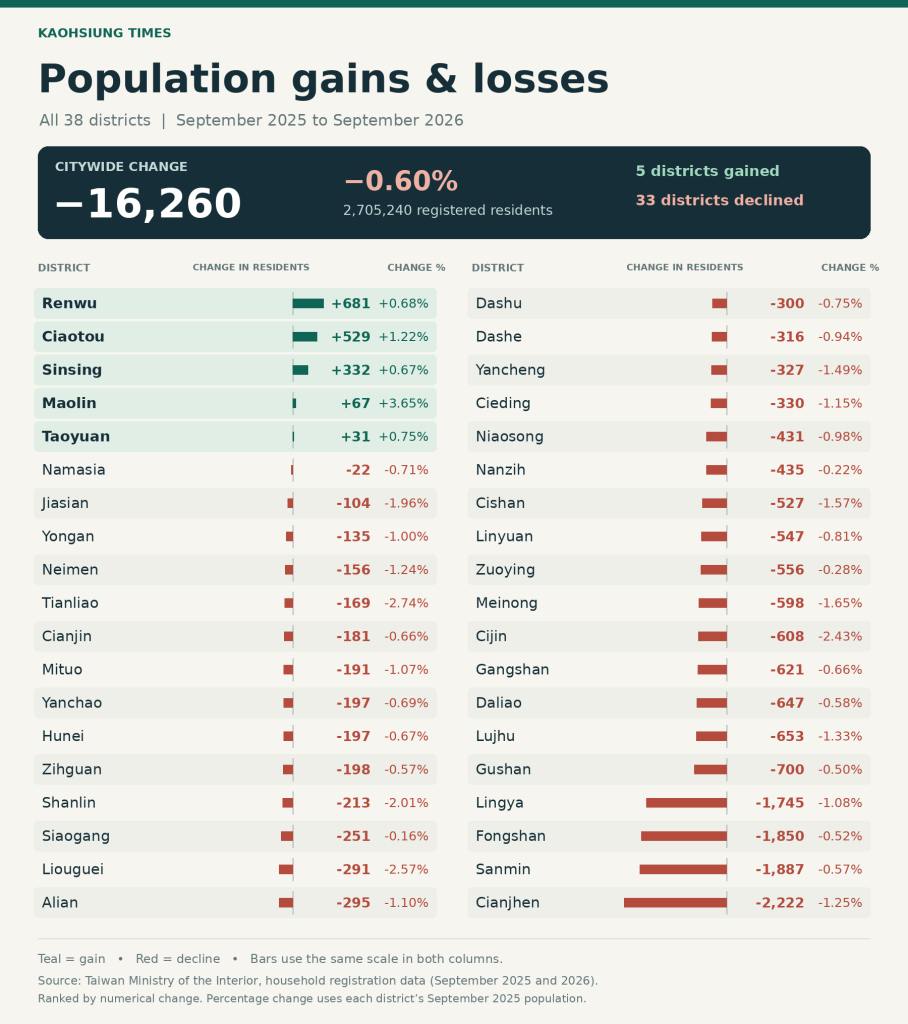
A comparison of Interior Ministry household registration data for September 2026 and September 2025 shows that just five of the city’s 38 districts grew during that period.
Renwu added 681 residents, bringing its registered population to 100,748, an increase of 0.68%. Ciaotou gained 529 residents, reaching 43,849 and growing by 1.22%.
Other districts that gained residents were Sinsing (新興), which added 332; Maolin (茂林), which added 67; and Taoyuan (桃源), which added 31. Maolin recorded the fastest percentage growth, at 3.65%, reflecting its much smaller population base.
Citywide, data showed the registered population fell from 2,721,500 to 2,705,240, a decline of 16,260 people, or 0.60%.
Taiwan’s second-largest city, Taichung, gained roughly 4,600 residents from September 2025 to September 2026. Every area south of Taichung, however, saw declines.
Changhua County and Pingtung County lost 9,100 and 5,800, respectively, while Chiayi City now has 1,000 fewer residents than at this time last year. Tainan City, Yunlin County and Chaiyi County each were down by 4,700.
Back in Kaohsiung, Cianjhen (前鎮) recorded the largest numerical decrease, losing 2,222 residents over the year. Sanmin (三民) lost 1,887, Fongshan (鳳山) lost 1,850, and Lingya (苓雅) lost 1,745.
Nanzih (楠梓), despite its prominence in discussions of northern Kaohsiung’s development, also recorded an annual decline. Its September population of 195,169 was 435 below the same month last year.
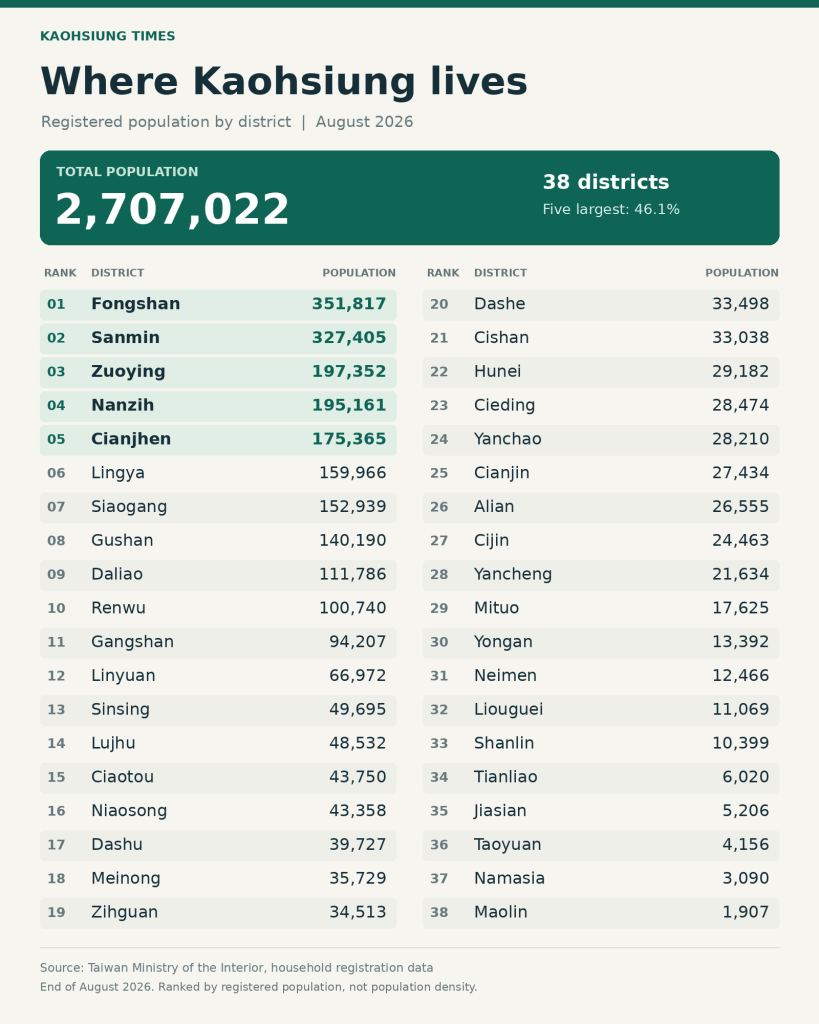
The latest monthly comparison shows a narrower picture. Between August and September, Ciaotou added 99 residents, the largest numerical gain of any district. Renwu and Nanzih each added eight, while the citywide total fell by 1,782.
Population size and population growth tell different stories. Fongshan remained the largest district in September, with 351,581 registered residents, followed by Sanmin with 327,213. Both nevertheless lost residents over the preceding year.
The figures measure household registration rather than everyone physically living in each district. They establish where registered population increased or declined, but, obviously, do not by themselves explain the causes for the declines.