
By KHT Staff
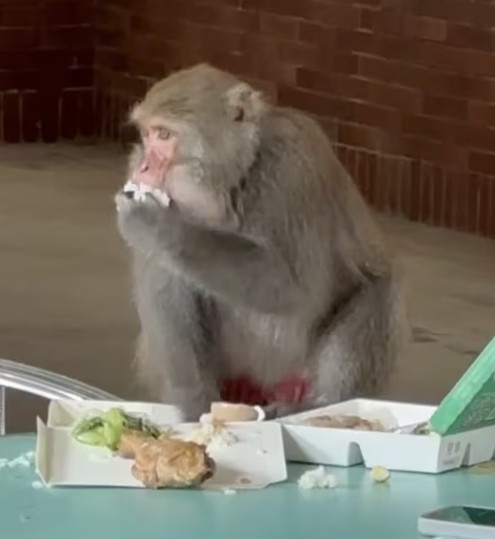
Photo shows a Formosan macaque stealing and eating students’ lunchboxes on the Zhongshan University campus in Kaohsiung, Taiwan. Image via Threads.
TAIWAN — Taiwan’s macaque population boom, long concentrated in agricultural foothills, has now shifted visibly into cities and university campuses, prompting lawmakers to demand a nationwide containment strategy. On December 3, the Legislative Yuan’s Economic Committee ordered the Ministry of Agriculture to deliver a comprehensive response to mounting crop loss and public safety concerns. Deputy Agriculture Minister Dou Wen-jian reportedly pledged to produce a “concrete action plan within three months.”
Minister Chen previously warned lawmakers in October that, without intervention, macaques could expand across Taiwan “within the next five years.”
From orchard raids to campus confrontation
Central and southern Taiwan have seen years of agricultural losses to macaques, but recent images from National Sun Yat-sen University (NSYSU, Zhongshan University) in Kaohsiung show monkeys stealing student lunches, chasing pedestrians, and rummaging through bags — scenes widely circulated on community forums. Sightings have also increased in residential zones in New Taipei.
Local governments have subsidized electric fencing to protect dragon fruit, citrus, and coffee crops, but macaques have adapted quickly. Officials and researchers note coordinated foraging behavior: some animals act as lookouts while others move in to harvest.
A conservation success turned population strain
The Formosan macaque — 50–60 centimeters long and weighing 5–12 kilograms — was once threatened by capture for laboratory use, the exotic pet trade, and habitat loss. Its protection under the 1989 Wildlife Conservation Act enabled significant recovery, leading to its removal from the protected species list in 2019. Population estimates now range from 600,000 to 800,000.
Although no longer listed as protected, fines for killing or capturing monkeys remain. Their status as primates makes lethal control politically and socially fraught. The Ministry noted that public sentiment sharply constrains policy options.
Measures under review
Lawmakers and the Agriculture Ministry are weighing:
• large-scale sterilization programs
• drone-deployed repellents
• licensed capture teams
• selective hunting permits modeled on Japan’s bear-management system
Officials caution that any drastic method risks backlash. “Since monkeys are primates like humans, there is significant emotional resistance to capture and culling,” the ministry stated.
Original reporting: Chosun Ilbo (English edition), Dec. 5, 2025.
Local Notes: Kaohsiung Macaque Activity
- 2025 — Kaohsiung City Agriculture Bureau launched a “Taiwan macaque data-sharing platform” to track macaque activity around 壽山 (Shoushan) and nearby residential zones. (中央社 CNA)
- 2025 — The government began hosting free “macaque coexistence” workshops and distributing educational materials to local residents near Shoushan. (Taiwan News)
- 2025 (Aug.) — Multiple reports emerged from Kaohsiung’s Gushan District of macaques entering homes and residential areas, even rummaging for food inside. (taidaily.com)
- Pre-2025 (2021) — There have been previous documented incidents of macaques entering campus buildings at National Sun Yat-sen University (NSYSU) in Kaohsiung, including a notable photo showing a macaque in an office cubicle. (Taipei Times)