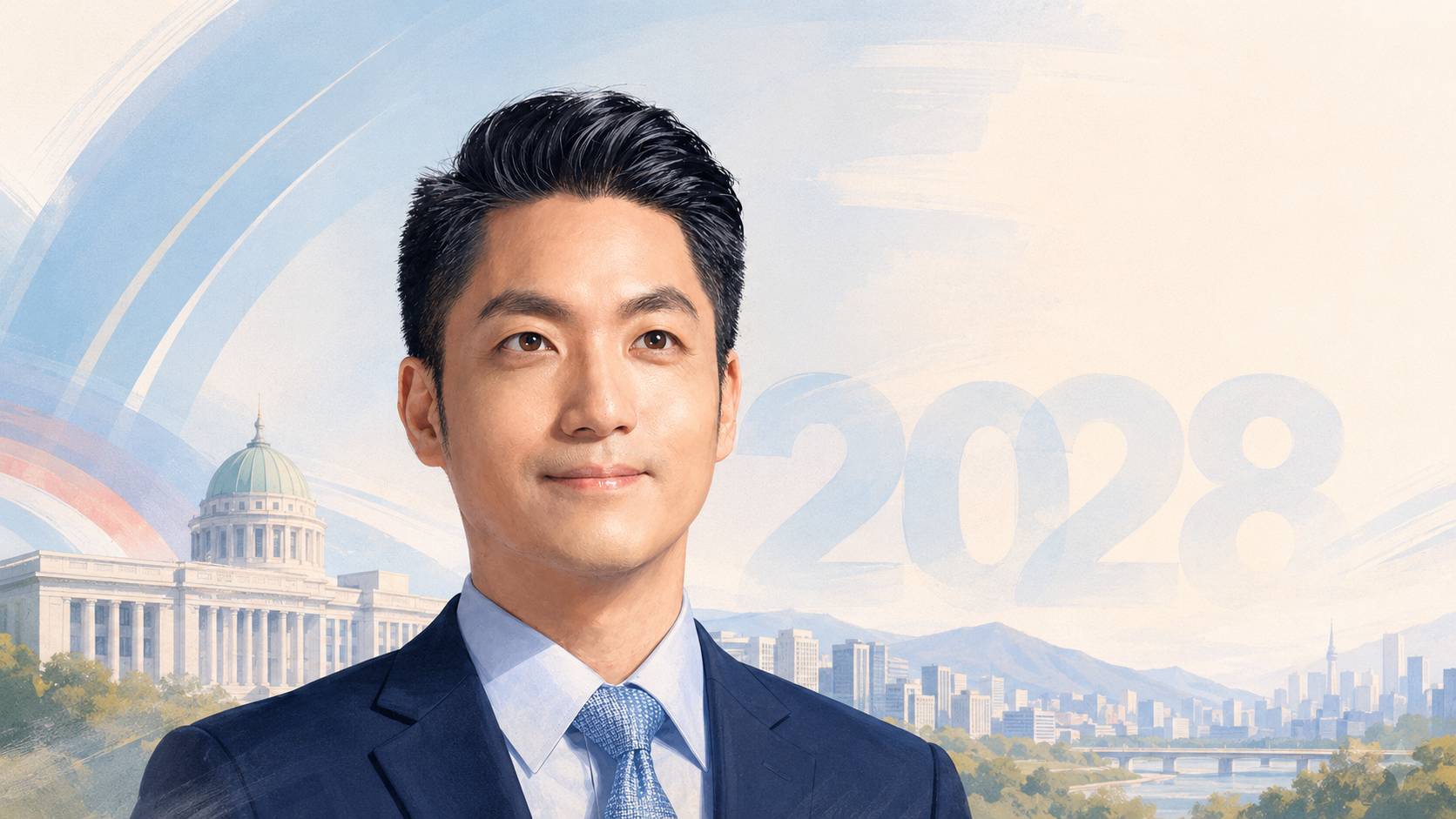
By Yu-Jhou (Jonathan) Chen. AI image based on Mayor Chiang’s official portrait.
TAIPEI — Taipei Mayor Chiang Wan-an (蔣萬安) recently said he would support a no-confidence motion against Premier Cho Jung-tai (卓榮泰) if the KMT reaches internal consensus and wins support from the TPP.
That sounds serious, and it is. Under Taiwan’s constitutional system, if the Legislative Yuan passes a no-confidence motion against the premier, the premier must resign within 10 days and may ask the president to dissolve the legislature. The president may then dissolve the Legislative Yuan after consulting its president, triggering new legislative elections within 60 days.
Chiang has framed this as a food safety issue. He has repeatedly pointed to the Central Union Oil (中聯油脂) scandal and argued that Premier Cho and the Cabinet should take political responsibility.
But this does not look like a food safety reform plan. It looks like a campaign launch.
Chiang is not just calling for better inspections, stronger penalties, or a clearer food safety chain of command. He is turning the scandal into a national political stage, with himself at the center of it.
That matters because food safety is not only a central government responsibility. Local governments also play a major role in inspections and enforcement.
Chiang’s own record on this issue is not exactly spotless. Taipei city councilors have accused him of missing 11 of 15 Taipei food safety committee meetings since taking office. A mayor who regularly attended his own food safety meetings would be in a stronger position to lecture the national government.
The same problem applies to the KMT more broadly. Central Union Oil is based in Taichung, and DPP politicians have criticized Mayor Lu Shiow-yen’s (盧秀燕) city government for failing to detect the problem earlier. They have accused Taichung authorities of not testing the company’s oil for benzo[a]pyrene, the carcinogenic compound at the center of the scandal, before the case broke.
None of this absolves the central government. The public deserves answers about why contaminated oil entered the food supply chain, why the response was not faster, and how the law should be changed.
But it does make Chiang’s attack look selective. The KMT wants the public to see Premier Cho and the DPP Cabinet as responsible, while saying much less about what KMT-run local governments did or did not do before the scandal became national news.
That is why Chiang’s recent moves should be read politically.
On July 17, he urged people concerned about food safety to join a Ketagalan Boulevard rally. On July 25, he stood on that stage as organizers claimed 200,000 people had gathered. He shared the spotlight with other major KMT figures, including Lu, Cheng Li-wun (鄭麗文), and Legislative Speaker Han Kuo-yu (韓國瑜). Soon after, he raised the idea of a no-confidence motion.
This is not just about Cho Jung-tai. It is about Chiang Wan-an.
The KMT’s 2028 presidential nomination is already taking shape in the background. Chiang is younger and less experienced than Lu, who has seniority, a strong local base, and a more established image as a national figure. If Chiang wants to close that gap, he needs something Lu already has: national visibility.
Food safety has given him that stage.
A mayor with presidential ambitions needs to look like more than a mayor. He needs to look like the face of the opposition. He needs national issues, national speeches, national rallies, and national conflict.
That is exactly what Chiang is building.
There is nothing wrong with ambition. There is also nothing wrong with demanding accountability from the Cabinet. The Central Union Oil scandal exposed real weaknesses in Taiwan’s food safety system, and the government should face tough questions.
But if Chiang wants to be taken seriously as a national leader, he should offer serious solutions.
He should explain how food safety inspections should be divided between central and local governments. He should say what Taipei has learned from its own food safety failures. He should work with legislators on closing regulatory loopholes. He should push for the stalled national budget to move forward instead of helping create another round of legislative chaos.
Calling for a no-confidence vote may create headlines. It may help Chiang look stronger inside the KMT. It may even help him compete with Lu for 2028.
But Taiwan does not need food safety to become another campaign prop.
It needs safer food, clearer responsibility, and politicians willing to fix the system even when the blame is not convenient.