
By John Ross
We continue with our serialization of Taiwan in 100 Books and find out what became of George Psalmanazar, a young Frenchman claiming to be a native of Formosa. He was the author of An Historical and Geographical Description of Formosa (1704), one of history’s greatest literary hoaxes.
* * *
A few individuals came forward to challenge Psalmanazar – even before his book was published – but their critiques were ignored. He benefited enormously by being such a champion of the Protestant church and by doubling down on the fraud. He did a good job of refuting the charges. Psalmanazar appeared before the Royal Society to address doubts about his outlandish description of Formosa. It’s hard not to admire the pluck needed to do this. Here was a young foreign man going head to head with heavyweight intellectuals and men of standing — the likes of astronomer and mathematician Edmond Halley and French Jesuit priest Father Jean de Fontenay, who had lived in China (and had spoken with priests who had been in Formosa).
In a later enquiry (1707) into the veracity of Psalmanazar’s claims, the blond Formosan produced a surprise witness by the name of John Albert Lubomirski, a supposed Polish prince and former missionary of decades to China and Formosa, who corroborated the tales of child sacrifice, the natives’ fair appearance, and other details. Not unexpectedly, Lubomirski had never been seen or heard of before his testimony and disappeared after the enquiry.
Psalmanazar addressed criticisms of his book in the preface to the second edition. He dismissed differences between Dutch accounts of Formosa with his own as them describing different regions. The Dutch had possessed a colony in southwestern Taiwan; however, Psalmanazar said, this had been on remote islands, a wild region unlike the more civilized Formosan heartland. In the preface to the French edition (September 1704) he gives the analogy of Japanese coming to Europe and thinking the Scottish Hebrides were representative of England.
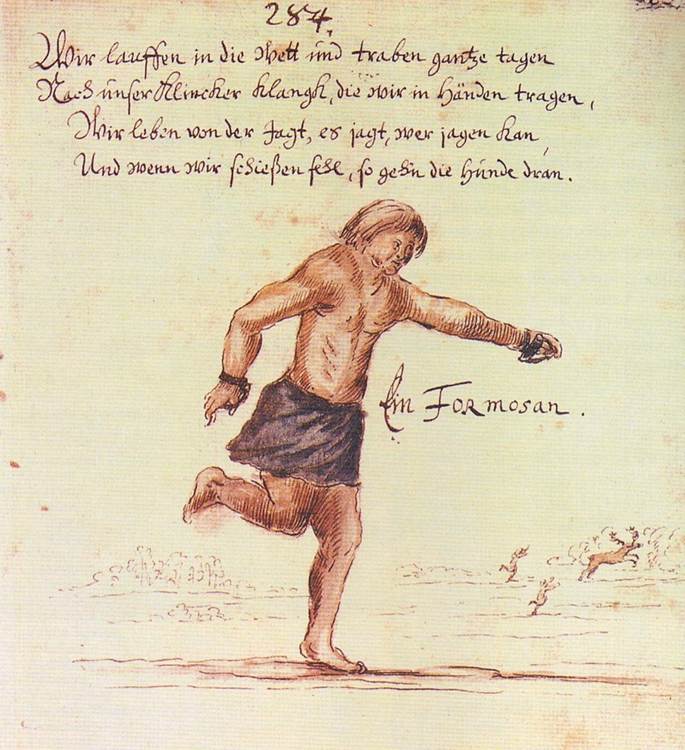
(Above: A painting of a Formosan aborigine by the German traveler Caspar Schmalkalden, 1650.)
In a remarkable piece of boldfaced jujitsu, Psalmanazar tried turning the differences between the Formosa of his imagination and the real one to his advantage; a fraudulent account, he explained with some logic, would surely have been more wisely based upon the existing materials. Psalmanazar also attacked the veracity of Candidius’ account, joining others in ridiculing the Dutchman’s claim that women not yet in their late thirties were forced to have abortions.
Looking back upon the fraud during his later years, Psalmanazar would write that his critics erred in not targeting his weakest point: the fake language he had invented. A simple test along the lines of the one Innes had originally used would surely have exposed the hoax.
Though not conclusively exposed, Psalmanazar was losing his novelty and credibility, which he countered by taking his Formosan show further down-market; he added excessive drug taking to the repertoire, consuming huge amounts of laudanum (opium in liquid form) and tobacco. After all, Formosans were hearty smokers, and, as he told people, even the women on the island smoked pounds of tobacco in a day.
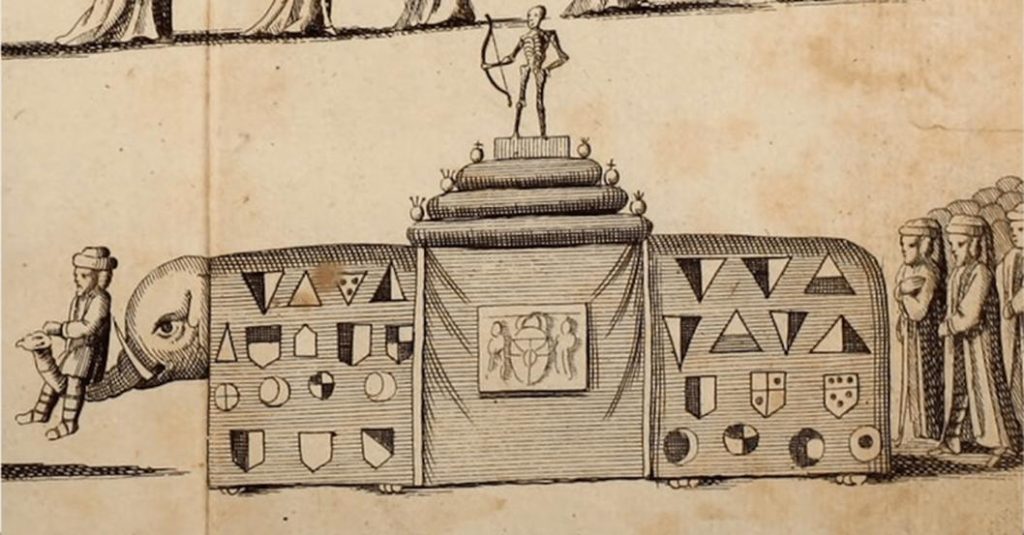
(Above: A Formosan funeral procession as depicted by Psalmanazar.)
By 1711, the impostor’s credibility largely gone, we see him being ridiculed for the sensational gore in his stories. That year, in the very first edition of the Spectator, the newspaper ran a fake advertisement for an upcoming play featuring Psalmanazar:
On the first of April will be performed at the Play-house in the Hay-market, an Opera call’d The Cruelty of Atreus. N. B. The Scene wherein Thyestes eats his own Children, is to be performed by the famous Mr Psalmanazar, lately arrived from Formosa; The whole Supper being set to Kettle-drums.
The tales of child sacrifice and cannibalism in Psalmanazar’s account made an impression on Gulliver’s Travels author Jonathan Swift, who references the Formosan imposter in his satirical essay A Modest Proposal (1729). Swift writes in the proposal – which suggests that the Irish poor could ameliorate their economic woes by selling their children as food to the rich – had been inspired by a conversation with “the famous Salmanaazor, a native of the island Formosa, who came from thence to London, above twenty years ago.”
A lesson of the Psalmanazar fraud is that the truth was out there for those who wanted to find it; some people chose to believe the lies for their own reasons, either through unenquiring, gullible ignorance or from alignments of prejudice. It’s important to stress that Formosa was obscure but hardly unknown. There was English-language material on the Dutch settlement (1624–1662), such as Candidius’ account mentioned earlier. Originally published in Dutch in 1666, and in English in 1704, the book also became a source for Atlas Japannensis (1670) and Atlas Chinensis (1671), both English-language works.
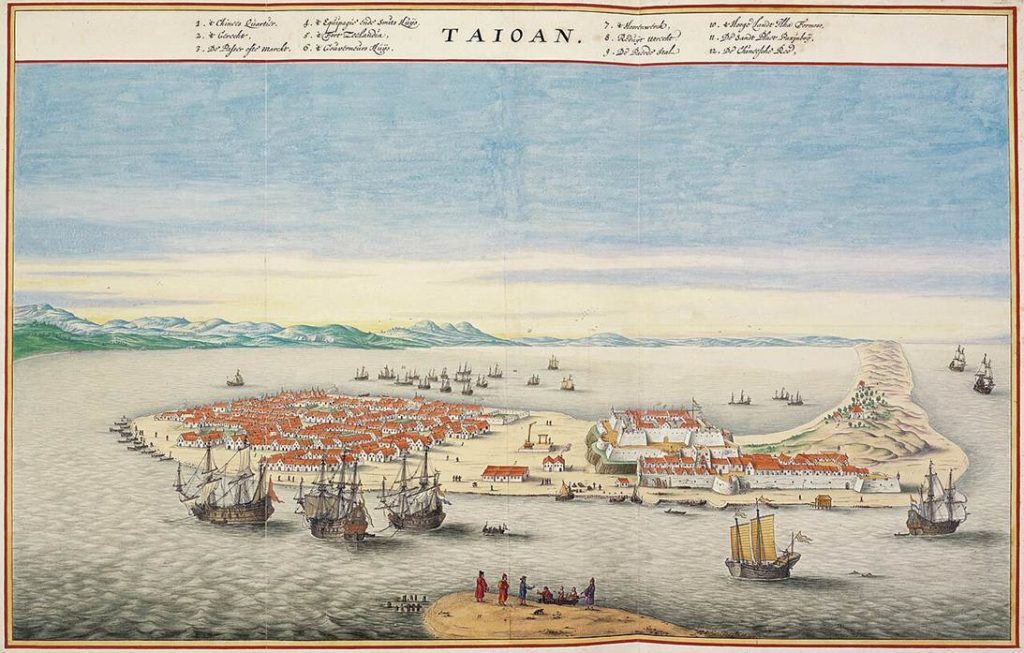
(Above: 17th-century colored drawing of Fort Zeelandia by Joan Blaeu; we’re facing south, with the Taiwan Strait on the far right, and the now-filled-in Taijiang Inland Sea on the left.)
Closer to home, there was Notes on Formosa, by Scotsman David Wright, a former employee of the Dutch colony in Formosa. When we refer to the Dutch presence in Asia, it’s actually a shorthand way of saying the Dutch East India Company (or VOC). Arguably the world’s first international corporation, the VOC was strikingly multinational – with Dutch nationals accounting for only half the staff; the last VOC governor in Taiwan, for example, was a Swede, and the traitor who helped ensure the governor had no successor was a German. Wright spent more than twenty years in Formosa; around 1655 (the timing is based on a plague of locusts he describes) he wrote a detailed, wide-ranging account of the island. Wright’s description was superior to Candidius’, in part because the Dutch had greatly expanded their control and knowledge of the island at this later time. Although Wright’s Notes on Formosa is a lost work, we have significant quoted material from it in Atlas Chinensis (which was available in England in Psalmanazar’s day).
Wright’s account describes a wide range of topics, from Formosa’s eleven political dominions, to agriculture, fishing, hunting, brewing, taboos, and religious ceremonies. Of the latter, like Candidius, he expressed his disapproval at the rampant and unbridled fornication during religious festival days.
And, if Wright’s account wasn’t enough proof of Psalmanazar’s hoax – and surely there were oral ones from other former VOC employees – remarkably, there had even been a direct English presence on Taiwan; from 1670 to 1685 – well within living memory at the time – the British East India Company had a trading post (called a “factory”) at the old Dutch settlement. This was during the short-lived Kingdom of Dongning (1661–1683), established by Ming loyalist Koxinga just a year before his death. It was Koxinga’s son who extended an invitation to the British East India Company’s regional headquarters in Bantam, an English enclave on the island of Java. The first English ship arrived in Taiwan in 1670, hopes high that the British could fill the vacuum created by the expulsion of the Dutch. The post, however, was a failure. The rulers’ monopolies on sugar and deer-hide exports kept competitors out, and English expectations of trade with China rested largely on the unreasonable hope of Koxinga’s heirs retaking the mainland. The company sought to establish trade in the region, especially Japan, whose cooler climate was seen as making it a better market than southern China for the woolen goods they were selling. One ship was dispatched to Japan; but it was sent away and the English didn’t try again – Japan was then off-limits to Europeans, except for the Dutch in Nagasaki.
The Englishmen at the factory had a lot of free time for writing letters outlining their plans and frustrations. These can be read in The English Factory in Taiwan: 1670–1685, an 808-page behemoth by Chang Hsiu-jung et al, published by National Taiwan University in 1995.
* * *
Next week we’ll look at the epic clash between the Dutch and Chinese for control of Formosa. Until then, happy reading.