

By KHT Staff
SOUTH TAIWAN — Taiwan’s military tested U.S.-made TOW and Javelin missile systems against maritime targets during live-fire drills in southern Taiwan, part of efforts to strengthen defenses against a possible amphibious landing, Army Recognition reported, citing Taiwan’s Military News Agency.
The drills were conducted by the Fourth Combat Zone (第四作戰區) at several southern training sites, including Sishu Beach (喜樹海灘) in Tainan, Fangshan (枋山) in Pingtung County (屏東縣), and the Fenggang North Training Ground (楓港北訓場) in Pingtung.
The report said the use of TOW and Javelin missiles against simulated maritime targets showed Taiwan is adapting land-based anti-armor weapons for coastal defense. In a landing scenario, such weapons could be used against landing craft, amphibious vehicles, fast assault boats, or troops moving from sea to shore.
Those procedures are especially important in southern Taiwan, where coastal areas in Tainan and Pingtung face waters linked to the Taiwan Strait, the Bashi Channel, and maritime approaches that could be relevant in a conflict scenario.
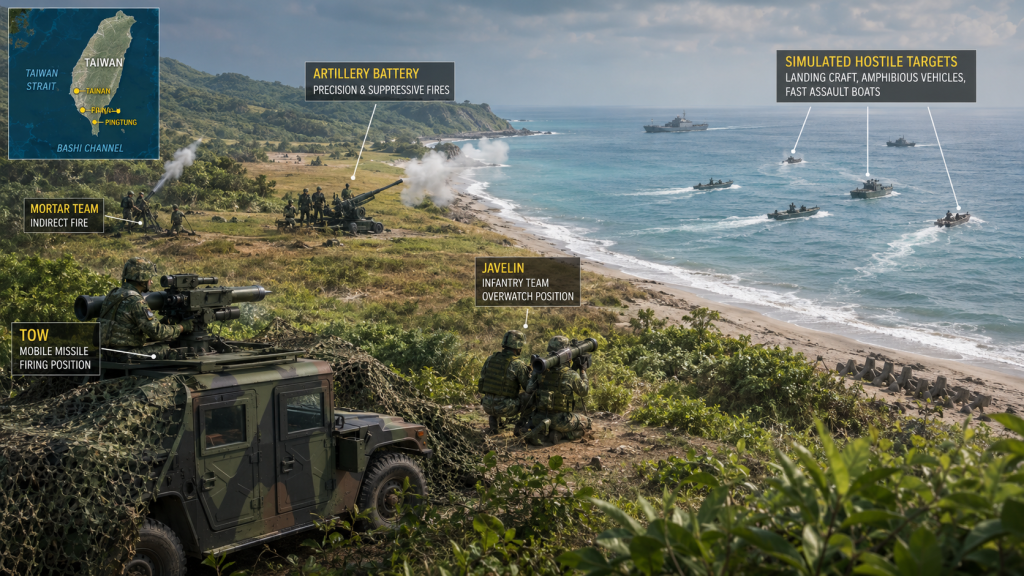
The report said Taiwan’s layered approach combines artillery, mortars, mobile missile teams, and infantry units to disrupt hostile forces before they can establish a beachhead.
The exercise highlighted the role of U.S.-origin weapons in Taiwan’s defensive strategy. TOW and Javelin systems are tactical weapons designed to stop armored, mechanized, and amphibious threats, giving smaller mobile units the ability to strike high-value targets from dispersed positions.
Army Recognition said the southern drills showed Taiwan is training for practical coastal combat conditions rather than a symbolic display, with mobile precision fires becoming a central part of homeland defense.