
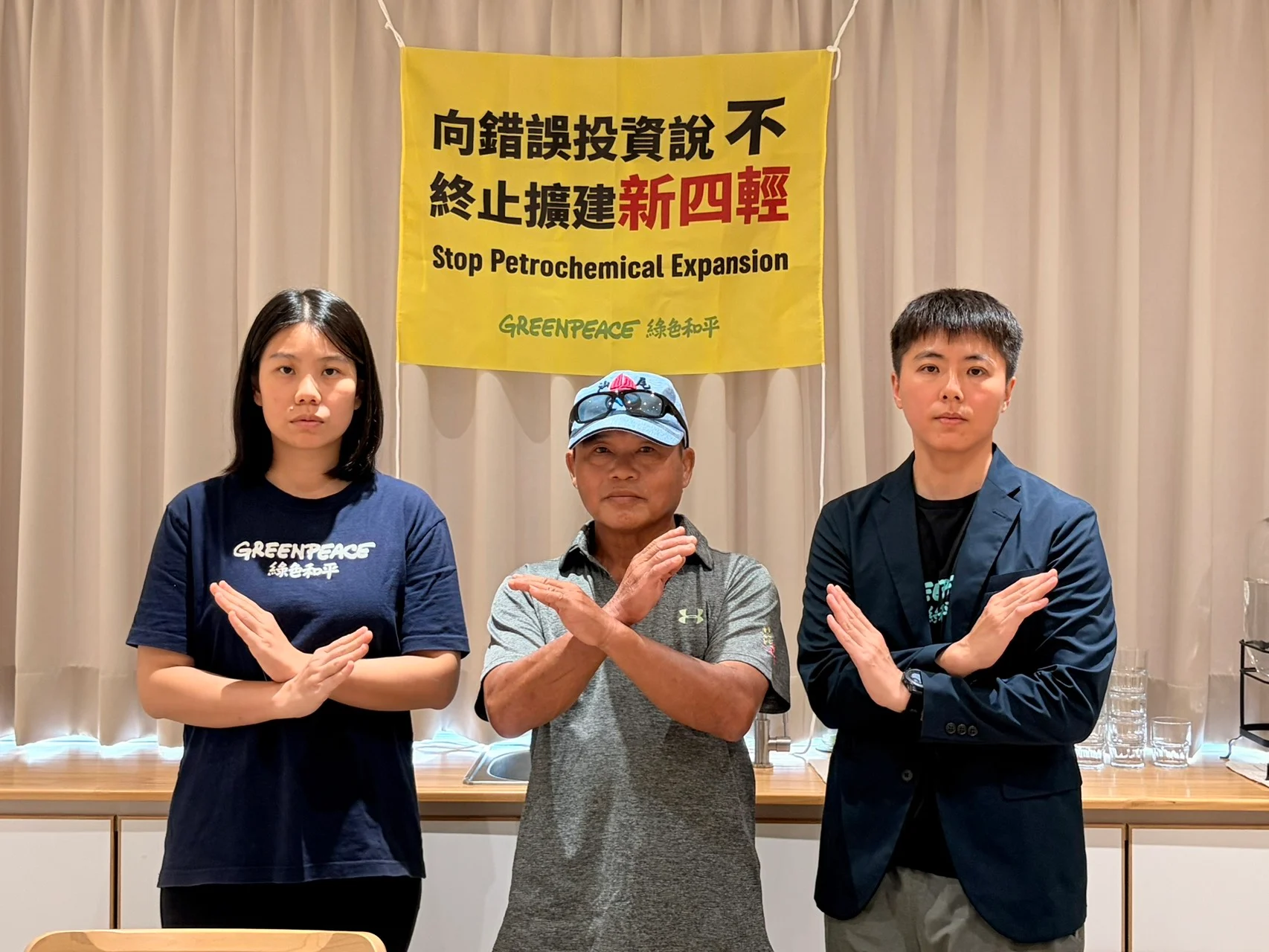
By KHT Staff. Image via Greenpeace Taiwan.
KAOHSIUNG — A Greenpeace-commissioned survey found that 90.3% of Kaohsiung residents had not heard of CPC Corporation’s proposed new fourth naphtha cracker in Linyuan District (林園區), while opposition exceeded support after respondents were given information about plastics, air pollution and possible health risks.
The Greenpeace Taiwan statement released Monday, Sept. 7, said initial support for the project stood at 41.4%, compared with 25.8% opposition. Another 32.7% of respondents said they did not know or had no opinion.
After the questionnaire introduced information about international efforts to reduce plastic, petrochemical air pollution and potential health risks from microplastics, support fell to 36.3%, and opposition rose to 47.6%. The undecided or no-opinion group declined to 15.9%.
The second result should be read in light of the survey design. It records views after those particular environmental and health prompts were presented, rather than opinions from a separate sample given independently selected information.
Survey finds limited public awareness
Greenpeace said an outside polling company interviewed 1,070 Kaohsiung residents aged 20 or older by mobile phone and landline from July 23 to 26. The results were weighted by demographic data and had a stated sampling error of plus or minus 3 percentage points at a 95% confidence level.
Awareness was also low in Linyuan and neighboring Daliao District (大寮區), the two areas closest to the petrochemical zone, where 82.9% of respondents said they did not know about the plan.
The survey also found that 87.2% believed the Kaohsiung City Government should assess the proposal more cautiously, including 64.1% who said such scrutiny was strongly needed. Greenpeace said 81.3% supported more proactive government policies to reduce unnecessary plastic production.
NT$106.2 billion project targets 2030 operations
An official CPC Corporation, Taiwan business overview says the Executive Yuan approved the NT$106 billion investment on May 13, 2024. The project would build a cracker capable of producing 1 million metric tons of ethylene annually and is scheduled to begin operations in July 2030.
A naphtha cracker processes hydrocarbons into ethylene and other basic materials used by plastics manufacturers and industries including electronics, vehicles, construction and medical products.
Greenpeace described the project as nearly tripling the capacity of the existing fourth cracker. The Central News Agency reported that the aging fourth cracker produces 350,000 metric tons of ethylene per year, while it and CPC’s newer third cracker have a combined annual capacity of 1.07 million tons.
Greenpeace public mobilization and development director Tseng Yi-ting (曾意婷) said the investment should not be treated as a routine equipment replacement because its scale could shape Kaohsiung’s industrial development, environment and public health for decades.
The environmental group called for the project to be halted and for public investment to be redirected toward higher-value materials, downstream research, worker transition programs and new local employment.
CPC and city government defend safeguards
CPC told the United Daily News that the project would replace equipment that has operated for more than 40 years and maintain supplies of essential industrial materials. The company said actual production could be adjusted according to market demand and that installed capacity did not necessarily equal output.
CPC said it supported reducing unnecessary single-use plastics but argued that demand would remain for materials used in health care, electronics, semiconductors, vehicles and construction.
The Kaohsiung City Government told the newspaper that the existing fourth cracker would have to stop operating when the new plant begins trial operations. The city said it would require advanced pollution controls, a comprehensive emissions-reduction plan and carbon capture, utilization and storage technology.
CPC has said the new plant, upgrades to the newer third cracker and other efficiency measures could reduce the Linyuan complex’s annual carbon emissions by about 300,000 metric tons compared with normal operations in 2021. Those figures remain projections tied to the company’s proposed operating plan.
Residents raise jobs and health concerns
Former Linyuan neighborhood chief Lee Chin-tsung (李進宗) said residents understood the petrochemical industry’s importance to local employment but had also lived with pollution and industrial risks for decades.
“We do not want a choice between the environment and jobs.”
Lee Chin-tsung, former Linyuan neighborhood chief
Lee called on the government to offer a transition path that protects existing workers while giving younger residents a safer environment and more employment options.
Greenpeace also urged candidates in Kaohsiung’s 2026 mayoral election to state whether they support proceeding at the proposed scale and how they would address employment, pollution and health risks. United Daily News reported that Kuomintang candidate Ko Chih-en (柯志恩) called for transparency, public participation and health protections. In contrast, Democratic Progressive Party candidate Lai Jui-lung (賴瑞隆) said local projects should proceed with residents’ agreement.
View the CPC Linyuan Petrochemical Plant area in Google Maps