
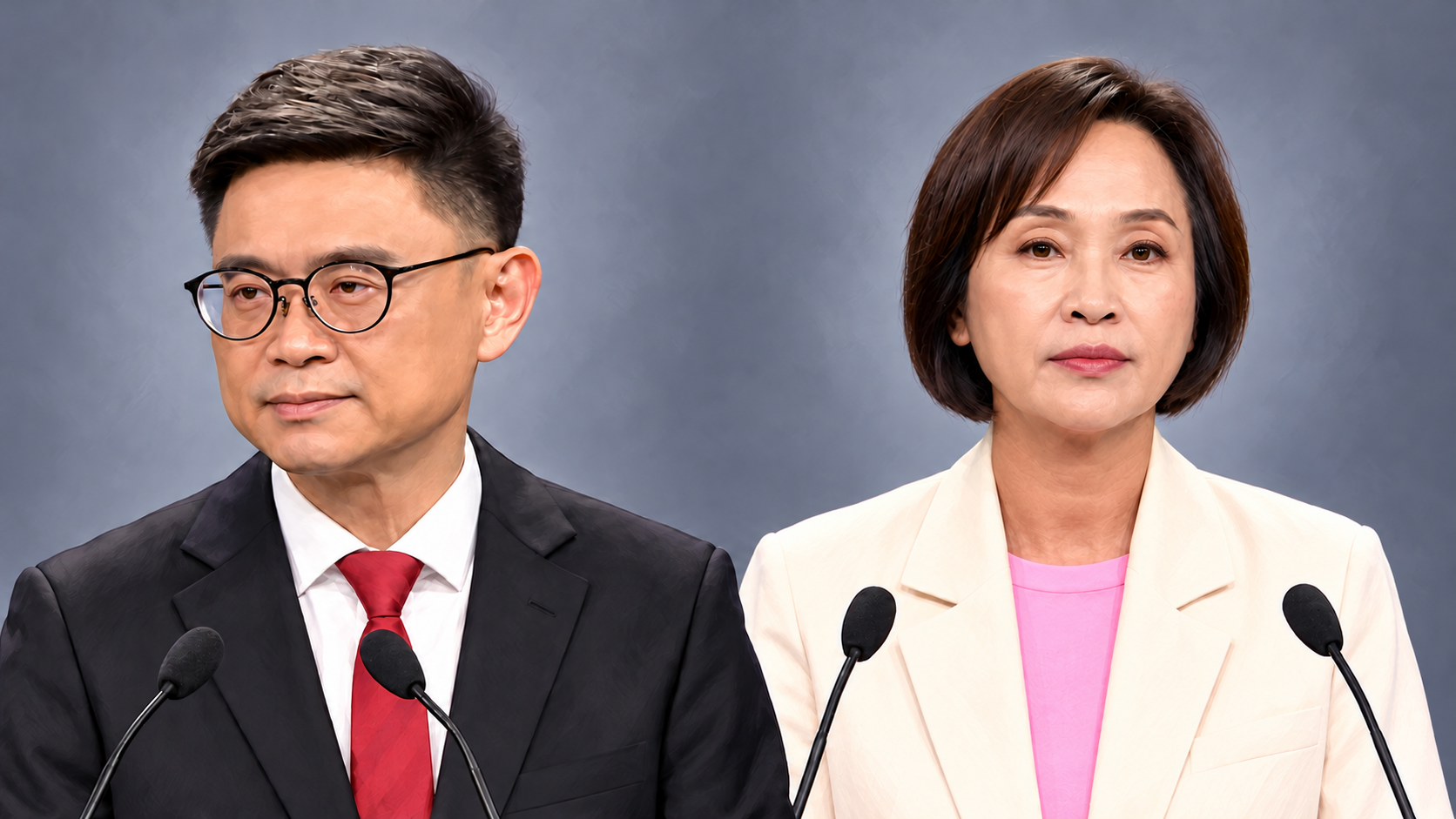
By KHT Staff. AI illustration loosely based on the debate photo published by TVBS.
KAOHSIUNG — Kaohsiung’s two major-party mayoral candidates traded accusations over city funding, political loyalties and government oversight Friday night, with post-debate assessments giving the Kuomintang’s Ko Chih-en (柯志恩) an edge in delivery but differing over whose arguments were more convincing.
Ko and the Democratic Progressive Party’s Lai Jui-lung (賴瑞隆) faced off Oct. 30 at 8 p.m. in a televised debate jointly organized by Formosa Television, CTi News and PTS Taiwanese. The roughly 90-minute event included opening statements, media questions, cross-examination and closing remarks, according to Public Television Service.
Lai presented himself as the candidate who would continue Kaohsiung’s transformation under successive DPP administrations. Ko argued that changing the governing party would strengthen scrutiny of City Hall.
Both nevertheless praised incumbent Mayor Chen Chi-mai (陳其邁), including his efforts to attract technology investment and develop the city’s concert economy. Ko argued that choosing her would not mean rejecting Chen’s achievements, TVBS reported.
Funding and party loyalty
Lai repeatedly challenged Ko over amendments to the Act Governing the Allocation of Government Revenues and Expenditures (財政收支劃分法), arguing that the changes favored Taipei and widened the gap between northern and southern Taiwan.
He accused Ko of following KMT instructions rather than defending Kaohsiung’s interests, also questioning her party’s role in public broadcasting and cultural budget cuts, according to Central News Agency.
Ko countered that Kaohsiung’s centrally allocated tax revenue had increased. She blamed the central government for restricting other funding and challenged Lai to identify occasions when he had opposed his own party.
The exchange left both candidates making similar accusations: that the other would put party interests ahead of the city.
Continuity or a change of government?
Ko attacked Lai’s ties to the DPP’s New Tide faction (新潮流), arguing that his promise to become Kaohsiung’s “fourth batter” reflected a political succession controlled by the governing party.
She raised the Meinong (美濃) illegal excavation controversy and argued that a different party needed to take office to uncover wrongdoing. Lai rejected attempts to define him through factional affiliation and said Kaohsiung’s interests would guide his administration.
Ko also challenged Lai over political donations. These exchanges involved contested campaign accusations, rather than wrongdoing established by the debate. CNA’s coverage recorded both candidates continuing to dispute the issues afterward.
Policy proposals
Lai proposed raising the childbirth subsidy to NT$50,000 per baby, increasing support for families with children under six, expanding public childcare and providing 60 hours of temporary childcare annually. He also pledged broader long-term care and respite services.
Ko proposed offices addressing bullying and resource disparities between the former Kaohsiung city and county. Her wider platform included support for traditional industries, transport expansion, an international airport without a night curfew and redevelopment of the former 205th Arsenal site, according to The Reporter.
Stronger delivery, divided assessments
Lai’s frequent reliance on prepared notes became a focus of post-debate coverage. United Daily News highlighted his repeated downward glances during his closing statement. Ko was also critical of his vocabulary and suggested he had not prepared enough material.
Political scientist Liao Da-chi (廖達琪), interviewed by The Reporter, judged Ko slightly stronger in debating technique and spontaneous responses. However, she said both candidates often failed to answer the questions posed.
Sociologist Chen Mei-hua (陳美華) offered a different emphasis in the same report: Ko was forceful but lacked implementation details for ambitious proposals, and at times sounded more like a legislator questioning officials than a prospective mayor.
The initial assessments did not establish a consensus winner. They pointed instead to a contrast between Ko’s more aggressive presentation and Lai’s emphasis on experience and continuity, with neither candidate decisively resolving the disputes that dominated the evening.