

The Philippines holds the world’s fifth-largest gold reserves, but in swamps, rivers, and coastal waters, much of that gold is mined by children.
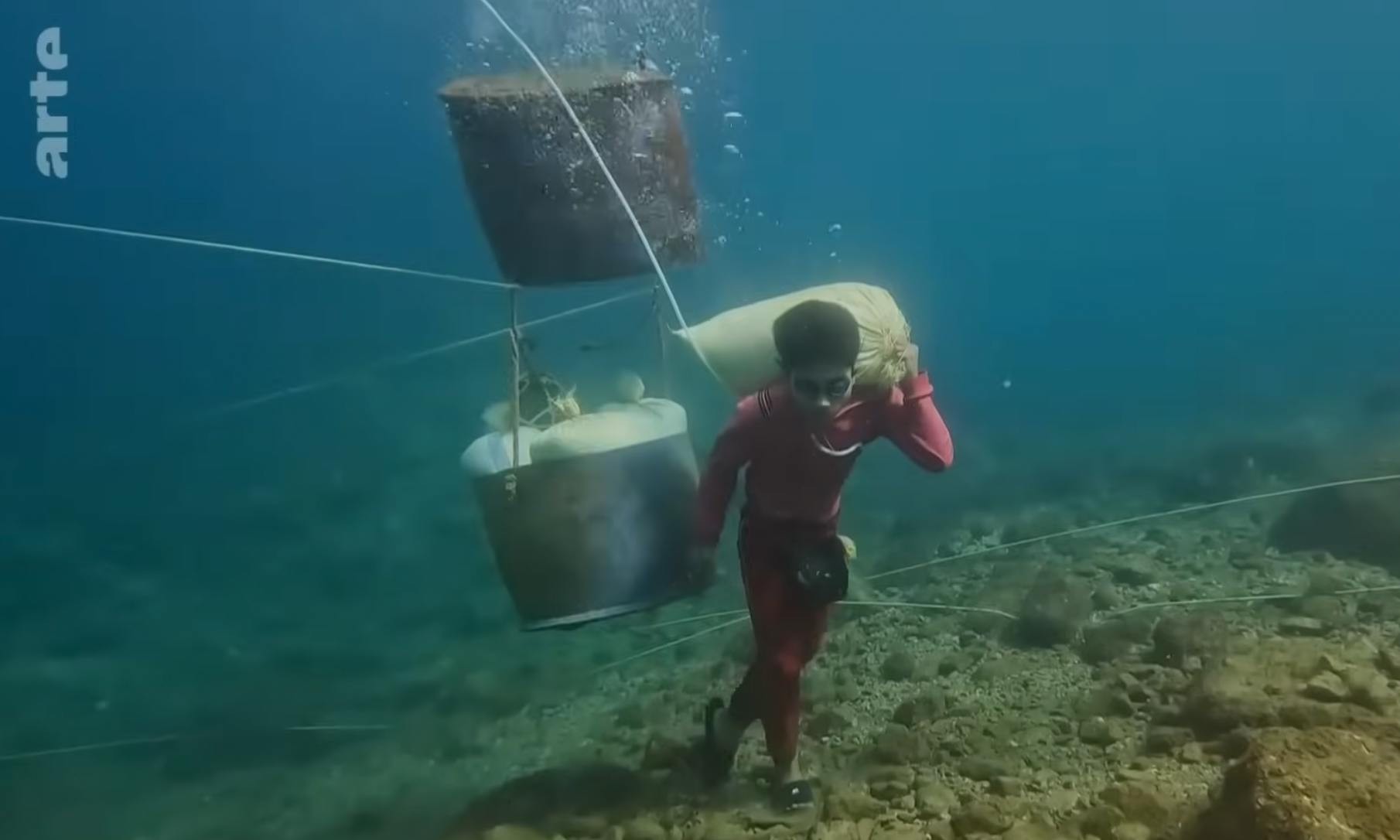
Armed with little more than a makeshift air hose connected to a compressor, underage divers squeeze into hand-dug tunnels as deep as 25 meters below the surface. They shovel sand and gravel in darkness and mud, while facing the constant threat of tunnel collapse, drowning, and chronic mercury poisoning from the gold-processing work that follows.
A 2015 Human Rights Watch report documenting small-scale mining in the Philippines quoted a boy named Jacob, who first entered a shaft at 14:
“I was really scared. I kept thinking: if something happens down there, what will I do?”
Diving for gold as a way to eat—and to stay in school
The Emmy-nominated documentary Philippines: Diving for Gold follows mining families in regions such as Camarines Norte and Leyte, where child labour fills the gap left by state-run mines that have long since shut down.
In one northern province, the film shows a family paddling a small canoe into a swampy area, where they work semi-submerged in thick, muddy water. When the tunnel narrows too much for adults to pass, the job of diving and hauling sacks of sediment falls to their teenage son.
Hato, a 13-year-old diver, spends hours underwater, drawing sand and gravel up to the surface. After washing and sifting, a few grains of gold appear—just enough to sell to local buyers for rice and meat.
Hato says he mines so his family can eat the next day and so he can afford to attend school. Although public education is officially free, he must still pay for transport by motorcycle taxi, using money earned from gold. He is the oldest in his class but often lags behind after missing lessons to work. Despite this, he says he loves studying, especially math, and dreams of becoming a soldier.
At his school, at least six students work in the mines. Teachers say they are distressed by the situation, but see few alternatives: without income from gold, families in these areas have no way to cover even basic costs.
Eight hours underwater with a plastic hose
The documentary also follows a father and son in Leyte. For three years, every weekend, 14-year-old Dennis Jr. has stayed underwater for up to eight hours at a time. His only lifeline is a thin hose delivering air from a compressor on the boat above.
Dennis dives to depths of around 20 meters to help his father move sacks of sand along the seafloor. He says he is proud to share the burden, while his father explains that the boy’s work pays for school expenses.
The risks are constant: a kinked hose, a compressor failure, or a minor landslide in the underwater tunnel can be fatal. On land, many children report back pain, skin infections, and muscle cramps—symptoms consistent with chronic mercury exposure.
Legal bans on child labour, weak enforcement on the ground
Officially, the Philippine government bans child labour in mining. In the film, a licensed gold buyer quickly denies purchasing directly from children, and reaffirms that authorities prohibit the practice.
In reality, enforcement is patchy, especially in poor, remote regions where mining is the only functioning economy. Former child miner Serafin Dasco, now a local councillor and mine owner, says he refuses to hire children—but argues that the government must conduct stricter inspections and penalise families and operators who rely on child labour.
Human Rights Watch’s 2015 investigation, based on interviews with 65 child miners, found that children regularly described fear when climbing down vertical shafts or jumping into pit lakes to dive. They also reported health problems common in mercury exposure zones.
Despite legislation on paper, the report concluded that Manila has done far too little to protect children from the hazards of small-scale gold mining. In many poor districts, legal restrictions are seen as unrealistic or hostile to survival, and receive little support from mine owners or traders.
Poverty that replicates itself underwater
For most mining communities, gold remains the only consistent source of cash. Without alternative livelihoods, families feel compelled to send their children into the water, passing both skills and danger to the next generation.
As long as gold-rich areas fail to develop other forms of employment, the cycle continues: parents who once dove as children now oversee their own sons and daughters doing the same work.
For Hato, Dennis, and thousands of other underage divers, a thin plastic hose connected to an old compressor is not just equipment—it is the boundary between another day of survival and the risk of never resurfacing.
Kaohsiung Times appreciates The News Lens for allowing us to translate and publish selected works. Visit The News Lens website for original articles.