
By Julia, editor at The News Lens.

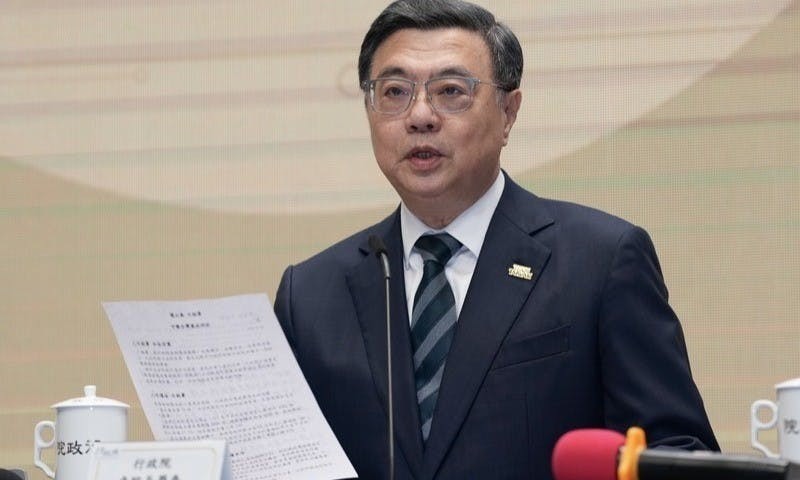
TAIPEI — Premier Cho Jung-tai (卓榮泰) announced Monday that he will refuse to countersign amendments to Taiwan’s Fiscal Allocation Act passed by the Legislative Yuan, citing constitutional violations and procedural concerns. The move marks the first time an administrative premier has declined to countersign a law governing fiscal distribution.
While there have been past instances of premiers refusing to countersign specific executive orders, including a personnel decision in the early 1990s, Cho’s decision represents the first known case involving refusal to countersign a law related to fiscal legislation or budgetary governance.
Cho said the revised legislation, passed on Nov. 14, violates constitutional principles of separation of powers, undermines democratic procedure, and would force the executive branch to engage in unlawful deficit financing.
The announcement was made at a Cabinet press conference attended by Vice Premier Cheng Li-chun (鄭麗君), Cabinet Secretary-General Chang Tun-han (張惇涵), and Finance Minister Chuang Tsui-yun (莊翠雲).
Constitutional Rationale
Cho said that under Article 37 of the Constitution of the Republic of China, the Executive Yuan is obligated to carry out its duties in accordance with constitutional limits. He argued that the amended act infringes on executive authority over budgeting and fiscal planning.
According to the Executive Yuan, the legislation would require the government to incur NT$264.6 billion in new debt for the fiscal year 2026 alone. Officials said this would push total borrowing beyond NT$560 billion, exceeding the 15 percent cap set under the Public Debt Act and forcing the executive branch to violate existing law.
Cho also criticized the legislative process, saying the amendments were advanced without clause-by-clause review and were forced through voting despite the absence of cross-party consensus. He said this amounted to a substantive breach of democratic procedure and popular sovereignty.
Legislative–Executive Standoff
Cho noted that constitutional disputes between the executive and legislative branches should ordinarily be resolved by the Constitutional Court. However, he said recent changes to the Constitutional Court Procedure Act and repeated delays in approving judicial nominations have left the court unable to function, eliminating an institutional mechanism for resolving the dispute.
He said the Legislative Yuan has increasingly expanded its authority in ways that raise constitutional concerns, leaving the Executive Yuan with limited options.
Political Consequences
Under Taiwan’s constitutional framework, the Legislative Yuan may respond to the decision by initiating a vote of no confidence against the premier. If such a motion passes, the premier may request that the president dissolve the legislature.
Cho emphasized that his decision does not constitute executive overreach. Instead, he said it reflects the constitutional checks and balances built into Taiwan’s system of government.
Source: Executive Yuan press conference, Dec. 15
Kaohsiung Times appreciates The News Lens for allowing us to translate and publish selected works. Visit The News Lens website for original articles.

About the Author:
Julia holds an undergraduate degree in medical laboratory science and biotechnology and is a licensed medical laboratory technologist. Her graduate research focused on zebrafish models, folic acid, and Alzheimer’s disease. She previously served as an associate researcher at Taiwan’s Development Center for Biotechnology and later joined The News Lens to pursue her interest in reading and writing. She describes her guiding goal as translating complex medical research into clear, accessible knowledge for the general public. She is currently an editor at The News Lens.