
By KHT Staff
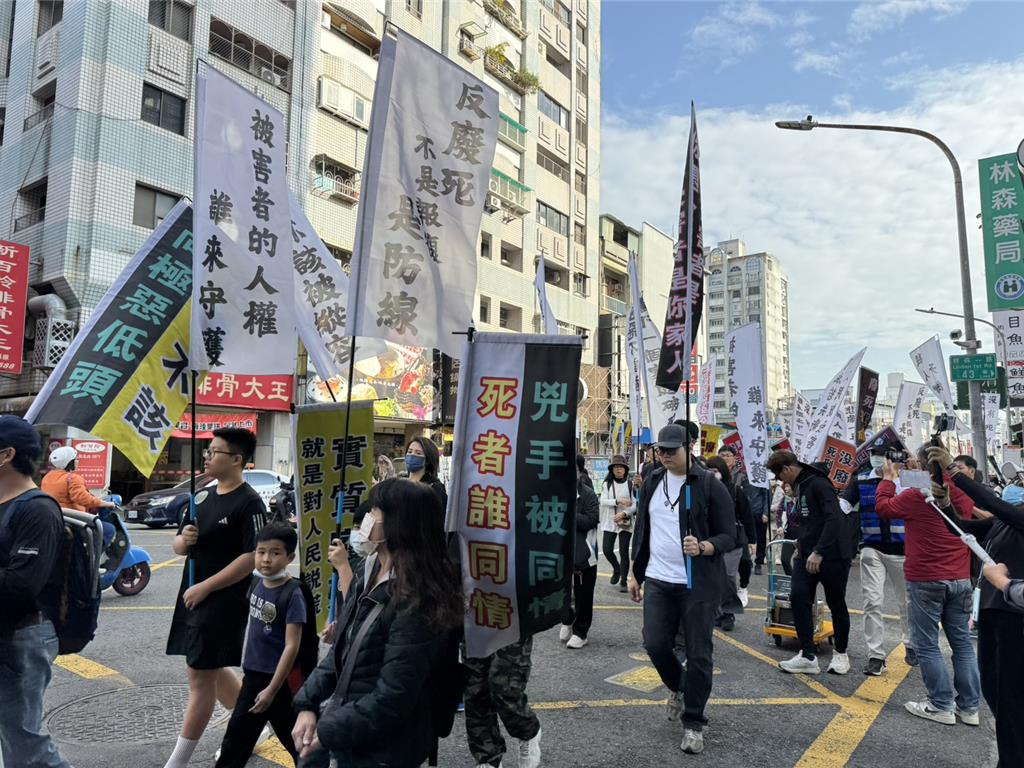
KAOHSIUNG — Roughly 50 demonstrators took to the streets of Kaohsiung on Saturday, calling on the government to maintain capital punishment for serious crimes, arguing that abolishing the death penalty would undermine justice for victims and their families.
The China Times reports that the protest, organized by the Kaohsiung Chinese Public Welfare Development Association (高雄市中華公益事務發展協會), began at the Taiwan People’s Party (TPP, 台灣民眾黨) Kaohsiung office before moving to Central Park and ending outside the Kaohsiung District Court, where participants lit white candles. Protesters held banners reading “A life for a life” and chanted “No to abolishing the death penalty, we want justice.”
The demonstration also comes in the wake of a September 2024 ruling by Taiwan’s Constitutional Court, which clarified the legal status of capital punishment. In that decision, the court ruled that the death penalty remains constitutional for the most serious crimes, including intentional homicide, but must be applied more narrowly and with stricter safeguards. The justices required unanimous verdicts for death sentences and barred executions of defendants with significant mental disabilities. While the ruling did not abolish capital punishment, it significantly raised the legal threshold for imposing it—fueling public debate and adding urgency to protests like Saturday’s march in Kaohsiung.
Association Secretary-General Shi Yi-hsuan (施亦旋) said crimes such as random killings, drunk driving fatalities, and deliberate murder shatter families forever, yet public debate increasingly focuses on the rights and rehabilitation of offenders. She argued that victims’ families are being forgotten and described the death penalty as a necessary last line of defense against violent crime.
TPP Kaohsiung honorary chair Chuang Yi-liang (莊貽量) claimed that around 90 percent of the public still supports capital punishment, criticizing what he called an imbalance in human rights protections that overlooks victims’ suffering.
Organizers urged the government to consider public sentiment and prioritize justice for victims when reviewing death penalty policies.