
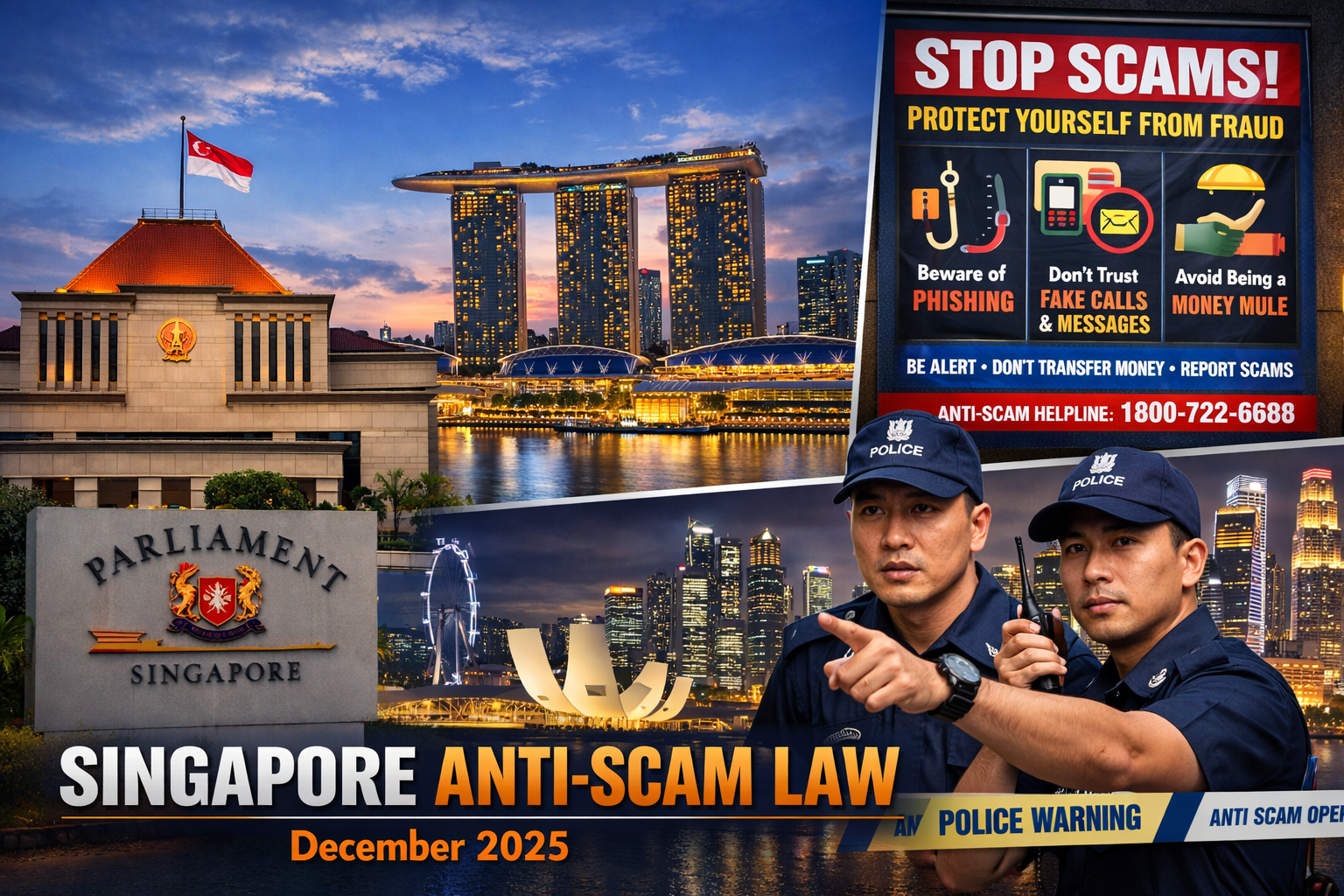
By Dr. TUNG Chen-Yuan, Taiwan’s Representative to Singapore – AI image for illustrative purposes only.
How Singapore Combines Institutions and Technology to Combat the Surge of Digital Fraud
As artificial intelligence rapidly permeates every layer of society, fraud has long ceased to be an occasional public security issue. It has evolved into an industrialized operation that integrates social engineering, cross-border financial flows, and digital platforms. For Singapore, a nation of just over six million people, this silent battle has been elevated to the level of national security, standing alongside counterterrorism and anti–money laundering as a major governance priority.
In 2024 alone, Singapore recorded 51,501 scam cases, representing an increase of about 10 percent year-on-year. Total financial losses surpassed S$1.1 billion (approximately NT$26.4 billion) for the first time, marking a striking 70 percent surge from the previous year. While the growth in case numbers remains relatively manageable, the sharp escalation in financial losses has sounded an alarm for social trust and financial stability.
Particularly concerning is that more than 80 percent of cases involved “self-effected transfers,” where victims voluntarily transferred funds under psychological manipulation. Scam syndicates no longer rely primarily on hacking techniques; instead, they deploy carefully crafted scripts—impersonating government officials, investment advisors, or even romantic partners—to exploit human vulnerabilities. Victims, caught between trust and fear, transfer money of their own accord. When victims are persuaded to “cooperate,” traditional post-incident investigative approaches become inherently less effective.
Between 2018 and 2024, scam cases increased more than sixfold, while total losses grew more than sevenfold. The year 2024 was characterized by slower growth in case numbers but a sharp spike in losses, indicating that a small number of high-value cases significantly drove overall damage. Investment scams, impersonation scams, and malware attacks often resulted in substantial losses, whereas e-commerce scams, though most frequent, typically involved smaller sums. This coexistence of high-frequency, low-loss cases and low-frequency, high-loss cases requires a dual strategy: broad-based public protection alongside targeted safeguards for high-risk financial flows and high-net-worth individuals.
As criminal tactics shifted from technical intrusion to cognitive manipulation, Singapore began reshaping its legal framework in 2019 to move the defensive line forward. Legislative amendments criminalized the provision of mule accounts, misuse of digital identities, and unauthorized SIM card registrations, while lowering the threshold for proving intent. Acts committed recklessly or negligently may now incur criminal liability, effectively disrupting the supply chain of tools used by scam syndicates.
At the same time, the Online Criminal Harms Act empowers the government to issue legally binding directives to major online platforms, requiring them to remove accounts, block content, or even restrict applications. As digital platforms have become primary arenas for criminal activity, platform operators are now expected to assume gatekeeping responsibilities rather than claim technological neutrality.
Perhaps the most groundbreaking reform is the introduction of the “Restriction Order” mechanism. When police assess that an individual is under significant scam-related influence, they may instruct banks to suspend account functions—even if the individual insists on proceeding with a transfer. This measure prioritizes asset protection and public interest in the balance of legal considerations. Since its implementation, the proportion of self-effected transfers has declined, suggesting that carefully calibrated state intervention can indeed prevent further financial loss in extreme cases.
Technology has further strengthened Singapore’s proactive defenses. ScamShield has evolved from a standalone mobile application into an integrated anti-scam system combining hotlines and reporting channels, using artificial intelligence to filter suspicious calls and messages. Downloads have exceeded one million. The government has also introduced a unified “gov.sg” SMS sender ID, enabling telecommunications providers to block unauthorized messages and effectively eliminate impersonation of official communications.
To combat phishing websites, Singapore has developed automated scanning and analytics systems that monitor large volumes of web domains and promptly disable suspicious sites, extending the defensive perimeter to the level of digital infrastructure. This shift from passive advisories to proactive interception exemplifies the transformation of governance in the AI era.
Equally critical is Singapore’s highly institutionalized public-private collaboration. The Anti-Scam Command operates under a co-location model, bringing together law enforcement officers, banks, and e-commerce representatives to enable near real-time fund freezing and information sharing. In 2024, coordinated efforts led to the prevention or recovery of more than S$600 million in scam-related losses.
On the regulatory front, a shared responsibility framework requires banks and telecommunications companies to bear part of the losses from phishing scams, incentivizing them to enhance authentication and risk controls. Features such as fund-lock mechanisms and cooling-off periods for transfers are increasingly becoming standard practice. Once responsibilities are clearly defined, anti-scam efforts are no longer solely a government task but a collective obligation across the financial and communications ecosystem.
Although overall case numbers remain high, growth has begun to stabilize, suggesting that layered defenses are yielding a buffering effect. Nonetheless, challenges persist. The rising share of cryptocurrency-related scams, difficulties in regulating cross-border platforms, and the targeting of high-net-worth individuals present ongoing concerns. Scam syndicates innovate at a pace comparable to tech start-ups—except that their “business model” is built on draining others’ savings.
Singapore’s experience demonstrates that effective anti-scam governance cannot rely on a single instrument. It requires the integrated deployment of legal authority, technological innovation, and structured public-private collaboration to create a multidimensional defense network. In the age of artificial intelligence, combating scams is no longer merely a matter of law enforcement; it is a litmus test of digital governance capacity and institutional resilience.
About the Author:

Dr. Tung Chen-Yuan is currently Taiwan’s Representative to Singapore. He was Minister of the Overseas Community Affairs Council of the Republic of China (Taiwan) from June 2020 till January 2023. He was Taiwan’s ambassador to Thailand from July 2017 until May 2020, senior advisor at the National Security Council from October 2016 until July 2017, and Spokesman of the Executive Yuan from May to September 2016. Before taking office, Dr. Tung was a distinguished professor at the Graduate Institute of Development Studies, National Chengchi University (Taiwan). He received his Ph.D. degree in international affairs from the School of Advanced International Studies (SAIS), Johns Hopkins University. From September 2006 to May 2008, he was vice chairman of the Mainland Affairs Council, Executive Yuan. His areas of expertise include international political economy, China’s economic development, and prediction markets.