
By Eryk Michael Smith / Staff. Images via UDN.
KAOHSIUNG — A long-simmering dispute over the future of the Ciaotou New Town project (橋頭新市鎮) has resurfaced after village chiefs and residents rallied over the weekend in support of the long-delayed phase three development plan. Environmental groups, however, warn that the proposal could damage one of northern Kaohsiung’s most significant remaining green corridors.
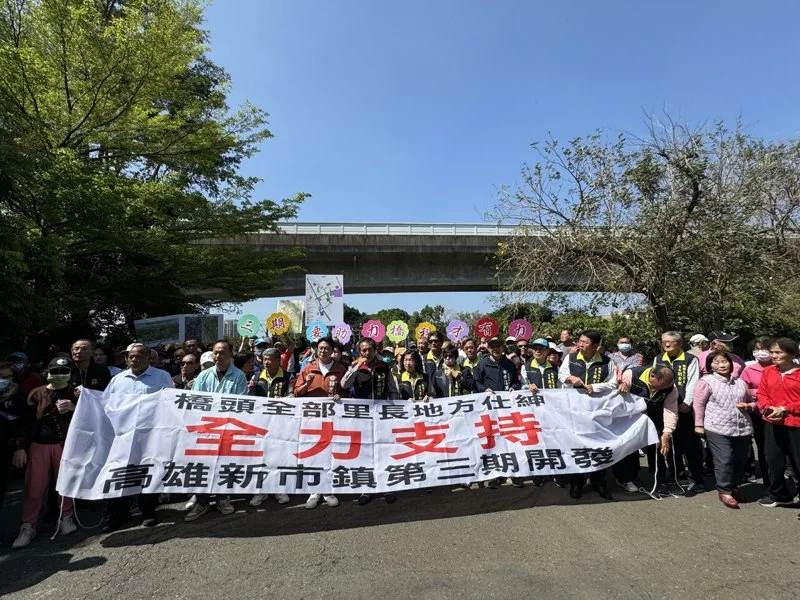
Seventeen village chiefs from Ciaotou District (橋頭區) organized a march involving nearly 100 residents along the planned route of the proposed 1-1 planning road, a key infrastructure project intended to connect the Ciaotou Science Park (橋頭科學園區) with surrounding communities and major highways. Supporters argue the project is critical to solving growing traffic congestion and ensuring the science park can expand. The rally also appeared to counter a planned March 21 environmental event, when conservation groups intend to hold a large “Protect the Sugar Factory Forest” walk to highlight concerns about the project.
City councilor Lin Chih-cheng (林志誠), who attended the rally, said the region has entered a decisive stage of development. He said the proposed road would serve as an important transport artery linking freeway interchanges, the science park, and nearby residential districts. Lin also criticized environmental groups for citing what he described as unclear or exaggerated figures suggesting the project would destroy large areas of forest or worsen flood risks.
Local village chief Su Dao-ming (蘇道明) of Ciaonan Village (橋南里) said many of the areas affected by the planned road consist of cemetery land already designated for development under the city’s urban plan. He argued the project has been misunderstood as a forest-clearing proposal when much of the route passes through previously disturbed land.
-1024x572.jpg)
The development has been under discussion for nearly three decades. Supporters say it would bring significant public infrastructure improvements, including more than 20 hectares of new roadways, approximately 15 hectares of detention ponds and parkland, and more than 60 hectares of public facilities and urban-use land.
The project has become more urgent, proponents say, as activity increases at the nearby Ciaotou Science Park, which forms part of the expanding semiconductor and advanced manufacturing corridor stretching across northern Kaohsiung. Currently, most vehicles enter and exit the area via Ciaonan Road (橋南路) and Tongyan Road (通燕路), both relatively narrow roads that have seen heavy congestion during commuting hours since the science park began attracting tenants.
Environmental groups, however, say the debate is not about opposing development itself but about how the area should evolve. Chuang Chieh-jen (莊傑任), chairman of the Forest City Association (森林城市協會), said large areas of land from earlier phases of the new town project remain undeveloped and questioned the need to expand construction into additional areas.
He also warned that the roughly 180 hectares of woodland surrounding the historic Ciaotou Sugar Factory (橋頭糖廠) plays an important environmental role in northern Kaohsiung. The forested zone acts as a natural flood buffer within the Dianbao Creek (典寶溪) watershed while also contributing to air quality and biodiversity in an increasingly industrialized region.
Environmental advocates have proposed transforming the broader sugar factory area into a large metropolitan green park modeled after major urban green spaces such as Central Park (中央公園) or Chengcing Lake Scenic Area (澄清湖).
Another point of contention involves the proposed alignment of the 1-1 road, which follows a route outlined in urban plans drafted more than three decades ago. Environmental groups argue the city should reconsider the corridor and explore alternative routes using existing roads such as Jingwu Road (經武路) and Cionglin Road (芎林路), potentially reducing the need to cut through sensitive green areas.
Supporters of the development say delays risk undermining the economic potential of the science park and surrounding districts. Some local leaders have warned that without phase three infrastructure improvements, transportation bottlenecks could hinder investment and job creation in the area.
The dispute reflects a broader tension across southern Taiwan, where rapid industrial expansion tied to the semiconductor sector is increasingly intersecting with environmental concerns and long-standing land-use plans.