
By KHT Staff
KAOHSIUNG — More than NT$1.1 billion in compensation recovery claims connected to the 2014 Kaohsiung gas explosions remain unresolved after 12 years, with Taiwan’s Supreme Court considering appeals and conducting mediation.
Kaohsiung City Councilor Chen Li-Na (陳麗娜) raised the issue during questioning on Tuesday, Sept. 8, 2026, according to the United Daily News.
Chen said donations collected after the disaster were intended to support victims, injured residents, and reconstruction. The city used part of the donated money to make compensation payments before pursuing reimbursement from parties considered responsible.
She said the litigation had yet to return the full amount to the donation fund and questioned how much longer residents would have to wait. She also said the committee overseeing the donations had not presented a clear plan for using any money eventually recovered.
Chen cited public financial statements indicating that more than NT$80 million had been set aside and asked whether LCY Chemical Corp. (李長榮化學工業) and China General Terminal & Distribution Corp. (華運倉儲實業) had accepted the appellate court’s allocation of liability.
Legal Affairs Bureau Director-General Shih-Fang Wang (王世芳) said the appellate ruling assigned 80% of the responsibility to the Kaohsiung City Government. LCY Chemical and China General were held jointly liable for the remaining 20%.
Wang said the city, LCY Chemical, China General and CPC Corporation, Taiwan (台灣中油) had all appealed. The case remains before the Supreme Court, where mediation is underway, and no final outcome has been reached.
The amount disclosed in the companies’ financial reports did not represent acceptance of the appellate judgment, Wang said. She described it as an interim balancing payment required under an earlier three-party settlement agreement, rather than reimbursement to the gas explosion donation fund.
Wang said the city disputed the 80% allocation because the pipeline remained in use for more than two decades after defects in the original inspection and acceptance process. The city argues that companies using the pipeline also had responsibilities for inspection, maintenance, and management during that period.
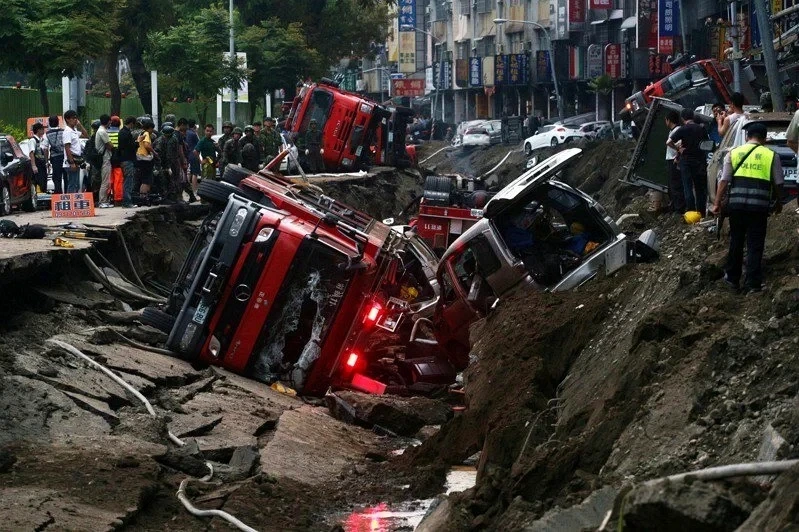
The disaster began with a leak from a corroded pipeline carrying propylene beneath the city. A Supreme Court decision involving some of the individuals charged in the criminal case summary said the pipeline had been left suspended inside a drainage culvert, where prolonged exposure to water and moisture contributed to corrosion. The explosions killed 32 people.
Chen said the city should acknowledge the administrative and pipeline-management failures investigated after the disaster. She called for responsibility to be settled promptly so that any recoverable money can be returned for the benefit of affected communities.