
By KHT Staff
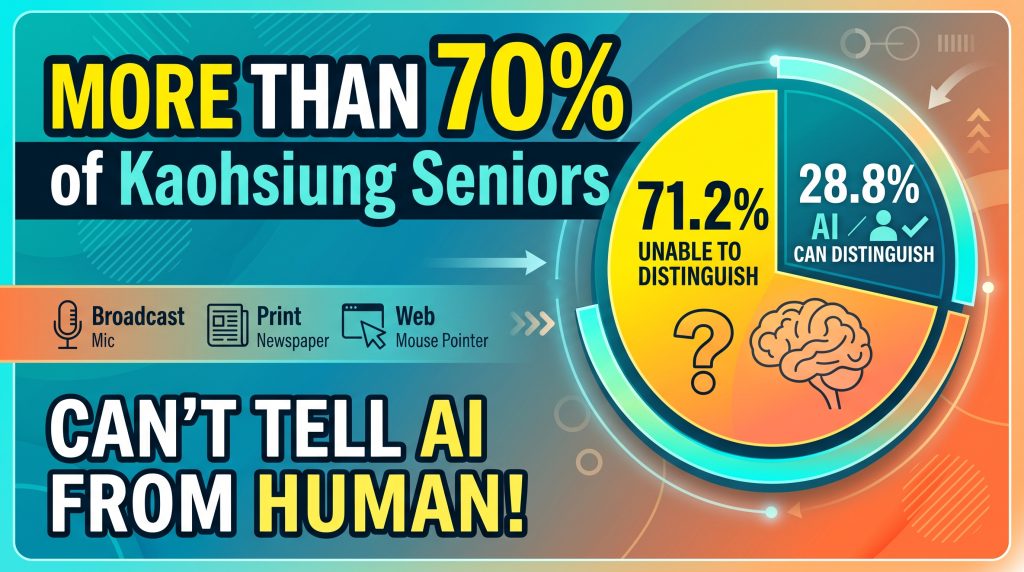
KAOHSIUNG — Only 28.8% of Kaohsiung residents aged 65 or older said they could tell whether they were interacting with artificial intelligence or a person, according to survey figures reported by the Liberty Times on Sept. 7.
The report said 28.8% of the city’s older residents had used AI, while about 41% of users accessed it at least once a week. Fifty-six percent considered AI helpful in daily life, and about 80% knew that AI systems sometimes provide incorrect answers.
When making decisions based on health information, however, 63.8% said they primarily consulted another person. The figure was the highest among Taiwan’s six special municipalities, according to the report.
National survey highlights broader gap
In a Sept. 4 statement, National Taiwan Normal University said its AI Ethics and Governance Center conducted the national survey from July 13 to 23, 2026. The telephone poll covered 1,457 people aged 65 or older, including 399 respondents in southern Taiwan.
The national results showed that 28.1% of older adults had used an AI application or device, while 33.6% of respondents who had used or heard of AI said they could clearly distinguish an AI system from a person.
The nationwide survey had a sampling error of plus or minus 2.57 percentage points at a 95% confidence level. The university’s public summary did not provide a separate Kaohsiung sample size or city-level margin of error.
Politicians call for human support
Kaohsiung City Councilor Lin Chih-Hung (林智鴻) proposed a three-part approach focused on reducing anxiety, building skills and making AI use safer for older residents.
Lin said government agencies should not pursue digital services while withdrawing customer-service staff or professional assistance. He called for better access to devices, instruction and support from people before expanding AI education and cooperation among health, care and community organizations.
Kaohsiung City Council candidate Teng Chao-pei (鄧巧佩) said long-term care services should incorporate smart health monitoring, telehealth and AI tools. She proposed connecting hospitals, clinics, public health centers and community care sites so older residents could more easily locate assistance.
Teng also called for instruction on fraud prevention, personal data protection and the evaluation of health information. She said older residents need guidance and continued assistance if AI tools are to reduce pressure on family caregivers rather than create another barrier.
The ideas were presented as policy proposals. The report did not provide implementation timetables, budgets, or confirmation that the Kaohsiung City Government had adopted them.