
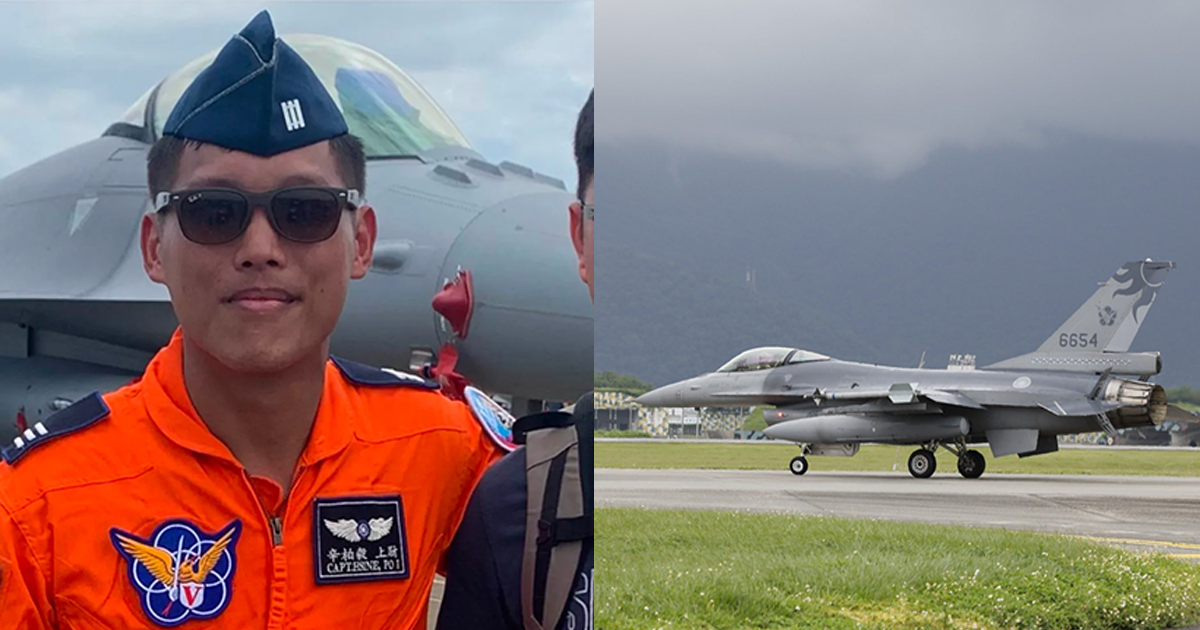
TAIPEI, Taiwan – Taiwan’s military and coast guard have expanded a search for an Air Force pilot after an F-16V fighter jet lost contact off Hualien County [花蓮] on Jan. 6, amid worsening sea conditions and a strong Kuroshio [黑潮] current that officials say can quickly alter drift patterns.
The aircraft went missing near Fengbin [豐濱] while flying over waters off Taiwan’s eastern coastline, according to a report by Taiwan Public Television Service (PTS). The pilot, Capt. Xin Baiyi [辛柏毅], was believed to have ejected about 10 nautical miles east of the area, but had not been found as of Jan. 9, the report said.
Military aircraft, ships, drones and drift modeling
PTS reported that the Air Force had dispatched multiple types of aircraft, while the Navy and Coast Guard together had sent more than 20 vessel sorties by Jan. 9. Along the coast, authorities also publicly disclosed deploying a “new tactical drone” for low-altitude searches, aiming to improve nearshore identification and tracking.
“Search and rescue is not limited to 72 hours,” the military said, describing its goal as “bringing Xin Baiyi home.”
The Coast Guard has also released sea-drift measuring buoys in the incident area and used an algorithm-based prediction system to estimate drift paths and adjust ship assignments, according to a Yahoo News report. The approach is intended to keep pace with shifting winds and currents that can push floating objects north or south.
PTS reported that items initially flagged at sea, including a suspected life jacket and a “large white debris” sighted near Xiyu, Penghu [澎湖西嶼], were preliminarily assessed as not belonging to the missing jet, highlighting the time needed for on-scene identification and verification.
The Kuroshio factor: fast currents, uncertain drift
Studies and observations cited in Taiwanese academic summaries describe the Kuroshio’s main flow east of Taiwan as powerful and variable: surface currents are commonly about 0.2 to 0.7 meters per second, while a maximum of about 1.0 meters per second has been observed at roughly 30 meters depth. Short-lived peaks near 2.0 meters per second have also been reported under certain conditions, a level that can quickly stretch a search area. (Data compiled from an academic report summary.)
Zoom-out
Taiwan’s Coast Guard describes its maritime search-and-rescue work as aligned with international practice, including coordinated responsibility areas and multi-agency response. In large offshore incidents, the mix of ships, aircraft, drift buoys and prediction tools is designed to update priorities as conditions change. The expanded use of unmanned aircraft in nearshore searches reflects a broader shift toward integrating real-time imagery with modeling, while still relying on crews at sea to confirm each lead.
Sources & References
Primary report (Jan. 6 to Jan. 9 developments, assets, drone deployment, preliminary debris assessment, leadership statements) – Taiwan Public Television Service (PTS);
Drift buoys and prediction-system use in the operation – Yahoo News (Taiwan);
Kuroshio current speed ranges cited (compiled academic summary) – “台灣海峽及附近海域之流場觀測分析” (summary page);
Taiwan Coast Guard quarterly (SAR system and international-practice framing) – Coast Guard Administration e-book (Issue 116).