
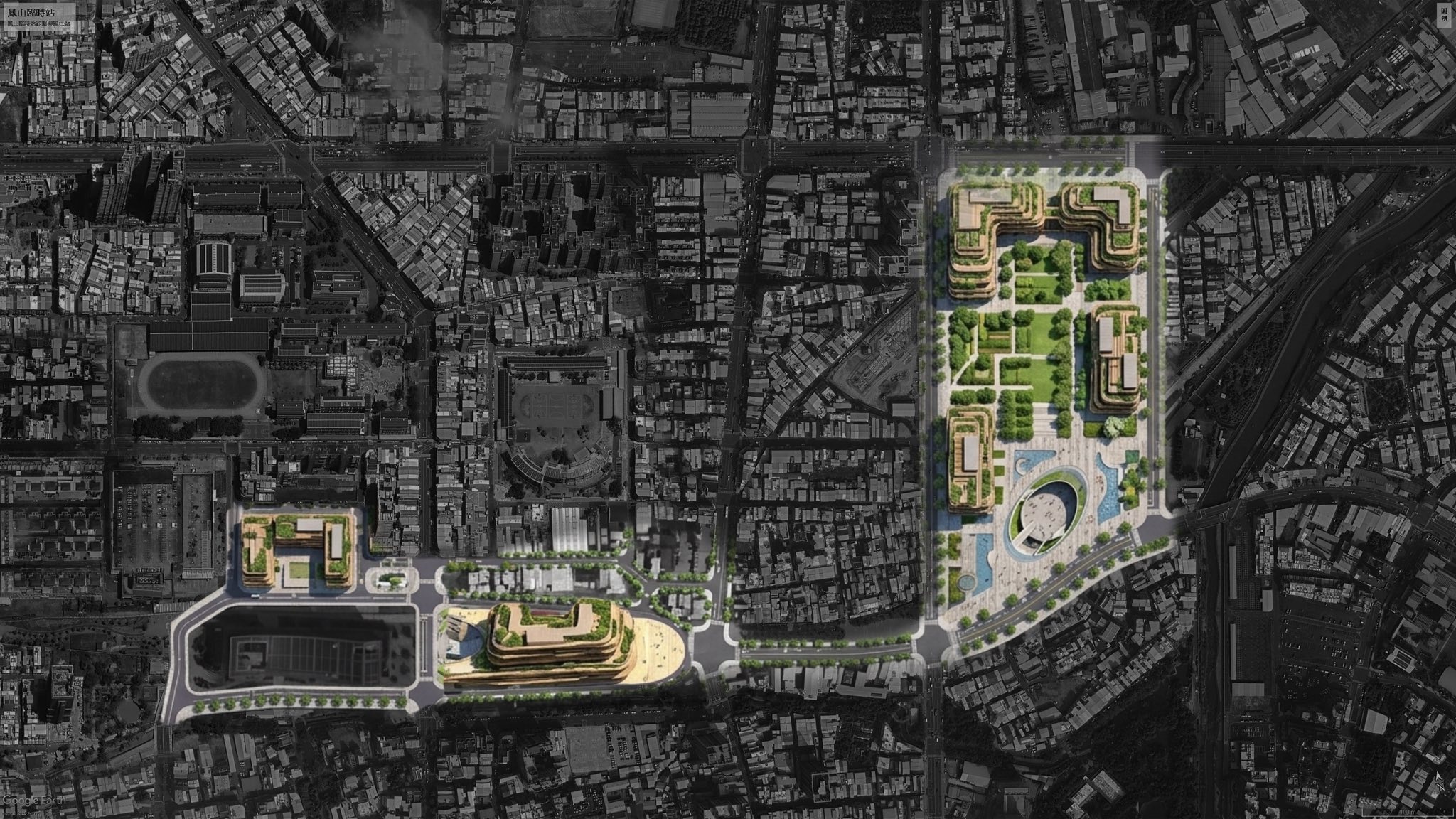
Opinion by Eryk Michael Smith. AI image by K Dreamlike presents a vision for an upgraded Fongshan City Hall.
KAOHSIUNG — Many residents likely didn’t notice a 2025 proposal to relocate Kaohsiung’s main administrative center, but recent social media posts are trying to revive the idea. The bigger picture is a long-running debate over whether the city’s post-merger government geography still makes sense.
Kaohsiung City Councilor Chang Po-yang (張博洋) suggested in a council session on May 15, 2025, that the Sihwei Administrative Center (四維行政中心) should be moved closer to the Kaohsiung Station area. Legislator Chiu Yi-ying (邱議瑩) also floated a similar idea, saying that using space near the new station complex could help drive urban renewal and commercial activity in the area and its surrounding districts.
Last year, Mayor Chen Chi-mai (陳其邁) responded cautiously, saying the idea is worth considering but pointed out that redevelopment schedules around the station and construction tied to the High Speed Rail southward extension would all have to be factored in.
At the center of the relocation ideas is a broader planning question: Should Kaohsiung continue operating under its current dual-administrative-center structure following the 2010 county-city merger, or use future infrastructure projects to create a more unified administrative hub? Currently, City Hall is split between a main center on Sihwei Rd. — which is not accessible by MRT — and the old seat of the Kaohsiung County Govt., located near the Orange Line’s Fongshan West Station (KH City Council) MRT Station.
A recent social media post made the case for Fongshan (鳳山) becoming the core, rather than the Kaohsiung Station. The essay said Fongshan has advantages such as its historical role as an administrative center and its large population. New rail links and a planned HSR Station are other reasons for Fongshan, according to some.
Supporters of an eastward shift say large infrastructure projects, including the High Speed Rail extension and future station-area planning, could give Kaohsiung a rare opportunity to rethink how public administration, transportation, and urban growth fit together.
Critics, however, are likely to question the legal, financial, and engineering assumptions behind any such proposal. Those who think moving to the Kaohsiung Main Train Station area is the best plan might not say it out loud, but it’s clear to most who visit the area that it’s not exactly thriving. Bringing in a huge number of city employees would likely lead to — at least some local businesses — seeing a jump in revenue.
For now, the proposal isn’t a formal relocation plan, but more of a political and planning challenge to the status quo: if Kaohsiung is about to undergo another major round of rail-driven redevelopment, where should the city’s administrative heart ultimately be?