
By KHT Staff. Images via CtiNews.
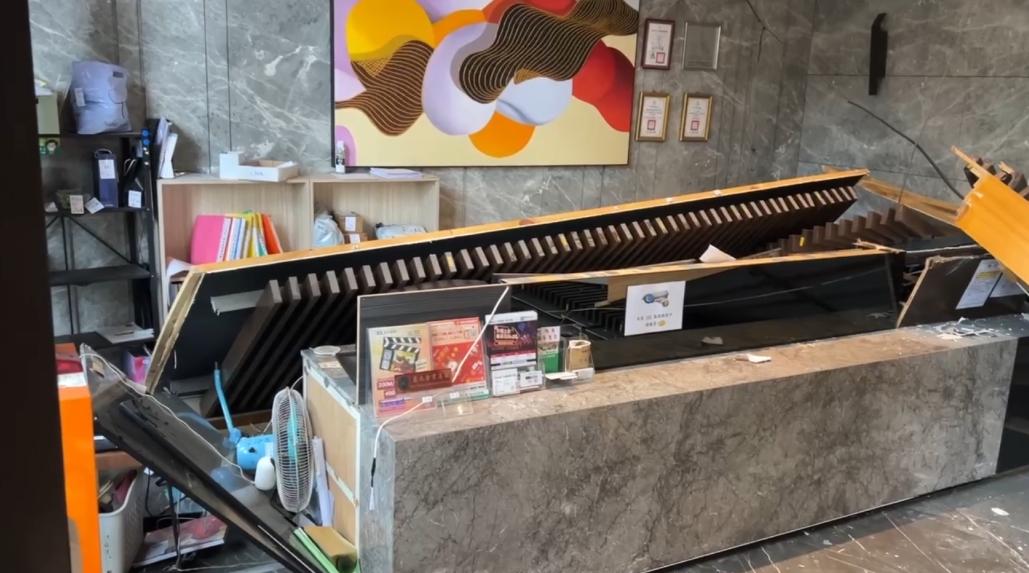
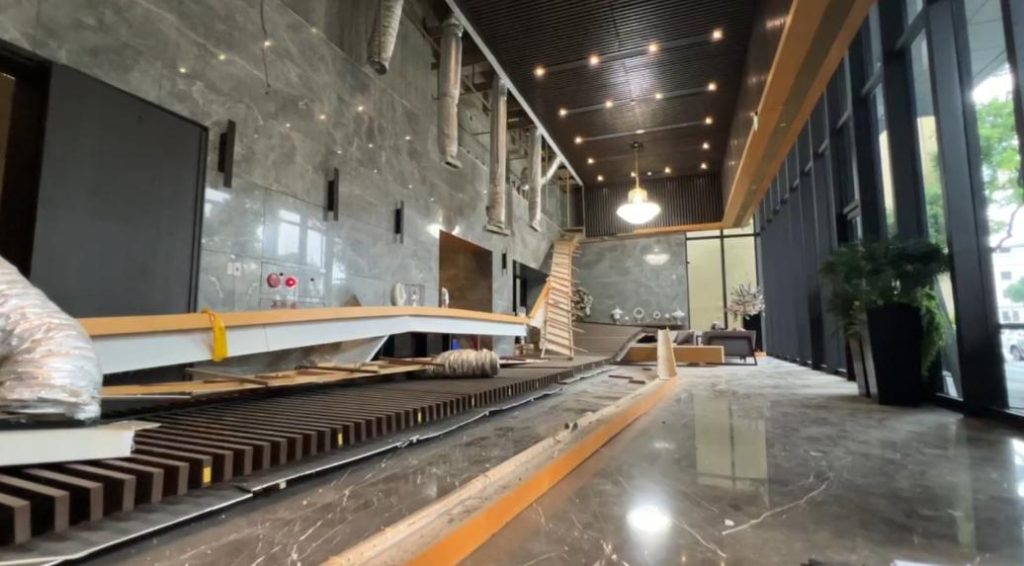
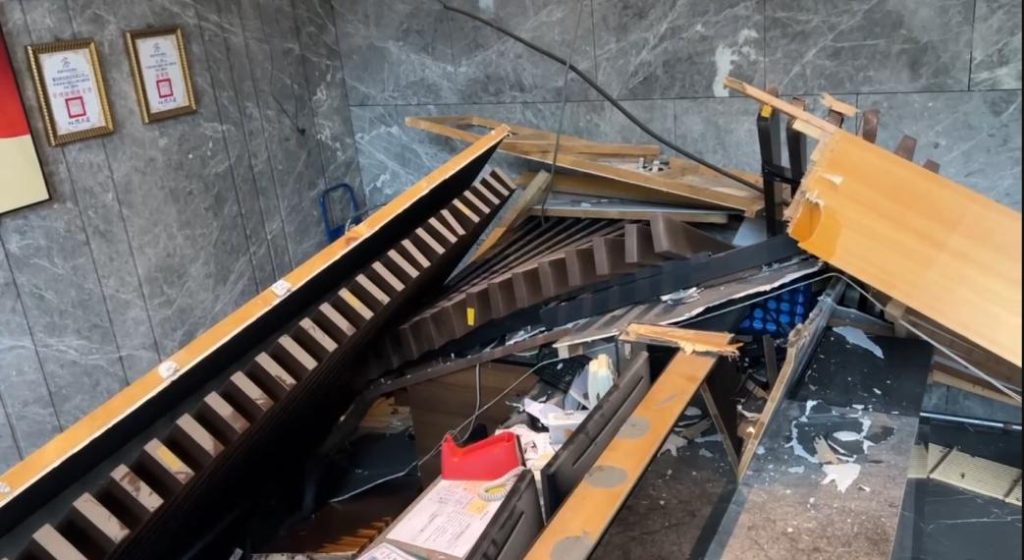
KAOHSIUNG — A major structural failure occurred early Wednesday, April 8, at a residential building on Cisian 1st Road (七賢一路), where the lobby ceiling collapsed without warning. CtiNews reports that the entire ceiling structure fell, burying the management desk in debris and exposing air conditioning lines. A night-shift security guard narrowly avoided being crushed, escaping with minor abrasions.
The building’s management committee chairperson stated that while the structure was completed eight years ago, the developer has never officially completed the handover (點交) process (see explanation of “handover” below).
Residents said the eight-year-old building has faced ongoing issues in its common areas, including water leaks, wall bulging likely caused by mortar separation, and tile efflorescence (a white, powdery deposit of mineral salts that appears on porous masonry surfaces like brick, concrete, and stone, caused when water dissolves internal salts and evaporates on the surface of tiles).
Understanding the “Handover” (點交) Process in Taiwan
In Taiwan, the Handover (點交) is the formal legal transition of responsibility for a building’s public facilities from the developer (起造人) to the Management Committee (管委會).
As seen in the Cisian 1st Road incident, a failure to complete this process can lead to years of legal limbo regarding who is responsible for structural repairs.
1. The Legal Framework
Under the Condominium Administration Act (公寓大廈管理條例), specifically Article 57, the developer must complete the handover of public facilities and communal areas once a Management Committee is formed.
2. The Step-by-Step Process
The handover is not just a signature; it is a rigorous technical inspection:
- Formation of Committee: Once enough units are sold, the owners form a committee.
- Joint Inspection: The developer, the committee, and often a third-party architectural firm inspect the Common Areas (lobby, elevators, fire safety systems, water tanks).
- Discovery of Defects: If issues such as “hollow” walls or leaks are found, the committee can refuse to sign the handover until repairs are made.
- Public Fund Transfer: Once the handover is signed, the developer transfers the Public Maintenance Fund (公共基金) to the committee’s account.
3. Common Points of Conflict
- “As-Built” vs. “Approved” Plans: Developers sometimes deviate from the original blueprints approved by the city.
- Latent Defects: Issues like the ceiling collapse in the Kaohsiung case often involve hidden defects that weren’t visible during the initial 7-day walk-through.
- Maintenance vs. Warranty: Developers often claim an issue is due to poor maintenance. by the residents, while residents argue it is a construction defect covered by the mandatory warranty (usually 1 year for equipment, 15 years for structure).
4. The Kaohsiung Case Context
In the Cisian 1st Road collapse, the fact that the building was 8 years old without a finished handover is a major red flag.
- The Risk: Without a signed handover, the Developer technically remains responsible for structural integrity, but the Management Committee often lacks the Public Fund to perform independent emergency repairs.
- The Legal Trap: The Kaohsiung Building Management Division noted that interior decoration (like the lobby ceiling) is often considered a separate consumer dispute rather than a structural handover item, which makes the legal battle for compensation more difficult for the residents.