
TUNG Chen-Yuan, PhD, Taiwan’s Representative to Singapore
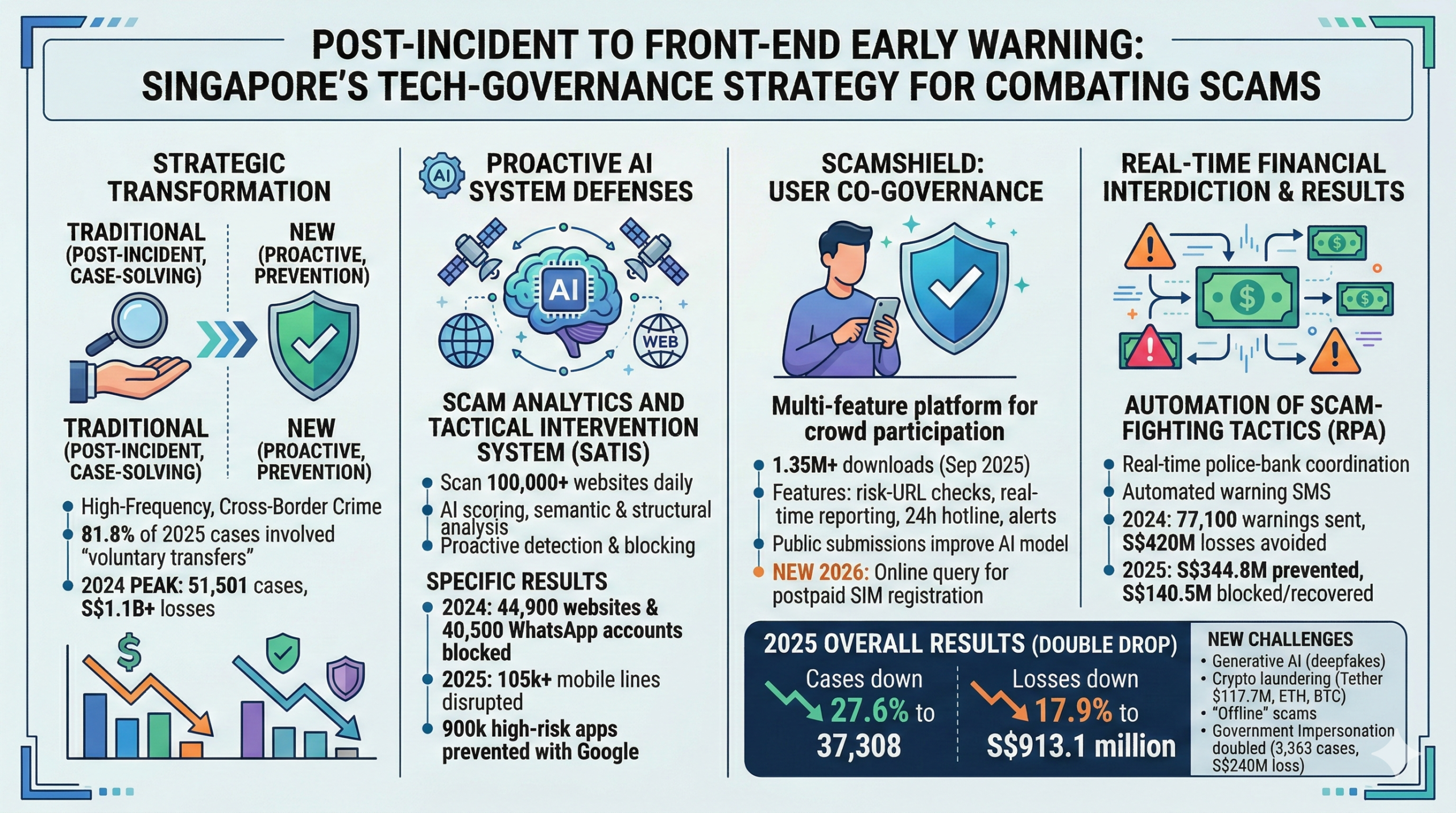
In Singapore, scams have been formally designated a national security concern on par with counterterrorism and anti–money laundering. In 2024, scam cases reached 51,501, and total financial losses surpassed S$1.1 billion for the first time—an all-time high. Yet as technological defenses and public–private collaboration were comprehensively strengthened, 2025 marked a clear turning point: annual cases fell 27.6% to 37,308, while total losses declined 17.9% to S$913.1 million—an uncommon “double drop” in both volume and financial harm.
Structural challenges, however, remain. In 2025, 81.8% of cases still involved victims making “voluntary transfers” under intense psychological manipulation. Scam tactics have shifted from exploiting technical loopholes to a hybrid operation combining digital tools with behavioral control. The problem is no longer merely cybersecurity; it is a precision assault on human vulnerabilities.
Confronted with high-frequency, high-volume, cross-border digital crime, traditional models reliant on post-incident reporting and manual investigations are clearly insufficient. Singapore has therefore adjusted its strategic approach, shifting from a “case-solving orientation” to a “prevention orientation,” aiming to identify and block scams before harm occurs and to reshape the overall governance tempo.
Moving System Defenses Forward: Proactive AI Scanning
At the system level, the speed at which scam sites and fake accounts are generated has long outstripped human review capacity. Launched in 2023, the Scam Analytics and Tactical Intervention System (SATIS) integrates artificial intelligence and a machine-based scoring engine to automatically scan more than 100,000 websites daily, using semantic analysis and structural comparisons to proactively detect phishing links and impersonation platforms.
Once risks are confirmed, relevant information is immediately reported to the police and linked to risk-detection systems of multinational technology firms, enabling malicious websites to be blocked in third-party browsers that support the relevant application programming interfaces. In 2024, the system blocked 44,900 scam websites and 40,500 WhatsApp accounts. In 2025, police further disrupted more than 105,000 scam-linked mobile lines—more than doubling the previous year’s figure.
In addition, the government partnered with Google to block high-risk sideloaded apps directly at the app-store level, preventing 900,000 installation attempts within six months. This “machine versus machine” model shifts enforcement resources from reactive pursuit to front-end deployment, answering tech-enabled crime with tech-speed governance.
User-Side Co-Governance: ScamShield’s Platform Shift
On the user-protection front, ScamShield’s evolution reflects an upgrade in governance logic. When launched in 2020, it already offered AI-based scam SMS filtering and call blocking. After its 2024 upgrade into an integrated platform, it added risk-URL checks, real-time reporting, a 24-hour advisory hotline, and messaging-app alert channels—forming a round-the-clock support mechanism.
This transformed anti-scam efforts from a one-way tool into a crowd-participation intelligence network. By September 2025, downloads exceeded 1,350,000. Suspicious information submitted by the public continuously improves the AI model, creating a data feedback loop.
In late February 2026, the government introduced an additional online query system allowing residents to check the number of postpaid SIM cards registered under their names, helping prevent identity misuse. Anti-scam technology, therefore, is not merely an app—it is a digital governance mechanism that incorporates civic participation.
Real-Time Financial Interdiction: Reshaping Early-Warning for Money Flows
The critical battleground for scam prevention is money flow. Singapore has adopted robotic process automation (RPA) to drive the “Automation of Scam-fighting Tactics & Reaching Out” initiative, building real-time coordination between police and banks and replacing the previously passive sequence of “report first, freeze later.”
When abnormal transactions are detected, official warning SMS messages are automatically sent to potential victims. Many victims manage to halt transfers in time. In 2024, more than 77,100 warnings were sent, with an estimated S$420 million in potential losses avoided. If expanded to the broader public–private defense network, in 2025 the police and partners reportedly prevented S$344.8 million in potential losses and recovered or blocked about S$140.5 million.
This mechanism also contributed to a 42.5% decline in “e-commerce scams” in 2025. Meanwhile, the government introduced a unified “gov.sg” SMS sender ID and required telecom operators to intercept spoofed sources, improving the recognizability of official messages. Scam prevention has thus extended from tracking money flows to rebuilding institutional credibility in communications.
Results and Limits
Overall, Singapore has pushed its defense line from post-incident investigation toward pre-incident warning and real-time interdiction, and in 2025 achieved declines in both case volume and financial losses.
Yet challenges continue to escalate. Scam groups are beginning to use generative AI to produce deepfake voices and videos, while shifting laundering channels toward crypto markets. In 2024, crypto-related scam losses accounted for 24.3% of total losses; in 2025, virtual assets remained the largest challenge, with the highest losses associated with Tether (about S$117.7 million), followed by Ethereum and Bitcoin.
At the same time, to bypass online interdiction, scams are increasingly “offline,” demanding in-person handovers of physical gold, luxury watches, and other valuables. “Government official impersonation” scams doubled in 2025 to 3,363 cases, with losses reaching S$240 million—posing a new stress test for existing detection models.
Tech Governance and Cross-Border Joint Defense
By connecting AI patrols, automated financial early-warning, and public reporting platforms, Singapore has built a highly efficient tech-defense architecture that reduces the burden on law enforcement. However, scams remain fundamentally cross-border social engineering and human manipulation. Technology can block URLs and freeze accounts, but it cannot fully block fear and greed; each algorithmic upgrade also prompts criminal tactics to evolve in parallel.
Looking ahead, the key may lie not only in stronger models, but in three long-term projects: deepening cross-border technical joint-defense mechanisms, strengthening regional information-sharing on suspicious money flows, and maintaining user experience and institutional trust while raising security standards. This contest is both a technology race and a long test of governance resilience.
About the Author:

Dr. Tung Chen-Yuan is currently Taiwan’s Representative to Singapore. He was Minister of the Overseas Community Affairs Council of the Republic of China (Taiwan) from June 2020 till January 2023. He was Taiwan’s ambassador to Thailand from July 2017 until May 2020, senior advisor at the National Security Council from October 2016 until July 2017, and Spokesman of the Executive Yuan from May to September 2016. Before taking office, Dr. Tung was a distinguished professor at the Graduate Institute of Development Studies, National Chengchi University (Taiwan). He received his Ph.D. degree in international affairs from the School of Advanced International Studies (SAIS), Johns Hopkins University. From September 2006 to May 2008, he was vice chairman of the Mainland Affairs Council, Executive Yuan. His areas of expertise include international political economy, China’s economic development, and prediction markets.