
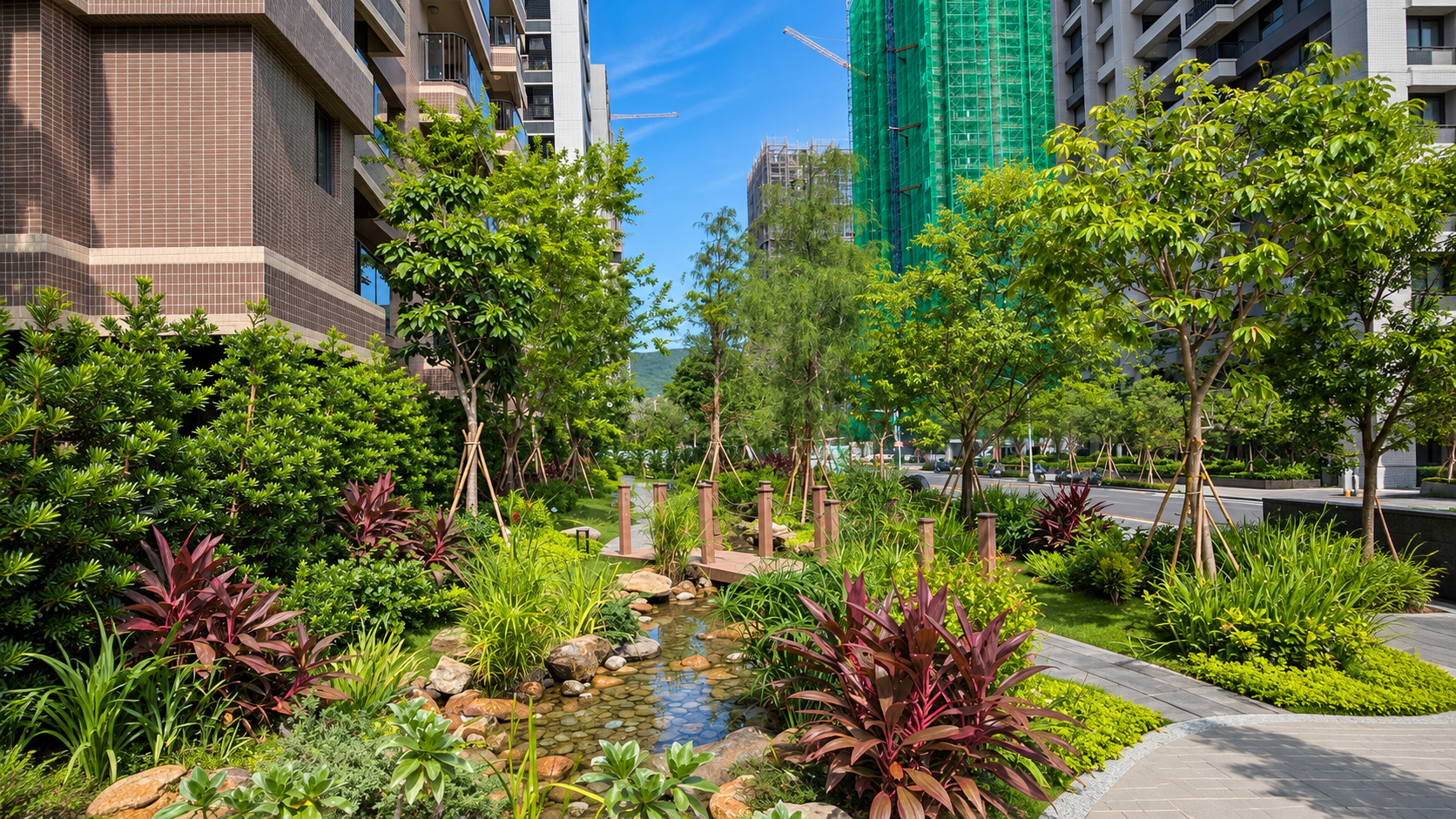
By KHT Staff. AI-generated recreation based on a reference photograph supplied by the Kaohsiung Urban Development Bureau.
KAOHSIUNG — Kaohsiung wants the open spaces in front of buildings to do more than meet minimum clearance requirements, with connected walking routes, shade, and seating that make streets more comfortable in hot weather.
The Kaohsiung Urban Development Bureau (高雄市政府都市發展局) recently brought together architects, landscape specialists, planners, and property developers to discuss how building setbacks—the spaces left between buildings and the street—can better serve pedestrians.
According to the bureau’s announcement, the city revised its urban design review standards in January 2025 to place greater emphasis on pedestrian access, planting, shade, and the quality of open spaces. The bureau said designs should provide continuous, level walking routes alongside places to pause and rest.
At the forum, speakers discussed retaining mature trees, arranging buildings to suit the local climate, and connecting public sidewalks with privately owned setback areas to create longer stretches of shaded walking space.
China Times reported that participants also examined planting, permeable paving, and combinations of shade structures as ways to reduce heat exposure and improve comfort.
Examples from Taipei’s Xinyi and Nangang areas illustrated how covered walkways, pedestrian links at different levels, and separation from vehicle traffic can connect destinations. Other presentations drew on social housing, offices, and sports facilities, arguing that development should provide useful public spaces alongside building floor area.
The bureau said it had approved 381 new urban design review cases since 2021. Their plans collectively provide for approximately 66 hectares of ground-level vegetation and 72,000 square meters of greenery on roofs and building façades. These are projected provisions across the approved plans.
The bureau said it would use the forum’s findings to improve how projects connect walking routes, provide shade, and accommodate places to rest.