
By Shen Nai-hsun (沈迺訓)
This article was first published by the China Times on Sept. 13, 2026, and is republished with permission. Editor’s note: This is an opinion article. The views expressed are those of the author and do not necessarily reflect the position of KHT. Images include AI regenerations based on reference pics via China Times/UDN.
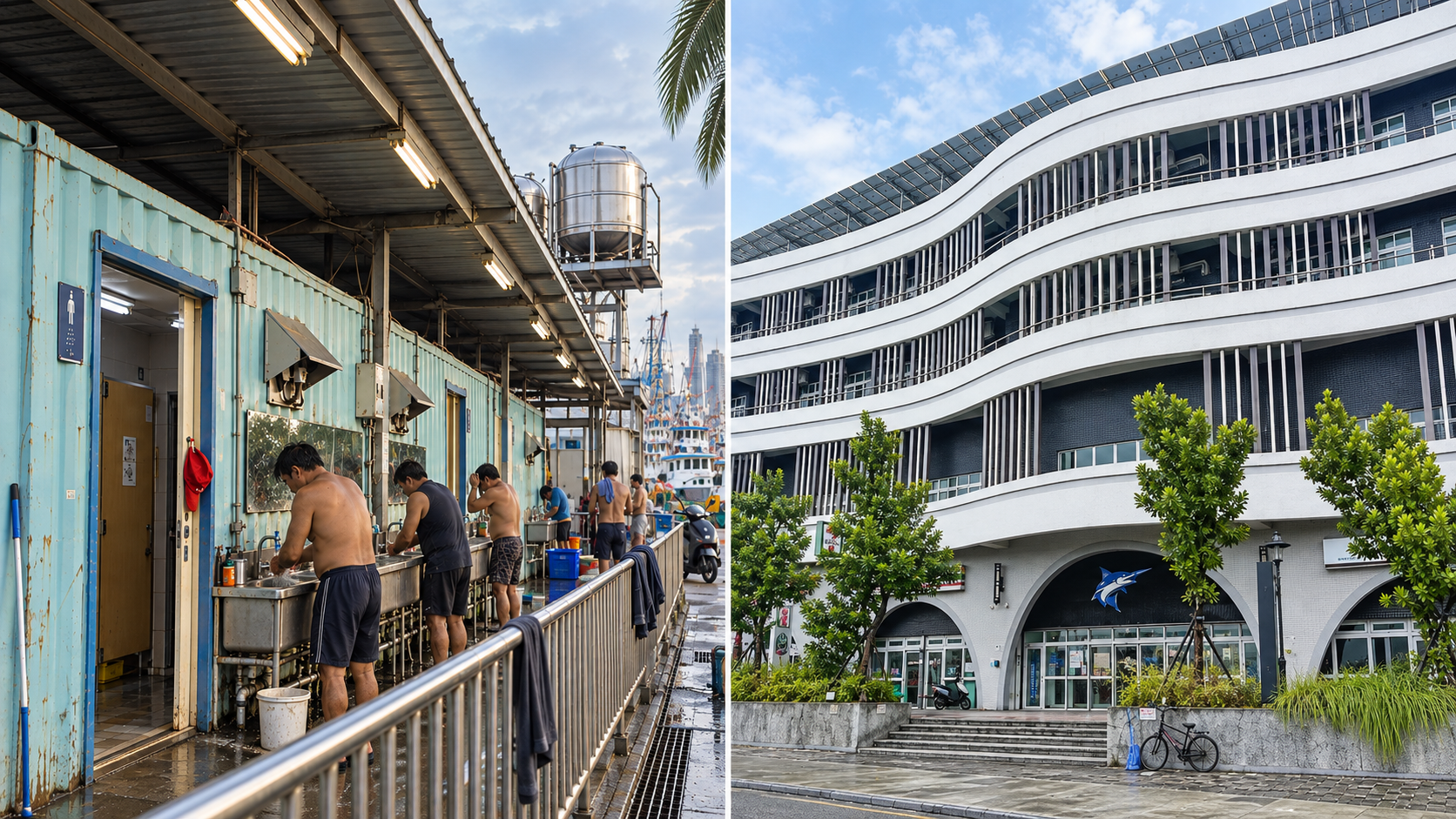
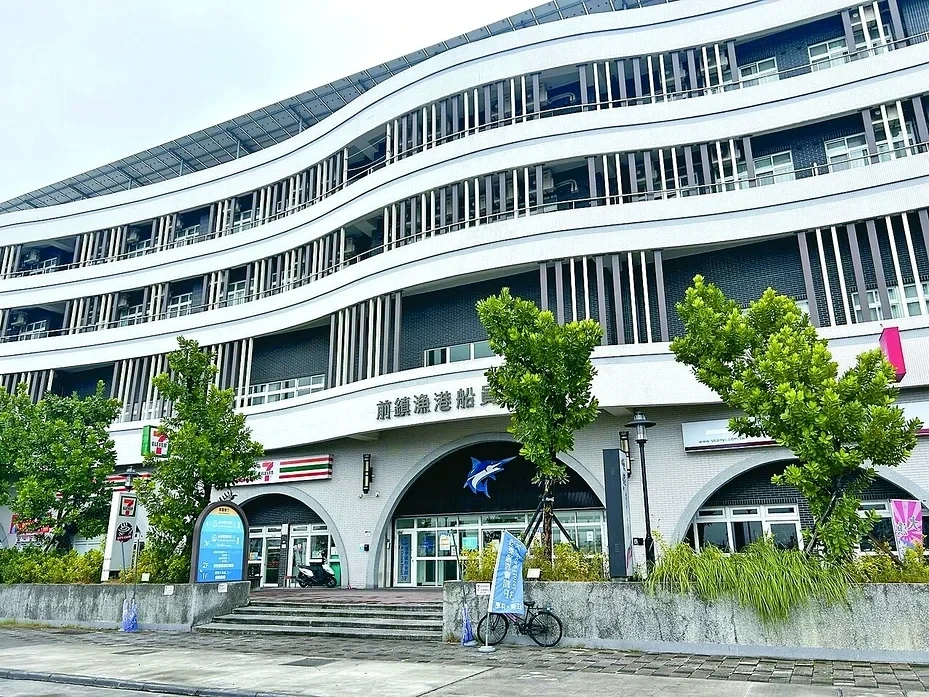
KAOHSIUNG — News reports have described the NT$400 million crew hostel at Cianjhen Fishing Port (前鎮漁港) as an “upmarket bathhouse,” saying some foreign fishing workers would rather wash outside the building.
The hostel is a major part of the port’s NT$8.1 billion redevelopment program. It was intended to provide foreign crew members with reasonable accommodation and address concerns about their living conditions. Yet it has apparently failed to fulfill that purpose and cannot even provide enough of the additional shower facilities promised to workers.
When NT$400 million in public funds is spent on a building that does not adequately serve its intended users, the public has every right to question the project. While the Control Yuan investigates controversies involving Taipei Mayor Chiang Wan-an’s (蔣萬安) family, it should also examine what has happened at Cianjhen Fishing Port.
Over the past several years, elected representatives from the Kuomintang (中國國民黨) repeatedly questioned the NT$8.1 billion redevelopment budget. Democratic Progressive Party (民主進步黨) politicians responded by accusing them of obstructing Kaohsiung’s development.
At the time, Kaohsiung Mayor Chen Chi-mai (陳其邁), along with several legislators and city councilors, frequently cited foreign fishing workers bathing beside the road as a reason the redevelopment was necessary.
However, reports published after the hostel opened found that it was not performing its intended function. About 15,000 foreign crew visits are recorded at the port each year for unloading, resupply and maintenance, but the facility provides only 40 showers and accommodation for 136 people.
During busy periods, long lines form for the showers. Some workers reportedly find it quicker to walk to basic shower facilities made from shipping containers, where they can also wash their clothes by hand.
The problem is more serious than that. Reports indicate that many fishing workers at Cianjhen still bathe outside beside the road because they cannot even get into the temporary shower facilities.
In other words, the conditions DPP politicians once cited to justify the redevelopment have not been resolved as the projects have been completed. Their willingness to invoke migrant workers’ rights when defending the budget, without ensuring that the finished facilities meet those workers’ needs, deserves scrutiny.
When the Cianjhen crew hostel opened last year, Chen said: “This is an operation from which it is very difficult to make money, but taking care of crew members is extremely important. The Kaohsiung City Government will take concrete action to support them when they come into port.”
Chen also said the city government would spend more than NT$3 million annually on recreational and cultural activities at the hostel.
But foreign fishing workers quoted in subsequent reports said rooms cost more than NT$1,000 per night, a price they would not consider paying. To them, the hostel is something they can see but cannot use. Accustomed to living aboard their vessels, they continue sleeping on their boats even while resting in port.
It is also unclear how much of the proposed NT$3 million activity budget directly benefits individual fishing workers. More fundamentally, the city has still failed to ensure that every worker has access to something as basic as a dignified daily shower.
Under these circumstances, it is difficult to argue that Chen has fully met his responsibilities regarding the rights and welfare of foreign fishing workers.
Chen recently published a book titled Kaohsiung, Full Speed Ahead (《高雄緊緊緊》), highlighting construction projects and the city’s success in attracting high-tech industries. He claims much of the credit for Kaohsiung’s development.
Yet the city now faces the embarrassing reality that some foreign fishing workers cannot afford to stay at the hostel and cannot get access to its showers, leaving them to continue bathing outdoors.
These labor and human-rights concerns receive considerable international attention, but they appear to receive little attention in Chen’s book. If the mayor is serious about addressing the problem, he should ask the Kaohsiung Marine Bureau (高雄市政府海洋局) how many foreign crew members have stayed at the hostel since it opened and why the shower shortage remains unresolved after nearly six years of his administration.
Legislator Lai Jui-lung (賴瑞隆), whose constituency includes Cianjhen Fishing Port and who is now seeking to become Kaohsiung mayor, recently challenged Taipei Mayor Chiang Wan-an to debate the NT$8.1 billion redevelopment program.
If Lai wants such a debate, he should first explain why a project promoted in part as a solution to foreign fishing workers’ bathing conditions has failed to solve that problem. He should also apologize for supporting planning that has not delivered what was promised.
The NT$8.1 billion Cianjhen Fishing Port redevelopment cannot fairly be described as a complete waste. But whether every part of the program reflects actual needs and represents responsible use of public money remains open to serious question.