
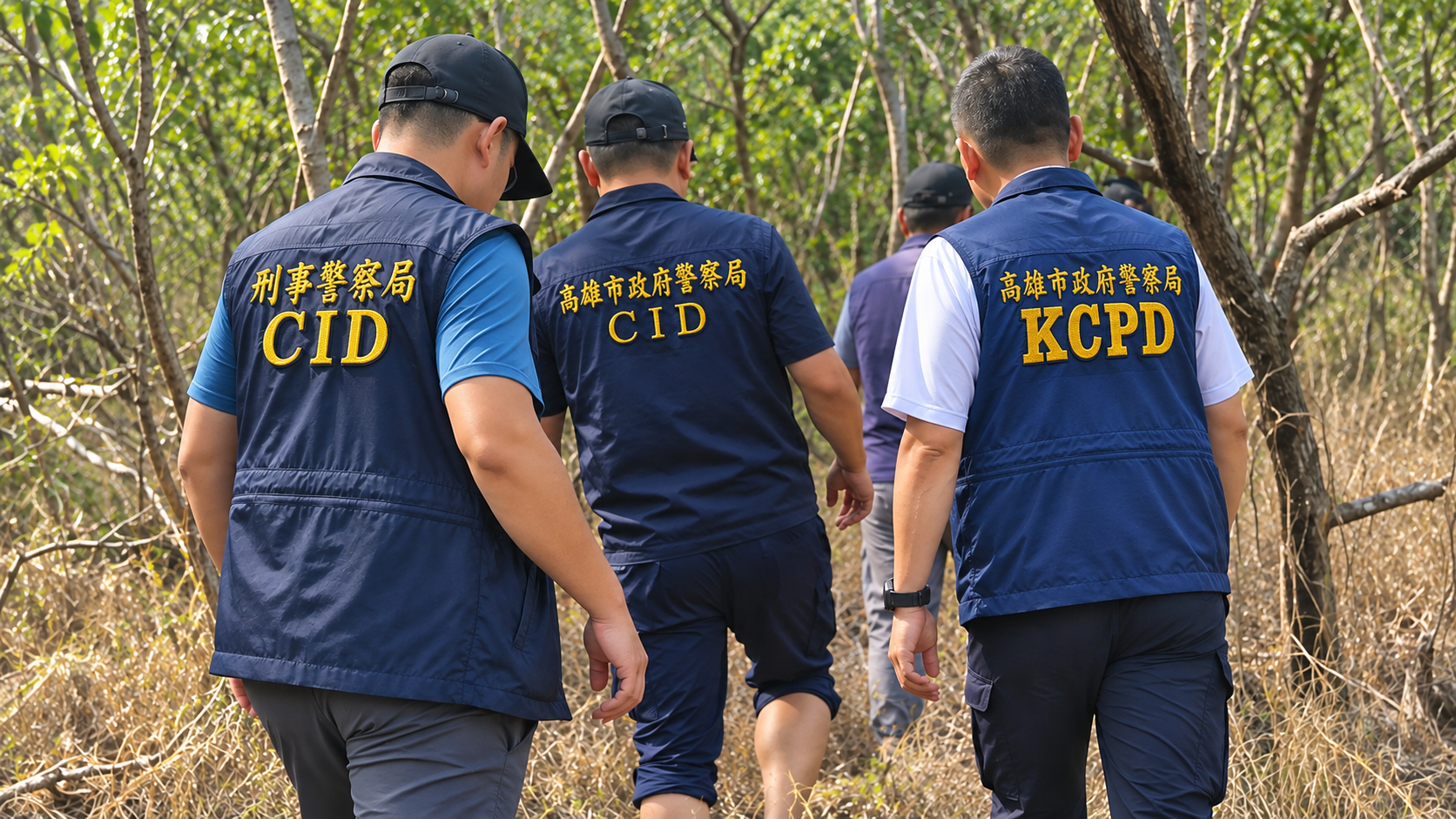
By KHT Staff. AI-generated illustration based on a reference photograph; not a documentary image of the investigation.
KAOHSIUNG — A woman convicted of helping plan the murder of a man who was held at motels before being killed and buried in Pingtung County was sentenced to 14 years in prison by Ciaotou District Court (橋頭地方法院) on Nov. 2.
Huang Yu-ning (黃于寧) was found guilty of jointly murdering Lin Ting-yi (林庭億). The panel, comprising three professional judges and six citizen judges, also sentenced Wu Yu-chu (吳育竹) to two years and eight months and Chu Yu-fu (朱有福) to three years and two months for unlawful detention involving three or more perpetrators carrying a weapon.
Prosecutors had also accused Wu and Chu of aiding the murder. However, the court said the evidence did not establish that either knew of, or could have foreseen, the subsequent plan to kill Lin. The first-instance ruling can be appealed.
The court found that Cheng Jen-hsiung (鄭仁雄), whose case is awaiting separate trial, told Huang before May 7, 2025, that he wanted to kill Lin. Huang then recruited Wu and Chu.
On May 7, Wu brought Lin to a motel parking lot in Ciaotou District (橋頭區), where Lin entered the back seat of a car. Chu activated the rear door’s child safety lock, preventing him from leaving.
After Lin produced a gun-shaped object, Cheng stabbed him, and Chu helped restrain him, according to the court’s findings.
Huang and Cheng subsequently transported Lin to motels in Niaosong District (鳥松區) and Pingtung County. While Lin was being held, the pair discussed killing him and burying his body, the panel found.
Huang left the group on the evening of May 8. The court’s account said Cheng and others later took Lin to the Pingtung mountains on May 10, killed him, and buried his body. Their alleged involvement is subject to separate proceedings.
Although Huang was no longer with the group when Lin was killed, the panel found that she had already shared in the murder plan. It rejected her claim that she knew nothing of Cheng’s intention to kill him.
The court cited recordings, messages, surveillance footage, route information, and witness testimony in reaching its findings.