
By Shen Nai-hsun (沈迺訓)
This article was first published by the China Times on Sept. 11, 2026, and is republished with permission. The views expressed in this commentary are those of the author.
KAOHSIUNG — After days of heavy rain, potholes and other road damage have appeared across Kaohsiung, attracting complaints from residents and questions from city councilors.
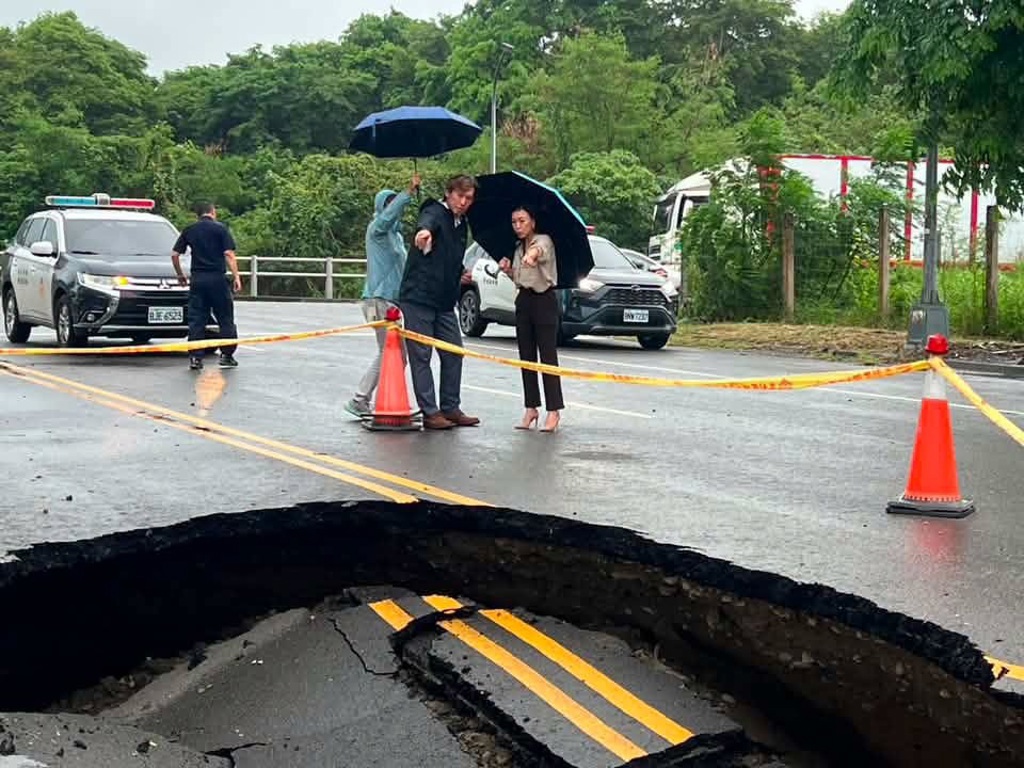
A road collapse near No. 100 Cyonglin Road (芎林路) in Nanzih District (楠梓區) also attracted attention after Kaohsiung City Councilor Pai Ciao-yin (白喬茵) posted photographs of the scene on Facebook.
Even Yanhai Road (沿海路) in Siaogang District (小港區), where the city secured NT$1.4 billion from the central government for road improvements, reportedly developed multiple potholes following heavy rain.
Potholes are not unusual after severe weather. Water enters cracks in the road surface, weakens the material below, and allows passing vehicles to break apart the pavement. But when damage appears repeatedly or is not repaired quickly, residents are entitled to ask whether maintenance and emergency-response systems are working properly.
Some district offices have reportedly said that their road-maintenance funds have been exhausted. If accurate, that deserves a fuller explanation from the city government. “No money” is not an adequate final answer when damaged roads pose an immediate danger to scooter riders and other road users.
The city’s budget figures, however, require careful interpretation.
According to figures cited in the original commentary, Kaohsiung budgeted NT$1.938 billion in disaster reserve funds for 2025. It reportedly spent NT$764 million and carried forward NT$744 million.
That does not necessarily mean NT$744 million sat unused or could immediately be redirected to pothole repairs. In government accounting, reserved funds may already be committed to approved projects for which work or payments continue into the following year.
Still, the figures raise reasonable questions. The city should explain how much emergency funding remains available, what it has already been committed to, and whether any portion can legally be used for urgent road repairs.
The same applies to the mayor’s secondary reserve fund. It is not a personal account that the mayor can spend at will. Any use must follow budgetary rules. But the city should say whether that fund, disaster reserves, or transfers from other departments could help district offices respond more quickly.
It is also important to distinguish ordinary potholes from larger road collapses. The hole on Cyonglin Road has been described as a “sinkhole,” but authorities were still investigating its cause. It should not automatically be treated as another example of routine pavement failure.
Mayor Chen Chi-mai (陳其邁) has repeatedly emphasized speed and efficiency through his “jin, jin, jin” governing slogan. With about 100 days remaining in his term, the administration should apply that urgency to road safety.
This is not simply a matter of political messaging. A pothole that is inconvenient for a driver can be deadly for someone on a scooter. The city should publish a clear account of the damage, the expected repair schedule, and the funding available.
Kaohsiung may or may not have enough immediately accessible money for every repair. Residents should not have to guess. The government should show them the figures and explain what it intends to do.
Photo caption: Authorities cordon off a road collapse near No. 100 Cyonglin Road in Nanzih District. Its cause remains under investigation, and it should not automatically be classified as an ordinary rain-related pothole. Photo from Kaohsiung City Councilor Pai Ciao-yin’s (白喬茵) Facebook page.
About the Author:

Shen Nai-hsun (沈迺訓) is a Kaohsiung-born freelance writer and political commentator.