
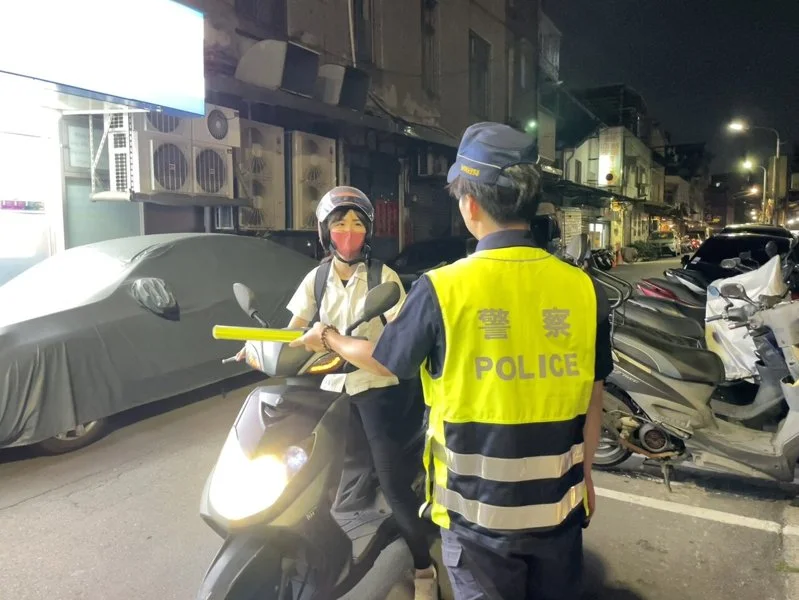
By KHT Staff. Photo courtesy of Taipei City Traffic Police Division.
TAIPEI — The Ministry of Transportation and Communications (MOTC) announced Wednesday a legislative proposal to mandate that 30% of traffic fine revenue be allocated toward road safety improvements, up from the current 12% requirement.
The move follows criticism that local governments are utilizing fine income to offset general budget deficits rather than reducing traffic casualties. During a legislative session on April 1, Legislator Chen Ching-lung (陳清龍) presented data indicating that despite an increase in traffic citations — rising from 13.85 million in 2022 to 16.31 million in 2025 — road casualties also increased to 536,000 cases over the same period.
A UDN report explained that under current regulations, 75% of traffic fine revenue is distributed to local governments, 24% to the penalizing authorities, and 1% to the national treasury.
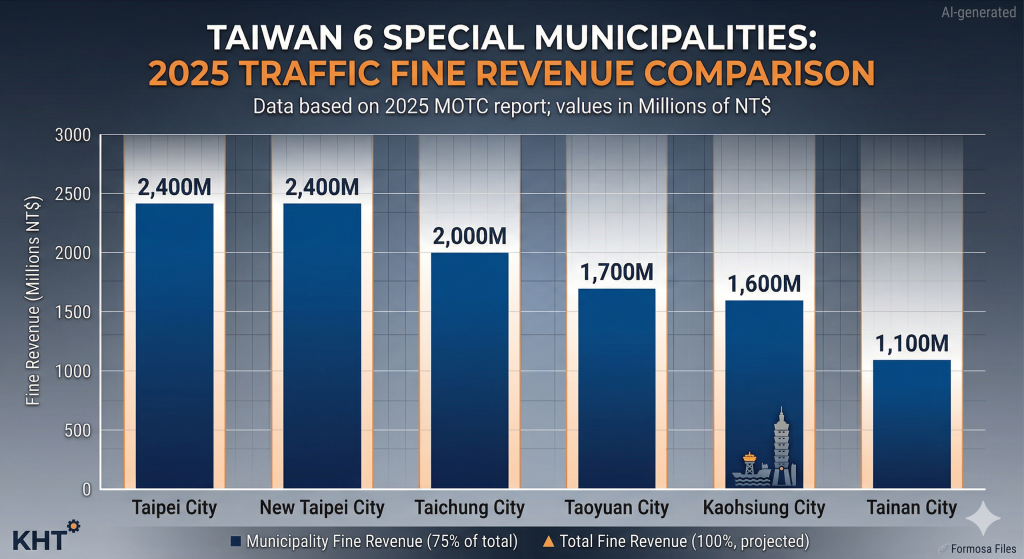
The 2025 fiscal data for Taiwan’s six special municipalities showed significant fine revenues:
- Taipei: NT$2.4 billion
- New Taipei: NT$2.4 billion
- Taichung: NT$2 billion
- Taoyuan: NT$1.7 billion
- Kaohsiung: NT$1.6 billion
- Tainan: NT$1.1 billion.
Chen noted that with only 12% of these funds legally earmarked for safety, major cities like Kaohsiung and Taipei are only required to spend approximately NT$200 million each on actual infrastructure improvements. Chen characterized the remaining funds as a “small treasury” (小金庫) for local governments to plug fiscal gaps.
Minister of Transportation Chen Shih-kai (陳世凱) acknowledged the current distribution is “unreasonable” and confirmed that the Ministry of Transportation and Communications plans to amend the law to raise the required allocation for safety spending from 12% to 30%.
Officials said the revised framework would prioritize road environment improvements and accident analysis, rather than expanding automated enforcement systems.
The proposal is expected to be formally announced in the first half of 2026.