
By Pai Pei-hua 白佩華
Image via Wikimedia Commons
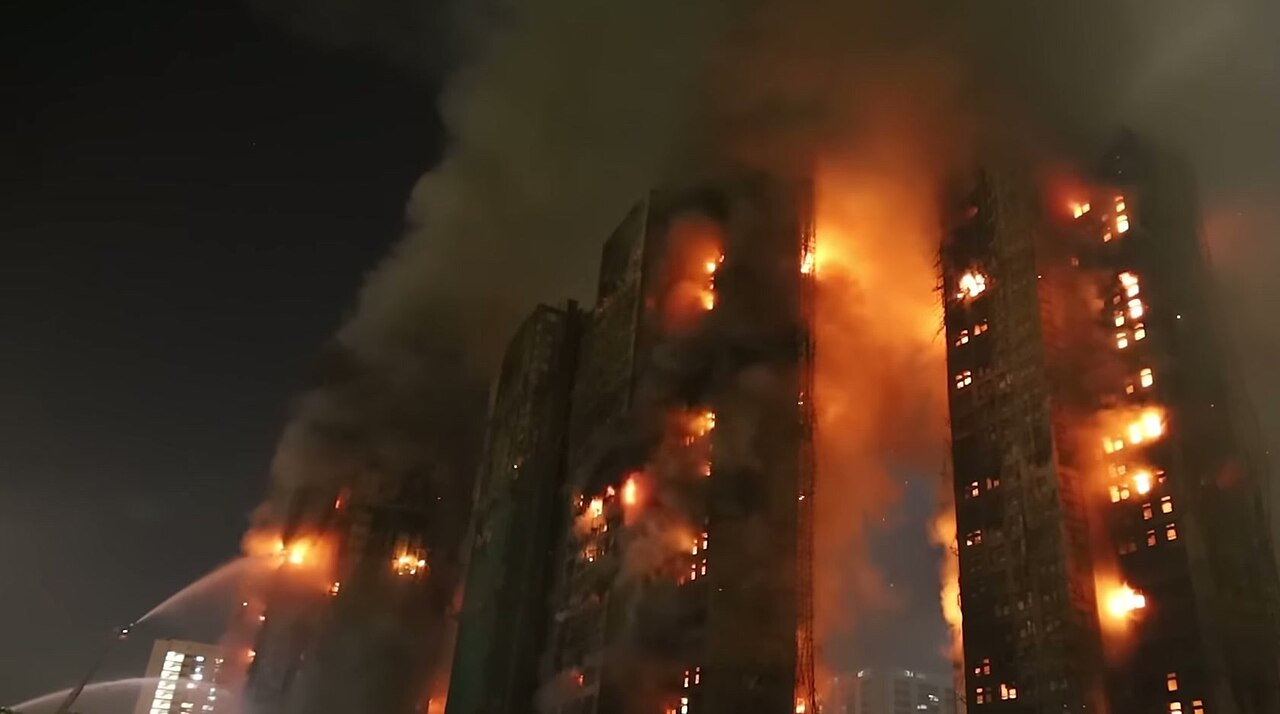
A devastating residential high-rise fire in Hong Kong spread with alarming speed, causing major casualties and property loss while revealing the extreme vulnerability of dense urban living. Although such incidents appear sudden, they are almost never caused by a single trigger. Rather, they result from multiple, long-ignored risks failing at the same moment.
For Taiwan, this was a rehearsal of our own structural reality. Like Hong Kong, we are defined by clustered towers, constant renovation cycles, night work, and a rapidly aging resident base.
When ordinary safeguards fail at the same time
The key concern is not whether a fire will happen, but whether a community has the capacity to absorb impact and recover swiftly when it does. Risk management is about system performance under stress, not isolated safety checks. In the Hong Kong blaze, core risks were already present: combustible materials, lax control of hot work such as welding and torching, weak site inspections, and the vertical chimney effect common in high-rises. None of these conditions appeared suddenly; they were daily risks left to accumulate.
Construction is not temporary, but a sustained exposure
A recurring blind spot in Taiwan’s large housing complexes is the assumption that construction risk is short-term. In reality, exterior refits, waterproofing, elevator replacement, pipe renewal, and common-area upgrades are perpetual. The community is always under partial construction, which means risk never leaves. It simply moves around.
Many building committees operate on a project mindset, focused on timelines, noise, and budgeting, rather than a failure mindset: if a fire or explosion occurs during work, can order be maintained and evacuation coordinated, and will the community remain functional? Disasters rarely break a community; collapse happens when governance fails to respond.
Safety is not equipment, but command
Communities often equate disaster preparedness with passing inspections and stocking extinguishers. Yet international experience shows that equipment is secondary to governance: who detects anomalies, who activates emergency protocols, who resolves bottlenecks between contractors and residents, and who protects core systems from secondary damage. Without decisive command, tools fail.
Recovery is measured in restored life order
Post-fire recovery involves housing arrangements, infrastructure repair, financial continuity, psychological security, and trust. Repainting walls and restarting elevators does not rebuild community confidence. If governance deteriorates into disputes, litigation, and resident flight, the building may recover physically but decline socially and commercially.
The missing instrument: a risk map
Every large community should maintain its own risk map, updated annually, identifying: construction hotspots, zones with heavy electrical load, storage or use of flammable materials, floors with significant elderly populations, weak night-shift oversight.
A risk map should sit alongside financial documents, not behind a reception counter.
True luxury is not marble, but governance credibility
Premium properties are not defined by address or amenities but by three premiums: professionally controlled risk, rational crisis response, and rapid restoration of order. This is the governance credit of a community. A single fire tests years of accumulated trust.
The core lesson
The warning from Hong Kong is not that fires are terrifying, but that modern communities must withstand extreme shock and stand back up. In high-density cities, the impact multiplies. In high-value properties, governance failure has deeper and longer consequences.
If Taiwan hopes to build sustainable communities, we must stop focusing solely on building specs and management fees. The real questions are whether risks are mapped, whether governance can withstand pressure, and whether recovery planning exists before a crisis, not after. True resilience is not defined by whether a disaster happens, but by whether a community can restore order, maintain trust, and preserve value when it does.
About the Author:

Pei-Hwa Pai (白佩華) has over twenty years of experience in risk management and sustainability consulting. Holding dual master’s degrees in communication from U.S. institutions, Ms. Pai also earned a Certificate in Circular Economy and Sustainability Strategies from the University of Cambridge Judge Business School, professional certificates in Strategy Analysis, Management and Leadership, and Business in Society from Harvard Business School, and an ESG Materiality Analysis Certificate from the Wharton School. She further holds certifications in TCFD, CDP, and SBTi training from Taiwan’s Industrial Technology Research Institute (ITRI), along with credentials as a lead auditor for ISO 14064, ISO 14068-1, ISO/IEC 42001, and expertise in ISO 14067 and BS 8001. Trained under the MIC Industry Analyst Program, she brings both academic rigor and industry insight to her consulting practice.
Pai has also established two scholarships dedicated to sustainability and AI, supporting academic research and encouraging young people to enter the field of sustainable development. Over the years, Ms. Pai has guided numerous companies in successfully implementing sustainability transformations. Her columns have been published across numerous media outlets, and she continues to serve as a strategic and sustainability advisor to the industry.