
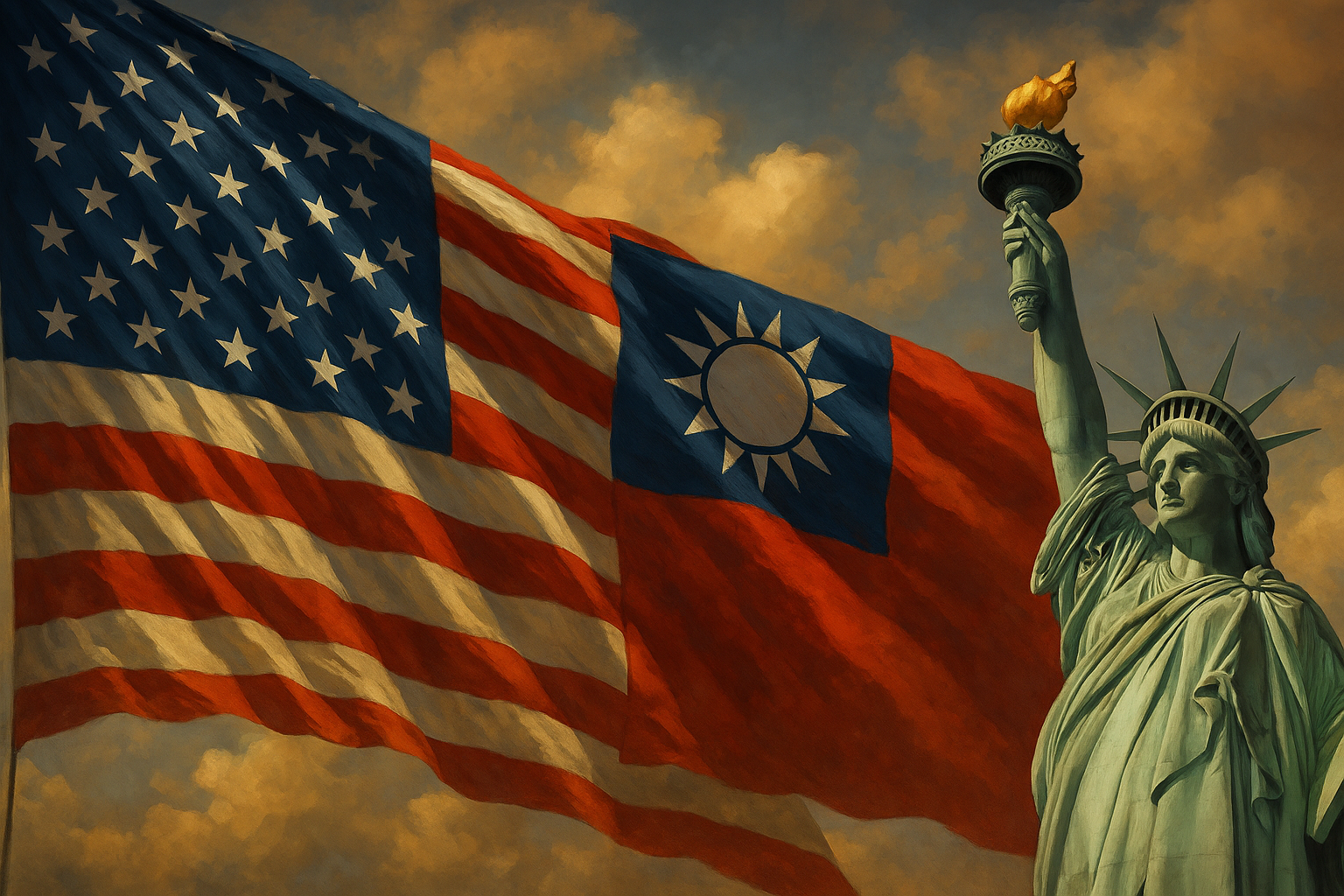
By Iap Tiong-cheng (阿忠仔 ) | Special to The Kaohsiung Times
Conservatives cannot defend America’s greatness by retreating from the world. Nowhere is this clearer than in the debate over Taiwan.
Isolationism has re-emerged inside the Republican Party. A Chicago Council on Global Affairs poll found that 53% of self-identified Republicans believe the United States should “stay out” of international affairs. The current Trump administration mirrors this instinct, with its America First agenda focusing narrowly on domestic priorities while pulling back from global leadership.
During his March confirmation hearing, Elbridge Colby — now Under Secretary for Policy at the Department of War — reflected this view when he said Taiwan’s security was “very important” but “not an existential interest.” That statement departs sharply from the conservative tradition of strength, deterrence, and moral clarity.
The Case for Taiwan
Three claims dominate the new isolationist argument:
- Taiwan is too far away to defend.
- Taiwan provokes China.
- Taiwan isn’t doing enough for its own defense.
Each collapse under scrutiny.
1. Distance Is No Excuse
The United States has never been deterred by geography when its interests or principles were at stake. As former Vice President Mike Pence and Heritage Foundation founder Edwin J. Feulner wrote:
- The beaches of Normandy are 3,700 miles away.
- Iwo Jima is 7,600 miles away.
- Afghanistan is 7,000 miles away.
- Taiwan is approximately 7,700 miles from Washington, D.C. — and sits at the heart of the Indo-Pacific, one of the world’s most vital trade corridors.
In 2022, US$2.45 trillion in goods transited the Taiwan Strait (台灣海峽). Nearly half the world’s container fleet passes through its waters. If Beijing seized Taiwan, it could strangle global shipping, cripple the U.S. economy, and project military power deep into the Pacific — threatening Guam, only 1,730 miles away.
Former Chief of Staff of the United States Army General Douglas MacArthur warned in the 1950s that Taiwan could become an “unsinkable aircraft carrier.” If lost, it would be armed and aimed at the United States.
2. Taiwan Is Not the Provocateur
Isolationists like Jennifer Kavanagh accuse Taiwan of “provoking” Beijing. The facts say otherwise. To the Chinese Communist Party, anything Taiwan does — from holding free elections to buying weapons — is labeled “provocative.”
Since 2016, China has:
- Cut official communications with Taiwan’s Democratic Progressive Party (民進黨) government.
- Damaged undersea cables using dredging vessels.
- Conducted “blockade-lite” military drills.
- Launched a reported two million daily cyberattacks.
- The Inter-Parliamentary Alliance on China (IPAC) stated on June 27, condemning China for an alleged plot to “engineer a collision with a car carrying Vice President Hsiao Bi-khim (蕭美琴) during a visit to the Czech Republic in March 2024 when she was serving as vice president-elect.” Taiwan’s Ministry of Foreign Affairs denounced China for “conspiring to engage in an act of state terrorism” and said that the “planning of such an overt act of politically motivated violence in a foreign country represented the crossing of a threshold and disregard for international diplomatic norms.”
President Lai Ching-te (賴清德) has maintained Tsai Ing-wen’s (蔡英文) approach — seeking dialogue, preserving the status quo, and extending goodwill. Beijing has responded only with greater hostility.
For conservatives, the moral question should be simple: freedom versus tyranny. Americans have fought against totalitarianism for 249 years. Expecting Taiwan to surrender to Marxist rule would betray that legacy.
3. Taiwan Is Defending Itself
President Ronald Reagan believed in “peace through strength.” Taiwan has embraced that philosophy. Recent reforms include:
- Raising defense spending from 2.5% to 3.2% of GDP, targeting 5% by 2030.
- Extending conscription from four months to one year.
- Purchasing $26 billion in U.S. arms since 2016.
The problem lies in Washington’s backlog — roughly $21 billion in delayed weapons deliveries. Former Defense Secretary Lloyd Austin promised to accelerate shipments, yet many systems remain undelivered.
As former Foreign Minister Joseph Wu (吳釗燮) said in 2023, “If we do not have the determination to fight for ourselves, we don’t have the right to ask others to fight for Taiwan.”
Taiwan is not asking the United States to fight its wars — only to honor its commitments.
The Conservative Imperative
Abandoning Taiwan would mark the end of American credibility — and the beginning of a new authoritarian century. Isolationist worries about domestic renewal are understandable, but retreat will not make the United States stronger.
Taiwan is central to U.S. national security, economic stability, and the balance of power in Asia. To preserve American greatness, conservatives must reject neo-isolationism and reaffirm the principles behind the Taiwan Relations Act (台灣關係法, 1979) and President Reagan’s Six Assurances (六項保證).
History has always judged America not by how it avoided struggle, but by how it stood for freedom. Taiwan’s survival is part of that story.
About the Author:
Iap Tiong-cheng (阿忠仔) is a Taiwanese independence advocate from Ohio. His commentary has appeared in the Liberty Times, Cincinnati Enquirer, Taiwan Insight, and American Citizens for Taiwan. He writes frequently on U.S.–Taiwan relations, DPP factional politics, and Taiwan’s independence movement. When not writing, he reads conservative essays and Buddhist sutras. You can follow him on X and Threads @Formosanafro