
By RK Shih / Staff
TAIPEI — A coalition of experts and scholars has issued a stark warning: The failure of the Legislative Yuan to pass a proposed NT$1.25 trillion (US$40 billion) special defense budget risks sending a dangerous signal of weakness to both Beijing and Washington.
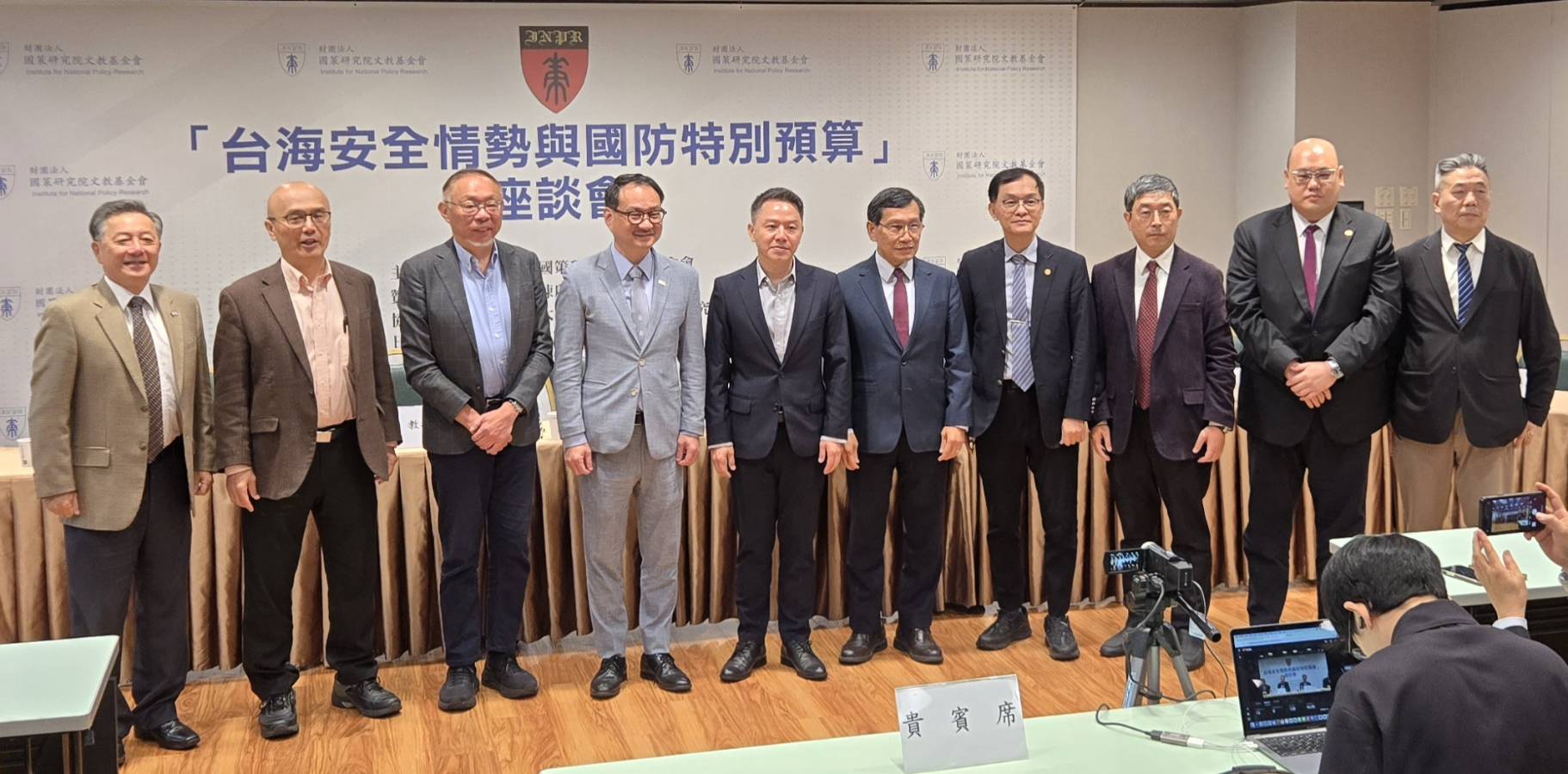
Speaking at a seminar on Feb. 26 organized by the Institute for National Policy Research (INPR/國策研究院), a panel of experts emphasized that the massive eight-year budget (2026–2033) is not just about military hardware, but about Taiwan’s survival in an increasingly volatile security environment.
The event, titled “The Taiwan Strait Security Situation and the Special Defense Budget” (台海安全情勢與國防特別預算), was hosted by INPR President (and former ROC Minister of Foreign Affairs) Tien Hung-mao (田弘茂).
Legislative Breakthrough and Han Kuo-yu’s Support
Despite weeks of deadlock, a path forward has perhaps emerged. On Feb. 24, party caucuses reached a consensus to send the Executive Yuan’s draft bill to committee for review, with a plenary agenda date set for March 6.
Legislative Speaker Han Kuo-yu (韓國瑜) has moved to the center of the negotiations, signaling a shift toward cooperation. Han and Deputy Speaker Johnny Chiang (江啟臣) issued a joint statement pledging to make the special defense budget a top priority for the new session. Han’s proactive stance follows growing international pressure, including a letter from 37 U.S. lawmakers urging swift action to maintain regional stability.
The Core Arguments: Geopolitics and “T-Dome”
The scholars’ arguments for urgency centered on three primary factors: international signaling, impending deadlines, and the critical need for a modern “T-Dome” defense shield.
- The Trump-Xi Summit Threat: Professor Kuo-Cheng Chang (張國城) argued that the current delay is exceptionally ill-timed, with a rumored summit between US President Donald Trump and Chinese leader Xi Jinping looming in late March. “Any internal division regarding defense sends the message to the United States that Taiwan is not serious about its own security,” Chang warned.
- The March 15 Deadline: The seminar highlighted that essential US arms procurements hang in the balance. The Letter of Offer and Acceptance (LOA) for several critical systems is set to expire on March 15, 2026. Tung Li-wen (董立文), Executive Director of the Foundation on Asia-Pacific Peace Studies, warned that failing to pass the budget by this date could result in years-long delays or costly renegotiations.
- The T-Dome “Shield”: Su Tzu-yun (蘇紫雲) of the Institute for National Defense and Security Research (INDSR/國防安全研究院) detailed the “Taiwan Dome” (T-Dome). “This is our shield,” Su explained. “If Taiwan can show it can withstand a first strike, it prevents China from achieving its strategic goal: a quick win.”
Historical Context and Economic Capacity
Addressing opposition criticism that the US$40 billion figure is excessive, INPR Vice President Kuo Yu-jen (郭育仁) framed the expenditure in historical terms.
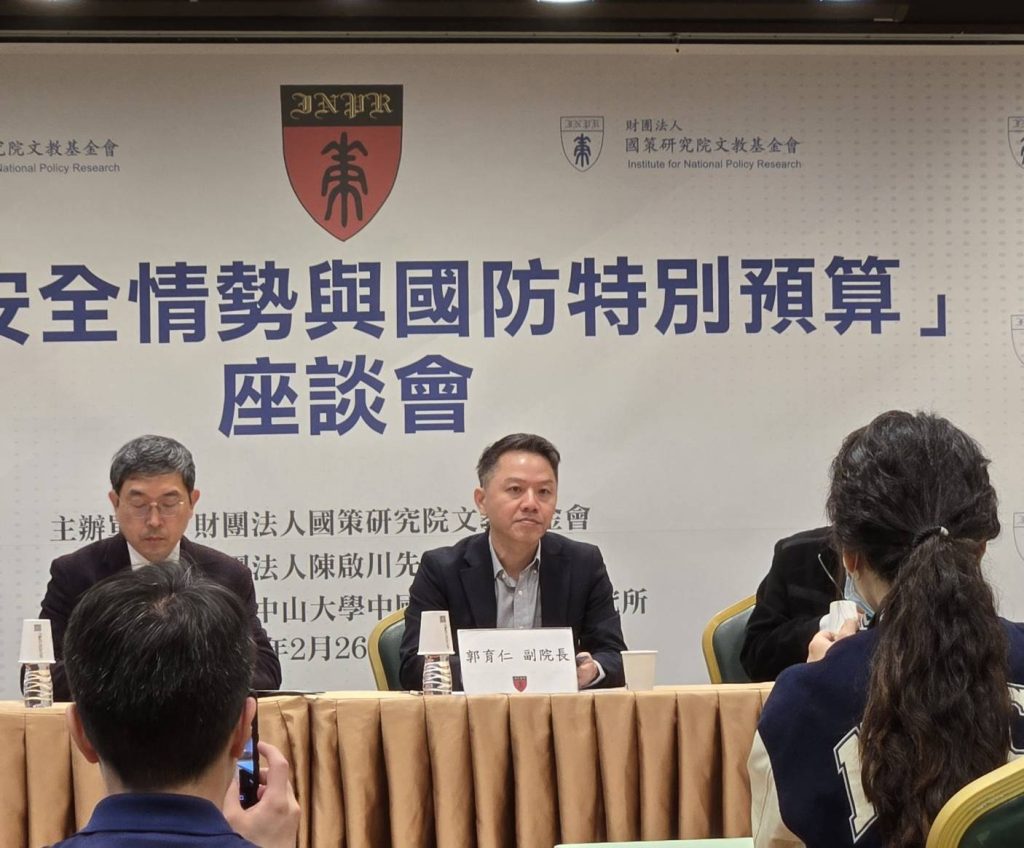
Kuo (郭育仁), who is also a Professor and Director at the Institute of China and Asia-Pacific Studies at Kaohsiung’s National Sun Yat-sen University (NSYSU/國立中山大學), head of the Global Risk Assessment Team (GRAT) at INPR, and serves as President of the Taiwan Society of Japan Studies, countered that the proposed level is low by historical standards. “In the 1960s and 70s, under both Chiang Kai-shek (蔣介石) and Chiang Ching-kuo (蔣經國), Taiwan consistently spent over 5% and even 10% of GDP on defense,” Kuo stated. “We have the economic capacity; we now need the political will.”
The Standoff Over Specifics
While the KMT and TPP have agreed to the review, they have introduced competing versions. The TPP has proposed a significantly lower NT$400 billion (US$12.7 billion) version, while the KMT remains concerned over debt financing.
The seminar concluded with a renewed appeal from participants—including Lin Ying-yu (林穎佑), former general Yu Tsung-chi (余宗基), Northrop Grumman Taiwan CEO Huang Ssu-hsun (黃思勳), and former US official Tony Hu (胡振東)—to treat the budget as a non-partisan security imperative before the mid-March deadline.