
By Dr. TUNG Chen-Yuan, PhD, Taiwan’s Representative to Singapore
The rapid advancement of artificial intelligence and generative computing is reshaping the global technology landscape. Semiconductors have consequently emerged as a core strategic resource of the digital age. Among the wide array of chip categories, memory chips are not only the single largest segment within general-purpose ICs, but also account for approximately 24.4% of the global semiconductor market. As major technology companies ramp up investment in AI model training and hyperscale data center construction, the memory industry has broken away from its traditional consumer electronics–driven cycle and entered a phase of structural growth powered by cloud computing and AI infrastructure. Amid this transformation, South Korea—leveraging deep technological expertise and highly concentrated market share—has become an indispensable pillar of the global AI computing ecosystem.
Market Expansion and Industry Restructuring
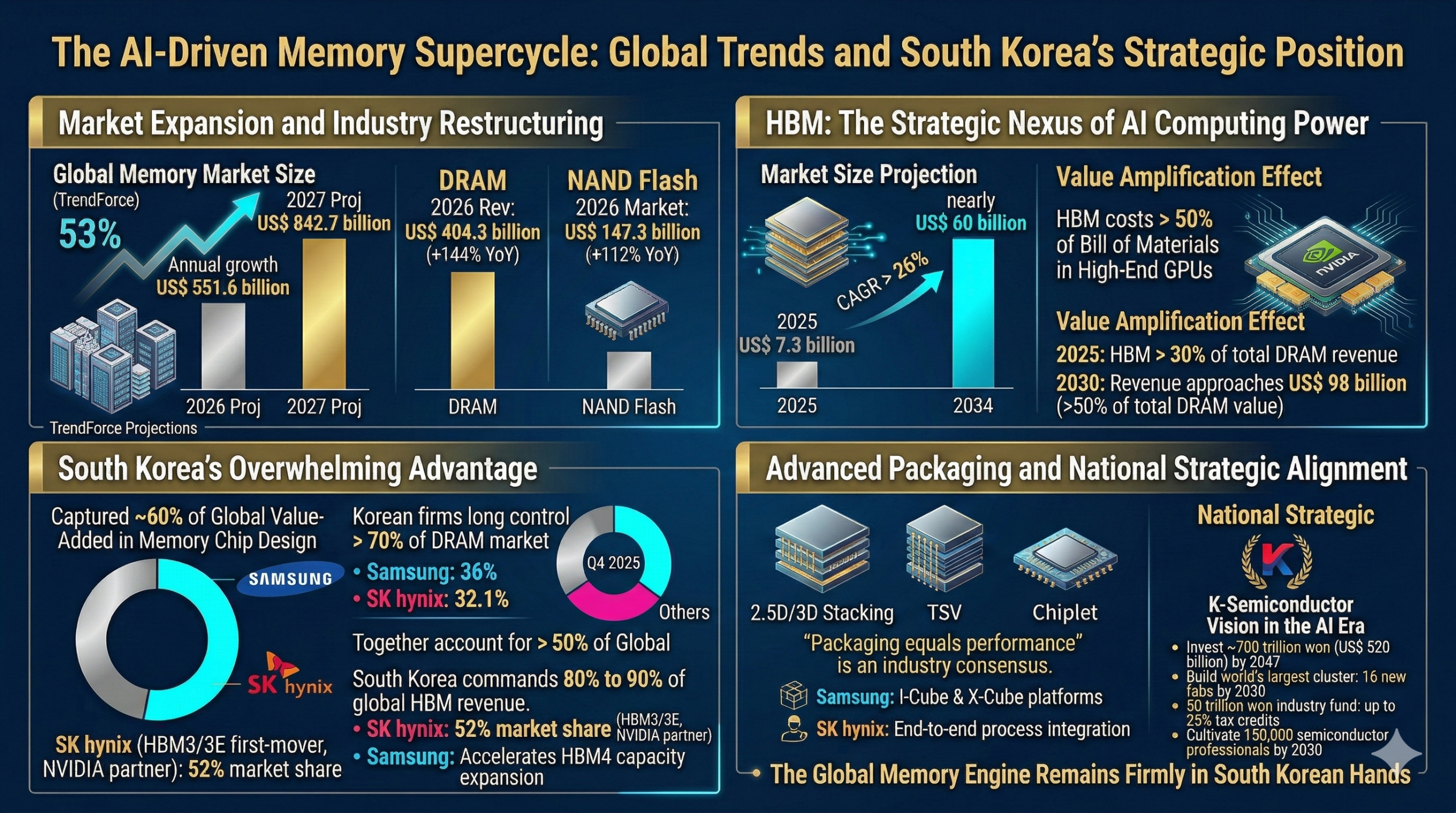
Surging demand for AI servers and high-performance computing has injected unprecedented momentum into the memory market. According to TrendForce, the global memory market revenue is projected to reach US$ 551.6 billion in 2026 and further expand to US$ 842.7 billion in 2027, representing an annual growth rate of 53%. This surge reflects not merely a cyclical rebound but a qualitative shift driven by product mix upgrades and evolving profitability models.
In the DRAM segment, tightening supply and rising prices are expected to propel revenues to US$ 404.3 billion in 2026, marking a remarkable 144% year-on-year increase. NAND Flash is likewise benefiting from the explosive demand for large-scale databases and enterprise SSDs fueled by generative AI, with market size projected to reach US$ 147.3 billion in 2026, up 112% annually. Procurement led by cloud service providers has reduced price sensitivity and strengthened pricing power for high-end products, fundamentally reshaping industry supply-demand dynamics.
HBM: The Strategic Nexus of AI Computing Power
At the heart of this memory supercycle lies High Bandwidth Memory (HBM). The immense data throughput and energy efficiency requirements of large AI models have elevated HBM from a niche product to a core component of AI hardware architecture. In NVIDIA’s high-end GPU modules, HBM accounts for more than half of the total bill of materials, underscoring its strategic importance.
HBM market size is projected to grow from US$ 7.3 billion in 2025 to nearly US$ 60 billion by 2034, with a compound annual growth rate exceeding 26%. Even more significant is its value amplification effect: HBM is expected to contribute over 30% of total DRAM revenue in 2025, and by 2030, its revenue could approach US$ 98 billion—accounting for more than half of the DRAM market’s total value. HBM is no longer merely an upgrade option; it has become a decisive factor influencing AI hardware deployment speed and cost structures.
South Korea’s Overwhelming Advantage
In the competition centered on HBM and advanced DRAM, South Korea has demonstrated formidable and resilient leadership. According to the Boston Consulting Group, the country captures roughly 60% of global value-added in memory chip design. The integrated device manufacturer (IDM) model adopted by Samsung Electronics and SK hynix—integrating design, fabrication, and packaging—delivers economies of scale, yield optimization, and rapid technological iteration.
In terms of market share, Korean firms have long controlled over 70% of the global DRAM market. In the fourth quarter of 2025, Samsung regained the top position with a 36% share, followed closely by SK hynix at 32.1%. Together, they also account for more than half of the global NAND market. In the strategically critical HBM segment, South Korea commands approximately 80% to 90% of global revenue. SK hynix, leveraging its first-mover advantage in HBM3 and HBM3E and close collaboration with NVIDIA, holds a 52% market share, while Samsung accelerates its HBM4 capacity expansion. Both companies are advancing next-generation product validation and mass production in tandem, reinforcing South Korea’s central role in the global AI memory supply chain.
Advanced Packaging and National Strategic Alignment
As HBM stacking layers increase, thermal management and packaging precision have become critical technological thresholds. “Packaging equals performance” has become an industry consensus. South Korea has built deep expertise in 2.5D and 3D stacking, through-silicon vias (TSV), and chiplet integration. SK hynix strengthens end-to-end process integration, while Samsung’s I-Cube and X-Cube platforms enable high-level integration of logic and memory chips. Advanced packaging capabilities thus form a key strategic moat sustaining Korea’s competitive edge.
Amid geopolitical risks and supply chain realignment, South Korea has elevated semiconductors to the level of national strategy. Under its “K-Semiconductor Vision and Strategy in the AI Era,” the government plans to invest approximately 700 trillion won (around US$ 520 billion) by 2047 to build the world’s largest semiconductor cluster, with 16 new fabrication plants scheduled by 2030. It has also established a 50 trillion won (around US$ 37 billion) industry fund, offering up to 25% tax credits for facility investment and 50% for R&D, while aiming to cultivate 150,000 semiconductor professionals by 2030 to strengthen the industry’s integrated innovation ecosystem.
The global memory market is entering an AI-driven supercycle, and South Korea stands at its strategic epicenter. Supported by robust manufacturing capabilities, leadership in HBM and advanced packaging, and strong national policy coordination, South Korea has evolved from a component supplier into a co-architect of global AI infrastructure. In an era where computing power defines national competitiveness, the memory engine underpinning AI systems remains—at least for the foreseeable future—firmly in South Korean hands.
📥 《Taiwan at the Core: Strategic Partner in Global Semiconductor Landscape and Realignment》Simplified E-Book Edition (Edited by the Taipei Representative Office in Singapore, available for free download):
https://maintain.taiwanembassy.org/sg_en/wp-content/uploads/sites/86/2026/01/29012026_Final5.pdf
📚 《Taiwan at the Core: Strategic Partner in Global Semiconductor Landscape and Realignment》Order the Print Edition from the Publisher:
About the Author:
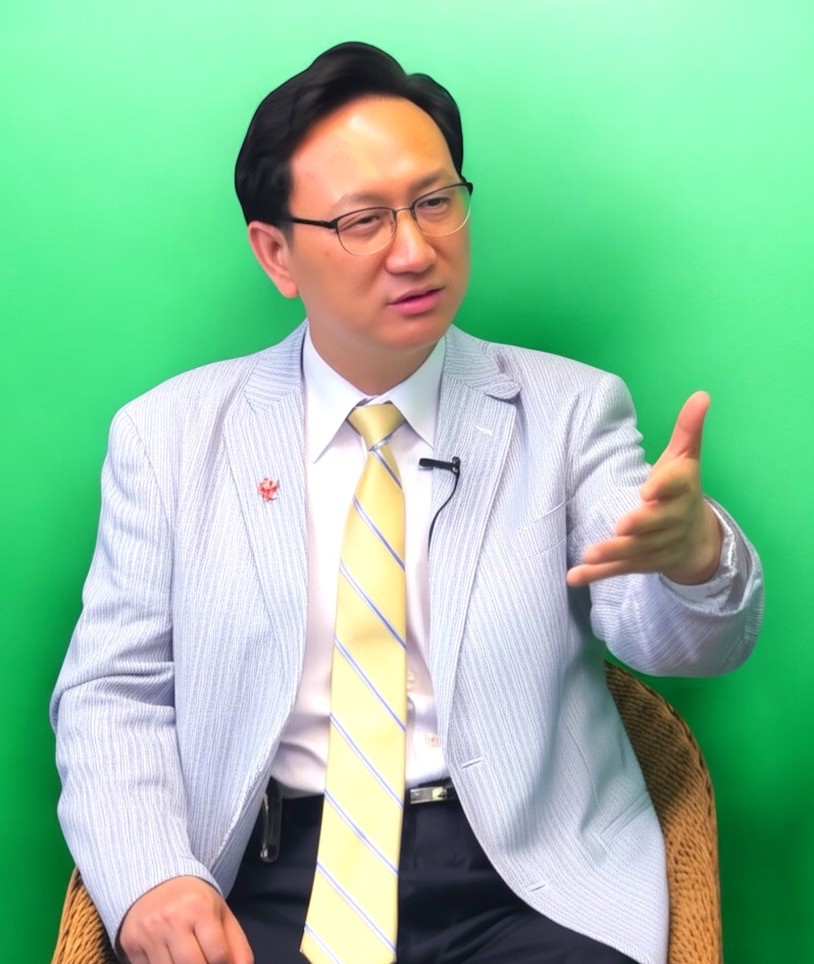
Dr. Tung Chen-Yuan is currently Taiwan’s Representative to Singapore. He was Minister of the Overseas Community Affairs Council of the Republic of China (Taiwan) from June 2020 till January 2023. He was Taiwan’s ambassador to Thailand from July 2017 until May 2020, senior advisor at the National Security Council from October 2016 until July 2017, and Spokesman of the Executive Yuan from May to September 2016. Before taking office, Dr. Tung was a distinguished professor at the Graduate Institute of Development Studies, National Chengchi University (Taiwan). He received his Ph.D. degree in international affairs from the School of Advanced International Studies (SAIS), Johns Hopkins University. From September 2006 to May 2008, he was vice chairman of the Mainland Affairs Council, Executive Yuan. His areas of expertise include international political economy, China’s economic development, and prediction markets.