
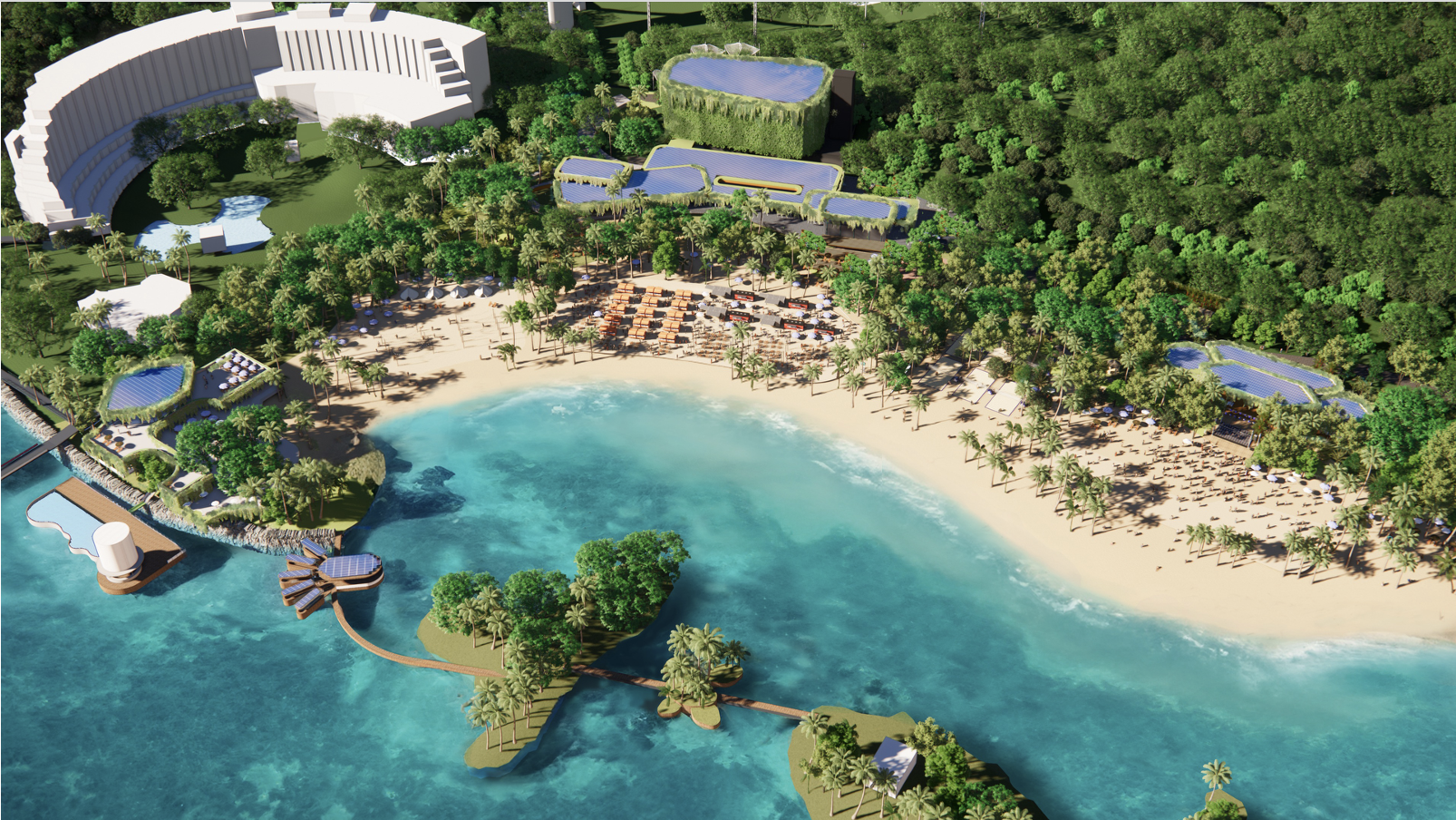
By Chen-Yuan Tung, Ph.D., Representative of Taiwan to Singapore. Images are artist renditions of the Greater Sentosa plan.
What determines a country’s tourism competitiveness? Is it breathtaking natural scenery, or the ability to continuously create new experiences? Singapore may offer an interesting case study.
Despite covering only about 736 square kilometers and lacking majestic mountains, great rivers, or spectacular natural wonders, the city-state welcomed 19.11 million international visitors in 2019, generating S$ 27.7 billion in tourism receipts. By 2025, international arrivals had recovered to 16.91 million, while tourism receipts reached a record S$32.8 billion, surpassing pre-pandemic levels.
This achievement is undoubtedly supported by Singapore’s position as an international aviation hub and its dynamic regional economy. Equally important, however, has been its sustained investment in major tourism infrastructure. Over the past six decades, landmark developments—from Orchard Road, Changi Airport, Marina Bay Sands, and Sentosa to Gardens by the Bay and Jewel Changi Airport—have successively reshaped Singapore’s global tourism identity.
Singapore has now unveiled its next major twenty-year initiative: the Greater Sentosa Master Plan.
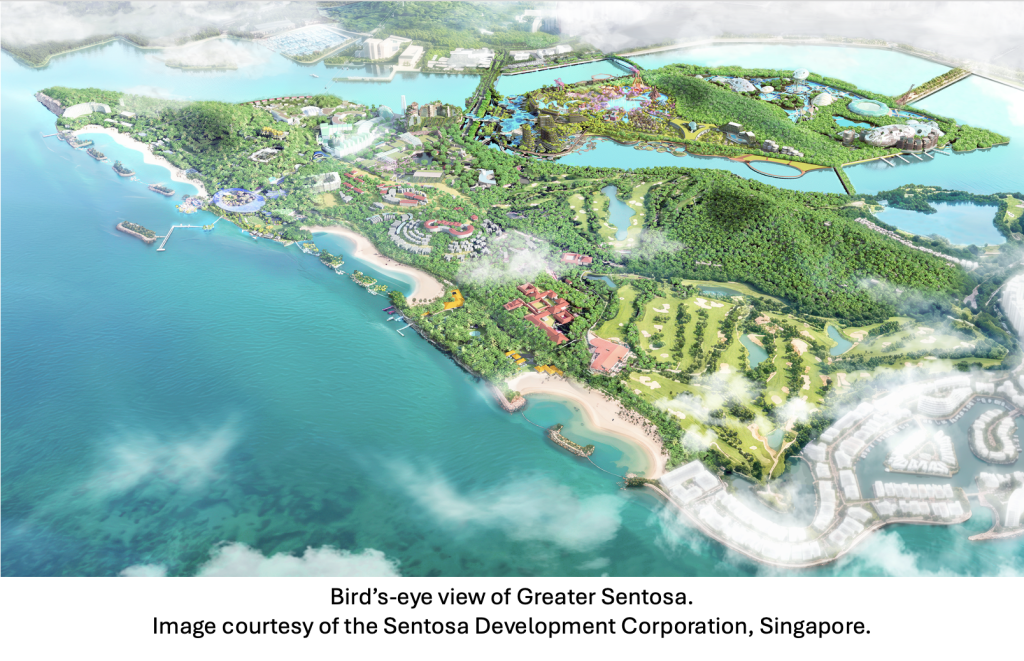
Rather than simply adding another theme park or constructing another iconic skyscraper, the plan seeks to comprehensively transform Singapore’s southern coastline over the next two decades, evolving Sentosa from a leisure island into a world-class island destination that integrates tourism, recreation, ecology, culture, and everyday living.
The Singapore Government has officially released the Greater Sentosa Master Plan, confirming that the project will be implemented in phases over the next twenty years. The first phase is expected to be completed in the early 2030s, with the entire development scheduled for completion around 2045. Under the plan, Sentosa will be integrated with the 120-hectare Brani Island, expanding the overall development area from approximately 500 hectares to 620 hectares.
Annual visitor numbers are projected to increase from the current 16 million to more than 32 million, effectively doubling total visitation. At the same time, the proportion of local visitors is expected to rise from around 20% to 30%, positioning Greater Sentosa not only as an international tourist destination but also as an important public space for recreation, sports, arts, culture, and family activities for Singapore residents.
The Singapore Government has not yet announced the total investment for the Greater Sentosa Master Plan. Given its nearly twenty-year implementation timeline and its combination of public infrastructure investment and private-sector participation—including transportation systems, coastal protection, public spaces, tourism facilities, hotels, commercial developments, and entertainment attractions—the total investment is widely expected to reach several billion or even tens of billions of Singapore dollars.
One major component of the initiative is the expansion of Resorts World Sentosa (RWS), whose investment has increased to S$ 6.8 billion. The expansion includes a new waterfront lifestyle district, two new hotels, the Singapore Oceanarium, an elevated nature trail, and a range of new entertainment attractions, demonstrating that private-sector investment is evolving alongside the broader development vision.
What makes the project particularly noteworthy, however, is not merely its scale of investment, but the planning philosophy it represents.
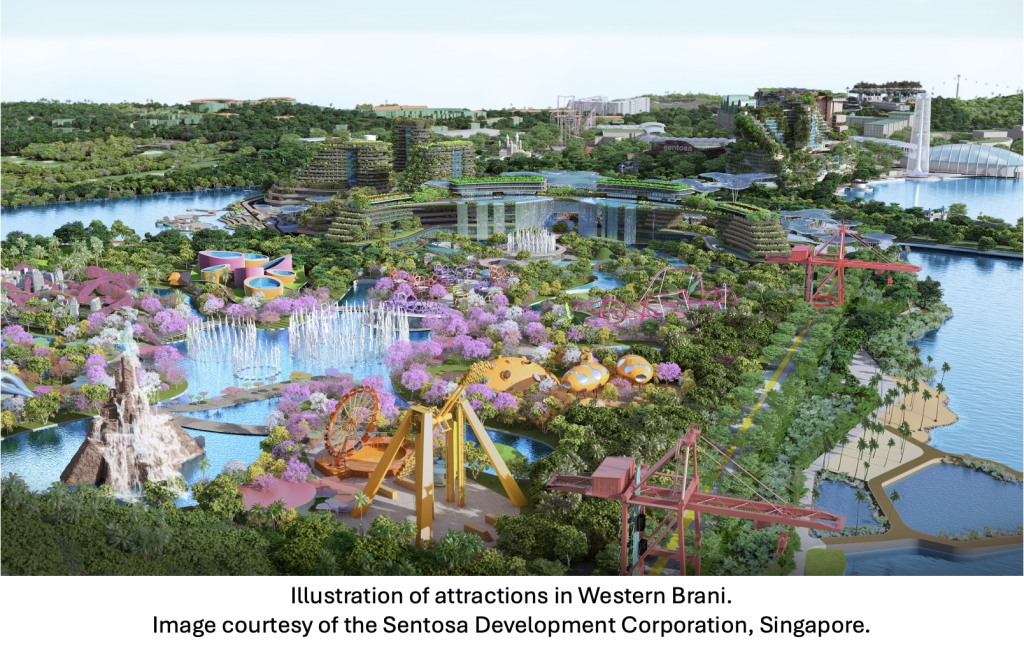
Over the past two decades, Sentosa’s appeal has largely revolved around Universal Studios Singapore, Resorts World Sentosa, the aquarium, and its three beaches—a traditional attraction-based tourism model. Greater Sentosa aims to move beyond this approach by transforming the island into an integrated destination combining nature, ecology, culture, hospitality, dining, entertainment, and lifestyle amenities. The objective is not simply to encourage day trips, but to attract longer stays while increasing the frequency of visits by local residents.
One of the plan’s defining features is the repositioning of Brani Island and Sentosa as complementary twin destinations.
Brani Island will accommodate world-class entertainment facilities, immersive attractions, new hotels, and distinctive dining experiences, while Sentosa will retain its forests, beaches, and natural landscapes to create a more relaxed and tranquil resort environment. Together, the two islands are intended to complement one another, serving diverse visitor preferences while encouraging longer stays.
Another distinctive feature is the integration of forests into the visitor experience.
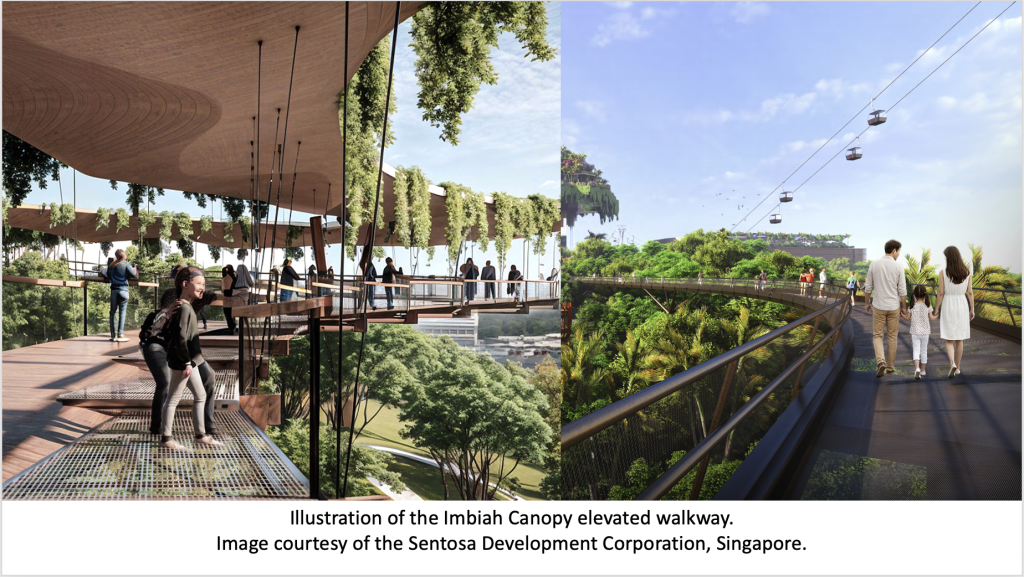
At the highest point of Sentosa, the Imbiah Canopy will become a new landmark, combining viewing decks, restaurants, retail outlets, and event spaces overlooking Brani Island, Sentosa, and Singapore’s southern waterfront. More importantly, it will be connected by an elevated canopy walkway linking forests and beaches, allowing visitors to stroll through the treetops from the hilltop down to Siloso Beach. The entire route will be sheltered, providing a comfortable walking experience even under Singapore’s tropical sun or during frequent rain showers.
Beyond the canopy walk, the plan also features treetop dining, sunrise- and sunset-themed beach clubs, and a fully sheltered Imbiah Ridge trail connecting the completed Sensoryscape to the summit, transforming the forest itself into an integral part of the visitor experience rather than merely serving as a scenic backdrop.
The coastline has likewise been reimagined.
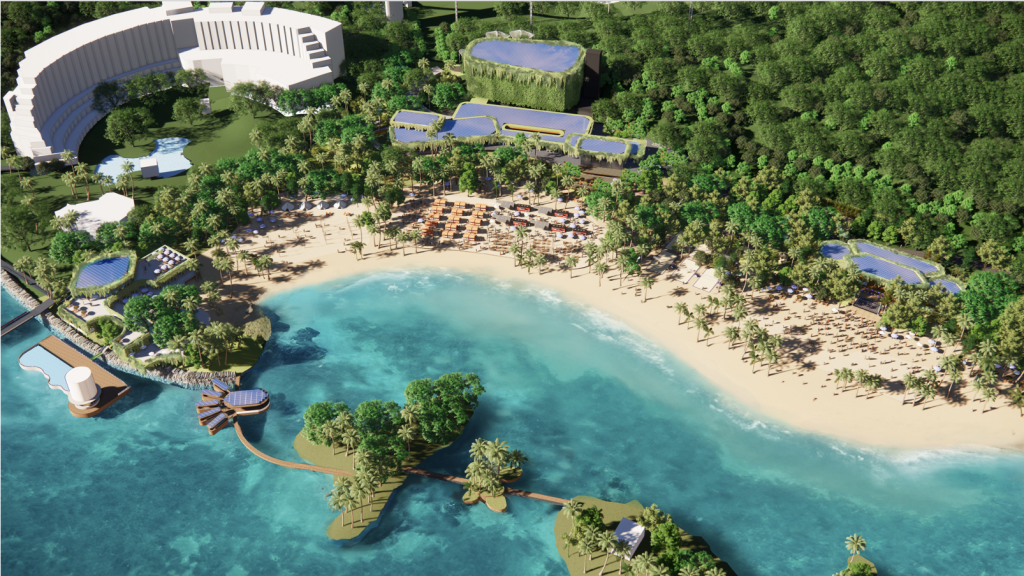
Off the shores of Siloso, Palawan, and Tanjong beaches, six new offshore islets will be created and linked by approximately three kilometers of floating boardwalks, introducing an “island-hopping” experience within Singapore itself. Visitors will be able to walk or travel by boat between the islets while enjoying close encounters with marine and coastal ecosystems just minutes from the city center.
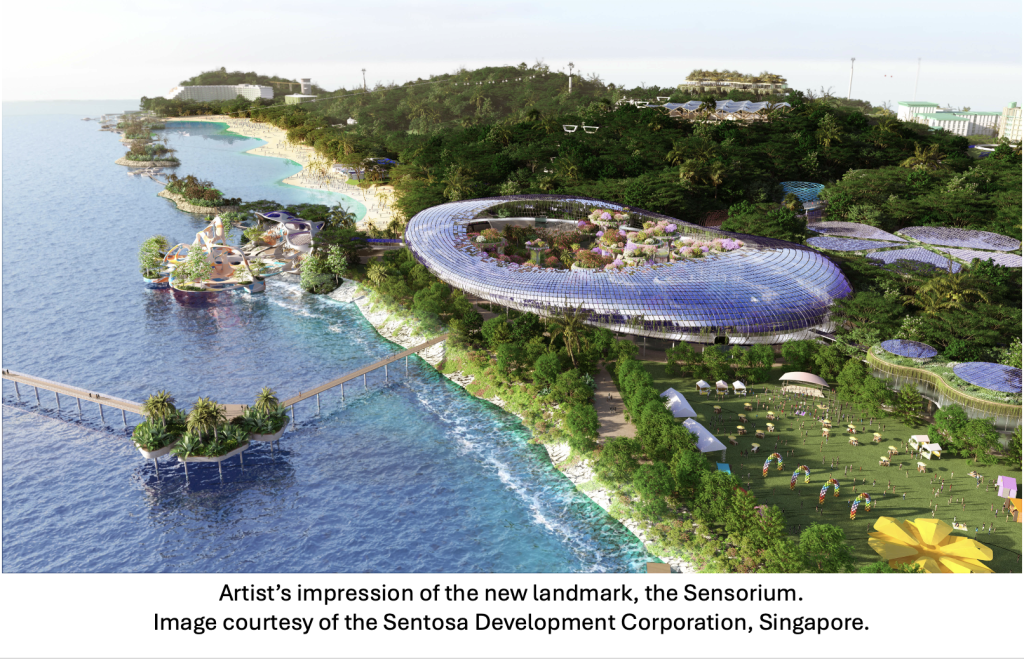
Another future landmark, the Sensorium, will combine lifestyle offerings, indoor attractions, multi-purpose performance venues, and large-scale event spaces, transforming the beaches into vibrant all-day destinations rather than simply places for swimming.
Transportation planning also forms an integral part of the overall vision.
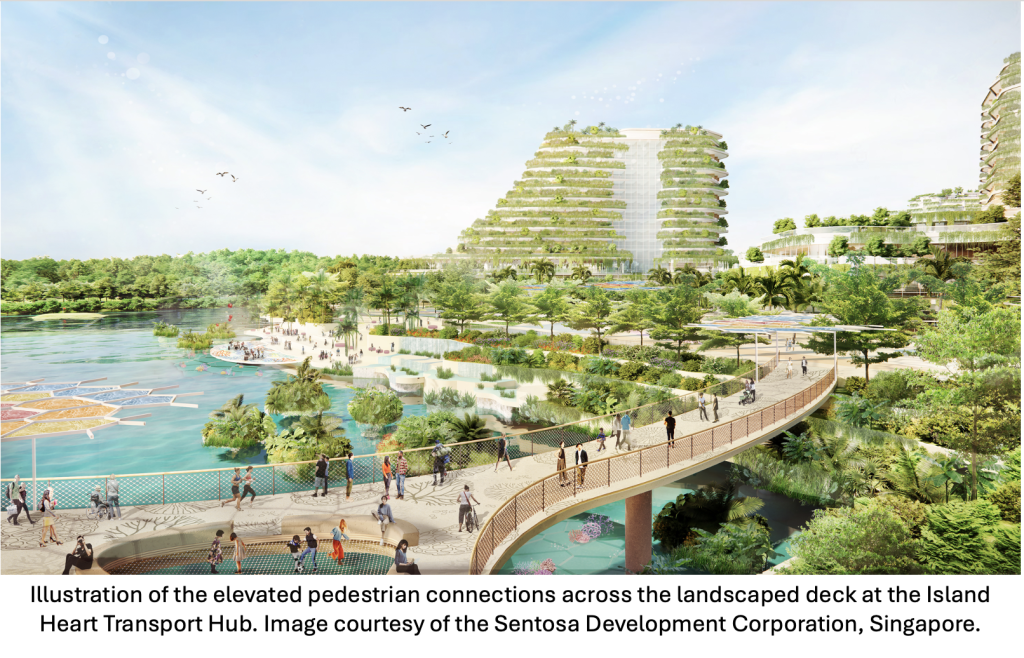
A new transportation hub known as the Island Heart will be developed between Sentosa and Brani Island, integrating the Sentosa Express, public buses, cable cars, water taxis, and pedestrian networks. Travelling by cable car across the bay, taking a water taxi, or walking through forest trails will become part of the visitor experience, rather than merely a means of reaching attractions.
Beyond tourism, sustainability has also been embedded throughout the master plan.
The forests of Brani, Serapong, and Imbiah will be connected into a continuous green ecological network extending to Singapore’s Southern Ridges. New developments will incorporate native vegetation, ecological corridors, low-carbon buildings, shaded public spaces, and coastal protection measures, while addressing climate change, sea-level rise, and biodiversity conservation. The objective is to achieve a balance between development and environmental stewardship.
Looking back over Singapore’s development during the past six decades, one can observe that each major project has represented more than simply the addition of another tourist attraction. Changi Airport, Marina Bay Sands, Gardens by the Bay, Jewel Changi Airport, and now Greater Sentosa have each contributed to redefining the city’s competitive position in different eras.
In the years ahead, Greater Sentosa is expected to become another world-class island destination. Through this twenty-year investment, Singapore seeks once again to demonstrate that a city’s long-term competitiveness depends not only on the natural resources it possesses, but also on its capacity for long-term planning and continuous innovation.
About the Author:
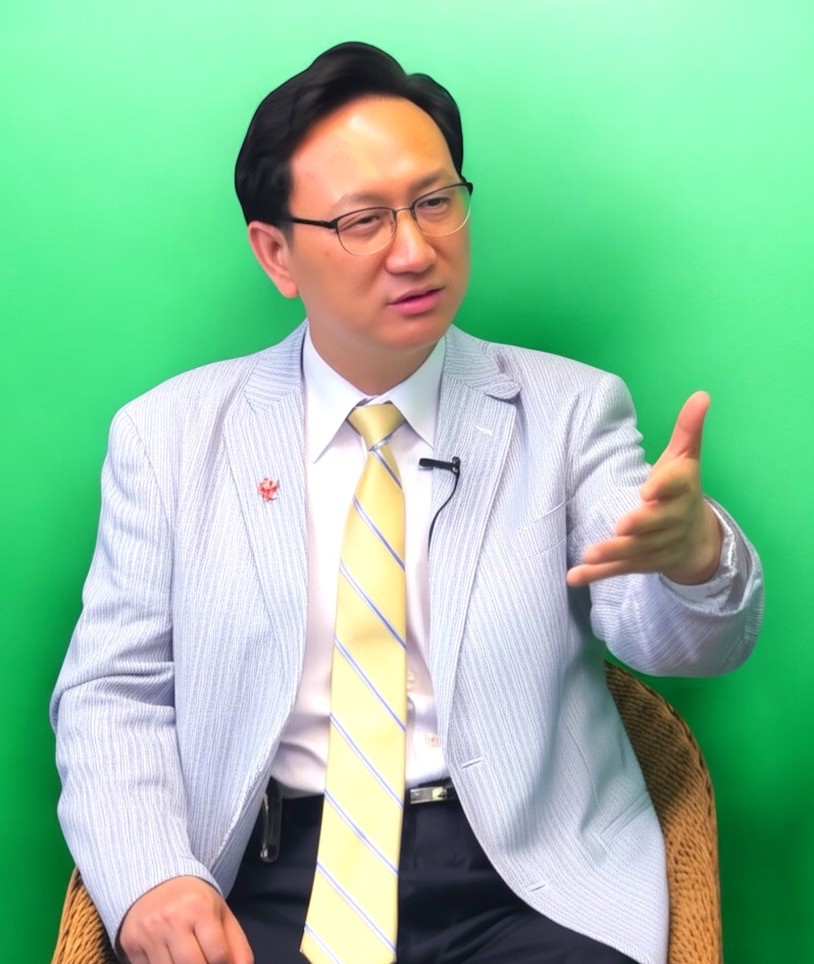
Dr. Tung Chen-Yuan is currently Taiwan’s Representative to Singapore. He was Minister of the Overseas Community Affairs Council of the Republic of China (Taiwan) from June 2020 till January 2023. He was Taiwan’s ambassador to Thailand from July 2017 until May 2020, senior advisor at the National Security Council from October 2016 until July 2017, and Spokesman of the Executive Yuan from May to September 2016. Before taking office, Dr. Tung was a distinguished professor at the Graduate Institute of Development Studies, National Chengchi University (Taiwan). He received his Ph.D. degree in international affairs from the School of Advanced International Studies (SAIS), Johns Hopkins University. From September 2006 to May 2008, he was vice chairman of the Mainland Affairs Council, Executive Yuan. His areas of expertise include international political economy, China’s economic development, and prediction markets.