
TUNG Chen-Yuan, PhD, Taiwan’s Representative to Singapore
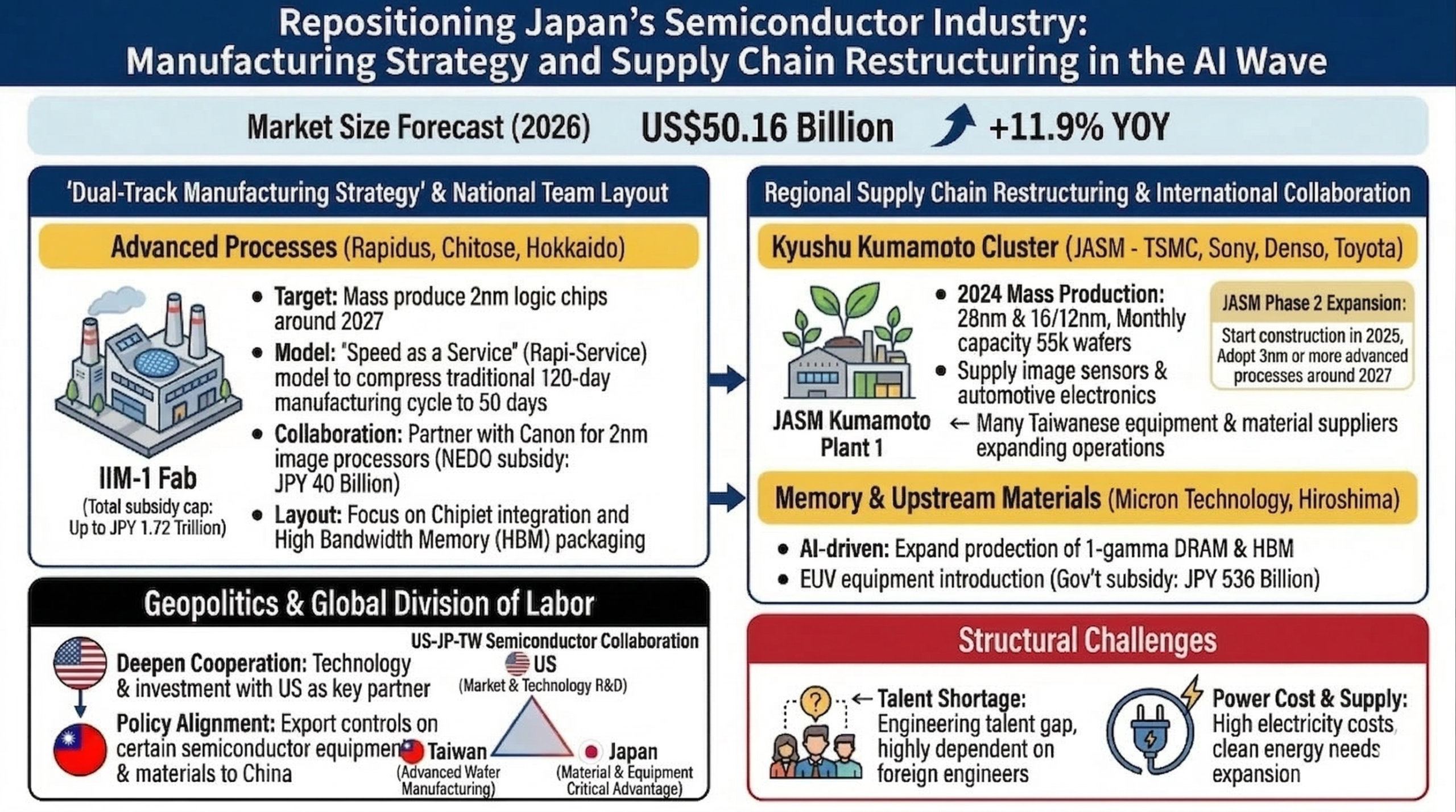
According to projections by the World Semiconductor Trade Statistics (WSTS), Japan’s semiconductor market is expected to reach approximately US$ 50.16 billion in 2026, representing an annual growth rate of 11.9%. This expansion not only reflects spillover effects from surging AI demand, but also indicates that Japan’s recent policies promoting domestic manufacturing and supply chain reconstruction are beginning to bear fruit.
Overall, Japan’s semiconductor policy has shifted from short-term subsidies during the pandemic toward a more institutionalized, long-term strategic support framework. This transition has gradually given rise to a “dual-track manufacturing strategy,” in which advanced logic processes and mature-node technologies develop in parallel, forming the institutional foundation for industrial repositioning.
In the advanced process segment, the progress of Japan’s national champion Rapidus has become a key indicator of its strategic transformation. Its “IIM-1” fab in Chitose, Hokkaido, has entered the pilot production and validation stage, with a target of achieving mass production at the 2-nanometer node around 2027. Facing the disadvantages of being a latecomer, Rapidus has introduced a “Rapi-Service” model—“speed as a service”—which compresses the traditional manufacturing cycle from around 120 days to 50 days. This approach enhances design iteration and pilot validation efficiency, enabling the company to enter the high-end customized and rapid development market while establishing differentiated competitive advantages.
To strengthen the ecosystem required for advanced manufacturing, Japan is also promoting cross-industry collaboration. In March 2026, imaging equipment giant Canon announced a partnership with Rapidus to jointly develop 2-nanometer image processing chips, supported by a subsidy of approximately JPY 40 billion from the New Energy and Industrial Technology Development Organization (NEDO).
Meanwhile, Rapidus is actively building backend R&D capabilities, focusing on chiplet integration and high-bandwidth memory (HBM) packaging technologies to support the growing computational demands of AI chips. To sustain such high-risk, capital-intensive initiatives, the Japanese government has raised the cumulative subsidy ceiling for Rapidus to JPY 1.72 trillion, demonstrating a clear policy commitment to advancing cutting-edge manufacturing through national resources.
Complementing the advanced manufacturing layout in Hokkaido, Kumamoto in Kyushu is rapidly emerging as a multinational semiconductor manufacturing cluster, becoming a key node in Japan’s supply chain restructuring. Japan Advanced Semiconductor Manufacturing (JASM), jointly established by TSMC, Sony, Denso, and Toyota, has become one of the most emblematic investments in Japan’s semiconductor revitalization strategy. Since entering mass production in 2024, JASM’s first Kumamoto fab has adopted 28nm and 16/12nm processes, with a monthly capacity of approximately 55,000 wafers, primarily supplying chips for image sensors and automotive applications.
Driven by Japanese government subsidies, JASM’s second-phase expansion began construction in 2025 and is expected to introduce more advanced processes, including 3nm, around 2027. This development not only strengthens Japan’s supply resilience in automotive semiconductors and image sensors, but also signals that Taiwan–Japan cooperation is extending from mature nodes to more advanced technology levels.
With TSMC’s presence in Kumamoto, a large number of Taiwanese equipment, materials, and component suppliers have followed suit, gradually forming a TSMC-centered supply chain cluster. This has positioned Kyushu as a key manufacturing hub linking Taiwan, Japan, and global markets, further advancing regional supply chain integration.
In the memory and upstream materials sectors, Japan continues to consolidate its existing strengths. Benefiting from AI-driven demand, the memory cycle is rebounding, and Micron Technology is actively expanding capacity at its Hiroshima plant. Supported by approximately JPY 536 billion in government subsidies, Micron is introducing extreme ultraviolet (EUV) lithography to produce 1-gamma generation DRAM, while simultaneously expanding HBM capacity to meet the rapid growth in AI data center demand.
From a geopolitical perspective, Japan’s role has also been elevated alongside supply chain restructuring. Since 2025, Japan has leveraged its strengths in materials and equipment to deepen technological and investment cooperation with the United States, becoming a key partner within the supply chain framework shaped by the U.S. CHIPS and Science Act. At the same time, Japan has aligned with U.S. technology security policies by strengthening export controls on certain semiconductor equipment and advanced materials destined for China.
Within this framework, semiconductor cooperation among the United States, Japan, and Taiwan continues to deepen. The United States leads in markets and technological R&D, Taiwan dominates advanced wafer manufacturing, and Japan holds critical advantages in materials and equipment. This complementary structure is gradually reinforcing their division of labor and collaboration within the global semiconductor supply chain.
However, beneath the favorable outlook of capacity expansion and policy support, Japan’s semiconductor industry still faces structural challenges—most notably, a shortage of talent. After more than two decades of industry contraction, Japan is experiencing a significant generational gap in semiconductor engineering talent, leading some newly built fabs to rely heavily on foreign engineers and international collaboration.
In addition, semiconductor manufacturing is highly energy-intensive. Japan’s relatively high electricity costs and still-limited renewable energy supply continue to put pressure on long-term operational costs.
📥 《Taiwan at the Core: Strategic Partner in Global Semiconductor Landscape and Realignment》Simplified E-Book Edition (Edited by the Taipei Representative Office in Singapore, available for free download):
https://maintain.taiwanembassy.org/sg_en/wp-content/uploads/sites/86/2026/01/29012026_Final5.pdf
📚 《Taiwan at the Core: Strategic Partner in Global Semiconductor Landscape and Realignment》Order the Print Edition from the Publisher:
https://www.vw-education.com/order/
About the Author:
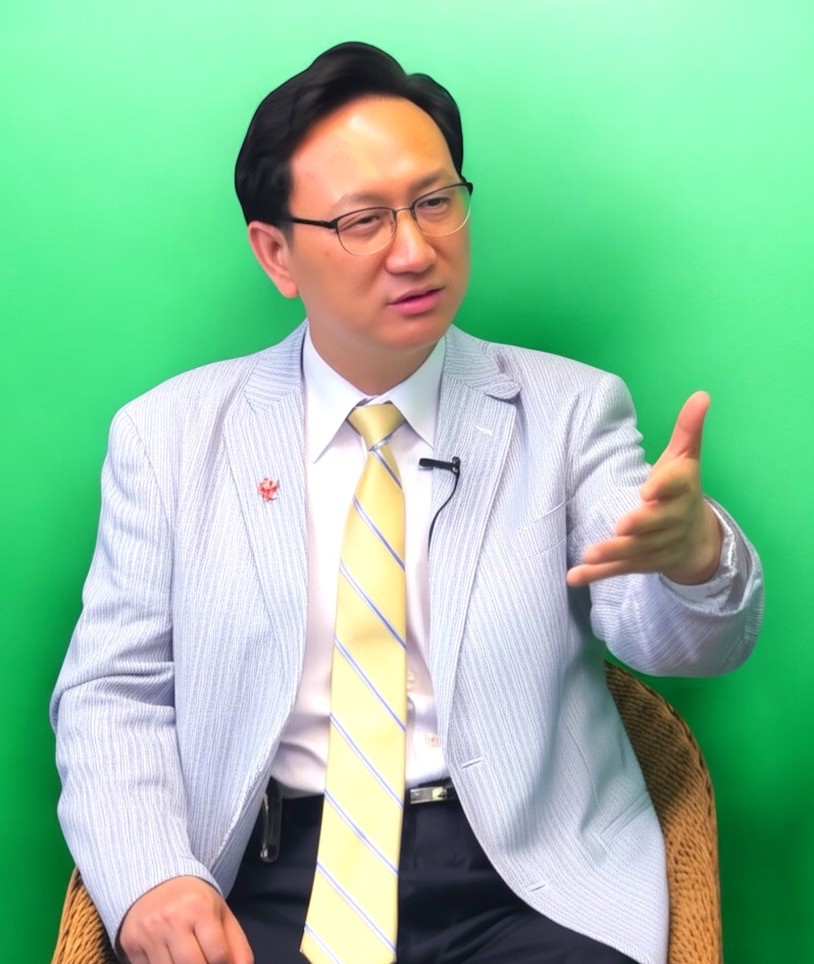
Dr. Tung Chen-Yuan is currently Taiwan’s Representative to Singapore. He was Minister of the Overseas Community Affairs Council of the Republic of China (Taiwan) from June 2020 till January 2023. He was Taiwan’s ambassador to Thailand from July 2017 until May 2020, senior advisor at the National Security Council from October 2016 until July 2017, and Spokesman of the Executive Yuan from May to September 2016. Before taking office, Dr. Tung was a distinguished professor at the Graduate Institute of Development Studies, National Chengchi University (Taiwan). He received his Ph.D. degree in international affairs from the School of Advanced International Studies (SAIS), Johns Hopkins University. From September 2006 to May 2008, he was vice chairman of the Mainland Affairs Council, Executive Yuan. His areas of expertise include international political economy, China’s economic development, and prediction markets.