
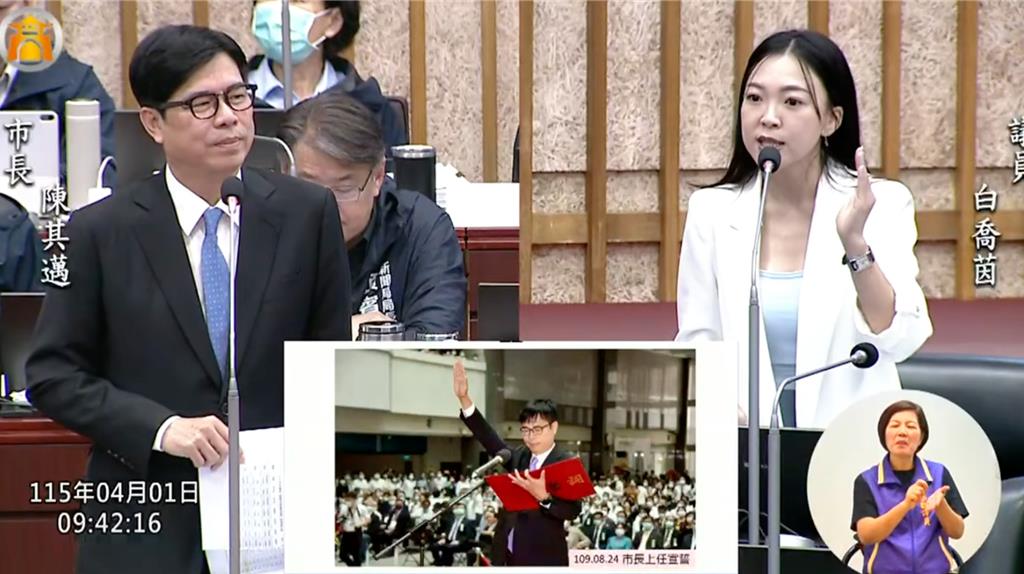
By KHT Staff. Image via China Times.
KAOHSIUNG — KMT Kaohsiung City Councilor Bai Chiao-yin (白喬茵) on Wednesday questioned the city government’s economic performance, saying key indicators do not match the strong approval ratings of Mayor Chen Chi-mai (陳其邁).
Speaking during a council session, Bai argued that headline figures, including a reported 30% increase in business sales over five years, lack context. She said Kaohsiung’s growth ranked last among Taiwan’s six special municipalities and pointed to a 2.74% decline in manufacturing, the only negative result among the six.
Bai also cited tax data showing corporate tax growth ranked fifth and personal income tax last, suggesting weaker business performance and household income. She added that Kaohsiung recorded a net population outflow of 268 people and the lowest wage growth among the six cities over the past four years.
On tourism, Bai said large events have not translated into stronger revenue, with restaurant sales ranking fifth and accommodation revenue declining.
In response, Chen said Kaohsiung’s industrial base has faced external pressures, including U.S. tariffs and global oversupply in steel, which have affected the city’s petrochemical and steel sectors. He said these were global factors and stressed that industrial transformation remains critical.
“If we do not pursue industrial transformation, Kaohsiung will face a dead end,” Chen said.
He added that, excluding traditional industries such as steel and petrochemicals, manufacturing output has grown, with electronic components increasing by 65%.
On wages, Chen said median income levels in Kaohsiung have ranked in the upper range among the six cities in recent years. Bai disputed that claim, saying the latest data placed the city fourth.
Chen said Kaohsiung is working to strengthen its industrial base by attracting semiconductor and supply chain investment, to boost employment and wages through high-tech development.
Bai said she supports industrial transformation but emphasized that results should be reflected in measurable improvements, adding that residents should see tangible outcomes rather than projections.