
By M. Syaprin Zahidi (University of Muhammadiyah Malang, Indonesia)
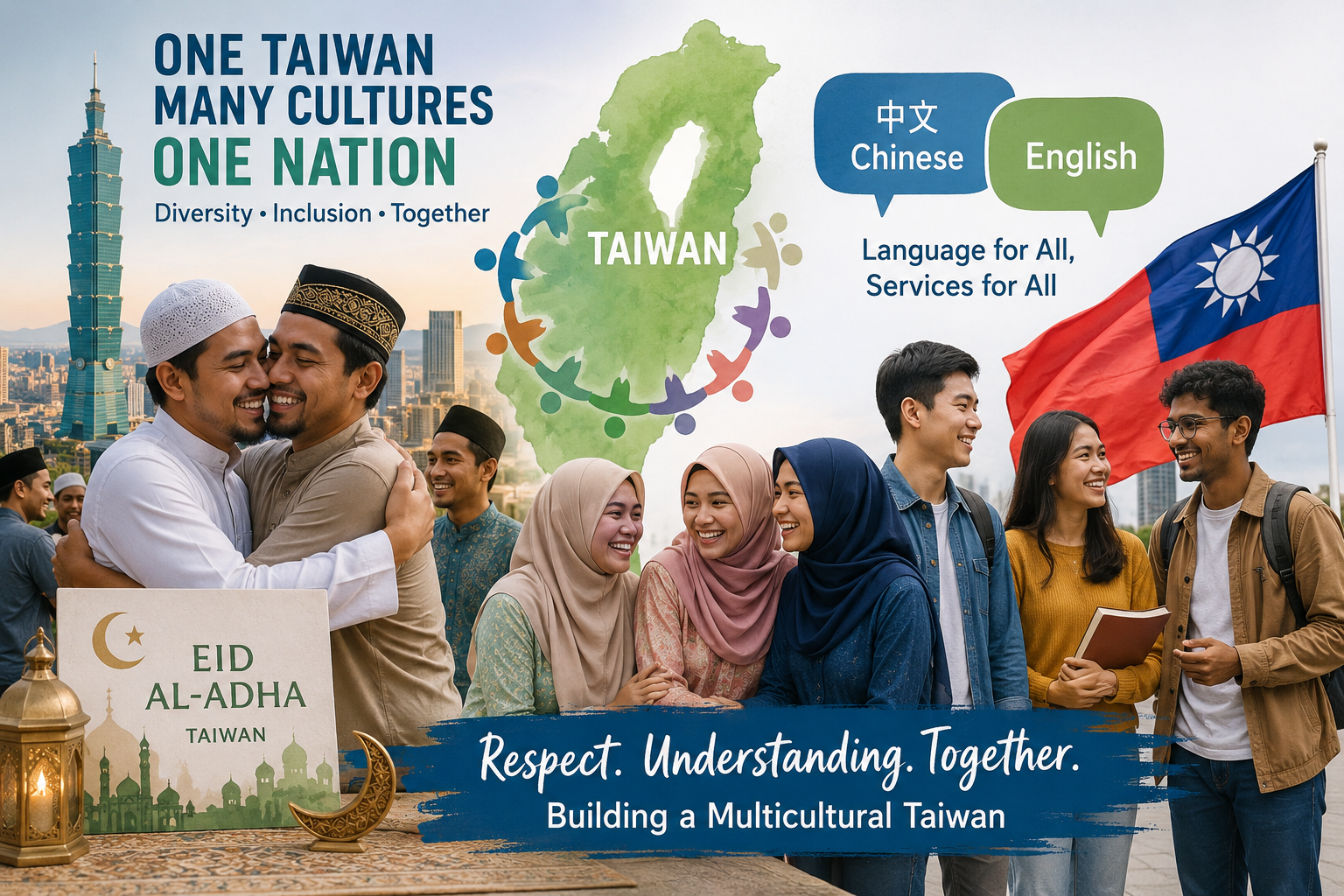
The concurrent and solemn observance of Eid al-Adha by the Muslim community in Taiwan this year further underscores the nation’s evolving multicultural identity, which has been cultivated over many years. The Eid al-Adha celebration, mostly observed by migrant workers and students from Southeast Asia (Indonesia, Malaysia) and various other Muslim-majority nations, establishes Taiwan as a notably hospitable environment for adherents of Islam.
In an article entitled “Ethnographic Encounters with Muslims in Taiwan: Exploration of their Religious Scenes and Experiences,” author Satoshi Abe notes that, to advance multiculturalism in Taiwan, the Taiwanese government has enacted significant policies, including the authorization of Muslim places of worship and the incorporation of Muslim culture into elementary school curricula, intending to cultivate tolerance among local inhabitants and immigrants in Taiwan.
If we refer to the concept of multiculturalism in Taiwan, as articulated by Adina Simona Zemanek and Lara Momesso in their article “Multiculturalism through a Lens: Migrants’ Voice in Taiwanese Documentaries,” it is inextricably linked to the public discourse of 1997, which aimed to identify the most suitable framework for defining Taiwan’s national identity.
At the time, cohesion was understood as something to be built among Taiwan’s four principal ethnic groups: Indigenous peoples, Taiwanese, meaning mostly Han Chinese whose ancestors arrived from Fujian centuries ago; Hakka, another long-established Han Chinese community in Taiwan; and the descendants of those who arrived more recently from China, often referred to as “Mainlanders,” many of whom came in the late 1940s. This framework was later expanded to include a fifth group: migrants, particularly those who married Taiwanese citizens and later acquired citizenship.
The cohesion among the five categories has fundamentally underpinned Taiwan’s societal growth to the present day. I believe this has been an essential asset for Taiwan’s ongoing survival as a nation, and it is intricately connected to its New Southbound Policy (NSP) and its “putting people first” objective.
This “putting people first” tagline has ultimately served as a “crucial bridge” for Taiwan’s public diplomacy with other countries and has also become an important source of soft power for Taiwan in positioning itself as a nation that emphasizes a multicultural and democratic society.
I concur with those who ask whether, in the pursuit of establishing Taiwan as a multicultural society, the continued use of Chinese as the exclusive official national language remains a judicious decision. Could designating English as a second official language in Taiwan help ensure — for example — that all public services are available in both languages?
There will undoubtedly be plenty of debate among the Taiwanese public on this issue, but such discourse will likely be more helpful than harmful, helping to carve out a middle ground that further solidifies the idea of a single Taiwanese nation composed of diverse groups, so that multiculturalism can truly flourish in Taiwan. Many agree that Singapore serves as an excellent example of success for Taiwan, as it has successfully accommodated its racial diversity, comprising a Chinese majority, followed by Malay and Indian communities.
Singapore, like Taiwan, has a Han Chinese majority. Therefore, if the Taiwanese government intends to further solidify the idea of a single nation, promoting and protecting racial diversity would be a breakthrough, one that Taiwan can confidently point to as a marker of its being an independent nation — one that is seen as distinct and separate from China.
Note: The opinions of the author are their own.