
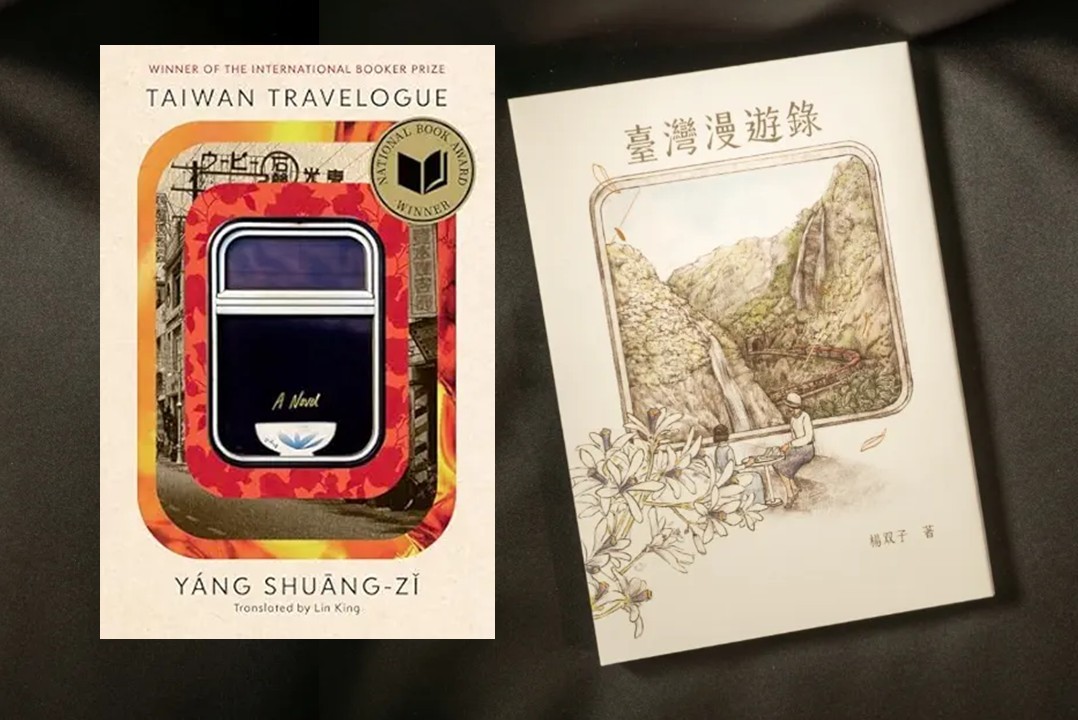
By Wang Zheng. Cover features Taiwan Travelogue in both its original Chinese and the award-winning English translation.
The day the Booker Prize was announced, a friend from Taiwan called me excitedly: We’ve finally been seen by the world. And I, in transit at Changi Airport, offered my congratulations while a complicated feeling stirred within me.
If Taiwan Travelogue is a novel, it is also at the same time a system: a system for how to make a place enter world literature. The reason Yang Shuangzi’s work set off a chain reaction in the English-speaking world is not simply because it writes about colonial-era Taiwan, but because it structurally presupposes a “translated mode of existence” from the very outset. At least “on the surface,” it appears to be a Japanese-language travelogue from 1930s Japanese-occupied Taiwan, later “translated” back into Chinese for publication, so that the text itself, from its starting point, refuses the originality of any single language.
In the English edition, the work was translated into Taiwan Travelogue by Taiwanese-American translator Lin King. Lin King mentioned in an interview that after prolonged exposure to Taiwanese literature, she gradually came to realize she wanted to devote more energy to translating Taiwanese Mandarin literature into English rather than other sources. This is not merely a linguistic choice, but a cultural one: when the world understands Chinese-language writing through the literature of the northern mainland, Taiwanese literature offers an alternative historical path and perceptual structure. This point is crucial: she is not simply a language converter, but a kind of “co-author” in a certain sense. Because the novel itself already simulates a translational structure, the translator’s job is no longer just turning Chinese into English, but rather reconstructing, within the English-speaking world, a “historicity that has already been translated.”
Consequently, when the novel enters the literary circulation system of the English-speaking world, it ceases to be merely a “translated work” and becomes instead a textual apparatus that continuously moves between different language markets. Translation here is not an additional layer, but the work’s operational principle.
The story of Taiwan Travelogue is actually not complicated. The novel disguises itself as a Japanese-language travelogue published in 1938: Japanese writer Aoyama Chizuko arrives in colonial Taiwan and, accompanied by interpreter Wang Chizuko, embarks on a round-the-island journey along the railway. They ride trains through Keelung, Taipei, Taichung, Tainan, and Kaohsiung, moving between hotels, eateries, markets, and shrines, sampling local cuisine while recording what they see along the way. On the surface, it appears to be a work about food and travel; but as the story progresses, readers gradually realize that what is truly being written is not the scenery, but the people viewing the scenery. Aoyama Chizuko, as a traveler from the colonizing motherland, sees a Taiwan that has been incorporated into the imperial order; while Wang Chizuko, as a colonial woman and interpreter, lives simultaneously between two languages, two cultures, and two power systems. She is both bridge and boundary; she enables mutual understanding, while also constantly reminding us of the impossibility of understanding.
The most unforgettable parts of the novel are not the meticulously researched historical details, but the food. Each dish is like a miniature archive, preserving the complex cultural encounters of the colonial era. Taiwanese cuisine, Japanese dishes, local snacks, and modernized dining appear repeatedly throughout the book, forming an alternative historical map. For Yang Shuangzi, taste is never just taste, but a technology of memory. Food can both bring people closer and expose differences in identity and power; just as translation can create understanding while also revealing misunderstanding. The ambiguous emotional relationship between Aoyama Chizuko and Wang Chizuko gradually emerges in these moments of shared meals and shared journeys. Yet the novel ultimately does not provide a romantic answer about crossing boundaries. On the contrary, it constantly reminds us that between colonizer and colonized, between Japanese and Taiwanese languages, between traveler and local, there always remains a certain surplus that cannot be fully translated.
It is precisely for this reason that, as a Singaporean reader, I find it difficult to read Taiwan Travelogue simply as a Taiwanese novel. The issues it addresses belong less to Taiwan alone than to all societies that have experienced colonial modernity. Singapore, too, is a country shaped by language. We receive English-language education from childhood, using English to access global markets and national institutions; but at the same time, Chinese, Malay, and Tamil carry different ethnic groups’ imaginations of history and culture. English is the language of governance and of upward mobility; Chinese is often regarded as the language of cultural inheritance, but not necessarily the language of power. To some extent, Singapore’s entire modern history is built upon this linguistic division of labor.
This contradiction is especially evident in the Speak Mandarin Campaign launched after 1979. The government hoped to replace dialects by promoting standard Mandarin in order to build a more efficient Chinese community; yet on another level, English gradually became the core language of national governance and global competition. As a result, Singaporean Chinese-language literature has long occupied a delicate position: it is neither at the center of the mainstream education system, nor can it easily enter the English-dominated public cultural space. The problems faced by many Chinese-language writers are, in essence, no different from Wang Chizuko’s—they too live within translation, constantly negotiating their linguistic positions. They know multiple languages, yet may not be able to fully settle into any one of them.
But to understand the novel only in terms of “how Taiwan is seen by the world” is still incomplete. Because for us, reading this book as Singaporeans, it is first and foremost not about Taiwan, but about a more universal postcolonial predicament: how do we speak ourselves in a world that has already been translated?
Within the novel, translation is never a neutral linguistic conversion, but a power structure. The interpreter Wang Chizuko shuttles between Japanese, Taiwanese, and Mandarin; she both makes the colonizer’s language comprehensible and recodes the colonized’s world. She does not stand between two languages, but is forced to become an interface between two powers. This position means: understanding never equals equal understanding, and communication is always accompanied by irreversible displacement.
The most moving part of the novel is not actually history itself, but how this displacement seeps into everyday life: hotels, railways, cities, food, even ambiguous same-sex relationships. Colonialism is not just an abstract macro-political structure, but a rewriting of subtle modes of perception. Who gets to see, who gets to name, whose language gets written into menus and maps—these details constitute the true technology of colonialism.
And it is precisely at this point that an unexpected overlap appears between Taiwan Travelogue and Singapore. Singapore’s colonial experience is not linear, but layered. British colonialism left behind institutional continuities: law, administration, and educational language were almost completely embedded into the modern state structure; the Japanese wartime occupation (the Syonan period) lingers in collective memory in the form of trauma.
One historical detail that continues to spark discussion is the renaming of Singapore during the Japanese occupation to “Syonan” (Shōnan, “Light of the South”). This naming itself has long been regarded after the war as part of colonial violence, yet it still appears in some public discussions and cultural exhibitions in the form of historical representation, repeatedly triggering controversy—for example, debates over whether “Syonan” is appropriate for use in art exhibitions and public commemorative contexts have provoked significant backlash in Singapore’s domestic discourse. This controversy itself illustrates that colonialism is not past tense, but a language politics that continues to be redefined.
Singapore, therefore, is not entering a clear “postcolonial” phase, but rather persists in a stratified temporality: institutional colonialism still operates, and traumatic colonialism remains undigested. But what makes Singapore even more distinctive is that this history is not primarily preserved through texts, but through taste.
Kaya toast, Bak Kut Teh, Chilli Crab—these foods are not cultural symbols, but traces of historical intermingling. The bread and coffee habits of English breakfasts, the cooking techniques of Hokkien and Teochew immigrants, the spice systems of the Malay archipelago, the trade routes of India and the British Empire—together they form a taste map that cannot be named in any single language.
And interestingly, Taiwan Travelogue is essentially doing the same thing. The numerous dishes and local snacks that appear in the novel are not just decorative backdrops for travel literature, but a form of historical archaeology. For Yang Shuangzi, taste is a technology for preserving colonial memory: a single dish may simultaneously contain the influence of the Japanese Empire, the traditions of Southern Fujian immigrants, and local Taiwanese adaptations. The journey of Aoyama Chizuko and Wang Chizuko across Taiwan is, in essence, also a historical ramble conducted through food.
Thus, the real difference between Singapore and Taiwan is not who uses taste to understand history, but where taste ultimately leads in terms of narrative direction. For Singapore, food often becomes proof of a multicultural national narrative; whereas in Taiwan Travelogue, food becomes an extension of translation. Each dish is like a word that cannot be fully translated—sharable, yet retaining a certain irreducible locality.
It is for this reason that an observation discussed in the media and interviews about the novel is especially interesting. Translator Lin King has mentioned that many overseas readers, when reading Taiwanese literature, often notice its complex feelings toward the Japanese colonial period. These feelings are not necessarily simple nostalgia, but closer to a kind of anxiety over historical positioning: how exactly does Taiwan understand the origins of its own modernity? Of course, the stance and veracity of such claims remain contentious in academic and public discourse, but they do repeatedly appear in Taiwanese cultural works.
From Hou Hsiao-hsien’s A City of Sadness, The Puppetmaster, and Good Men, Good Women, to Wei Te-sheng’s Cape No. 7, to Chen Yingzhen’s My Younger Brother Kang Hsiung and other works, we can see a particular historical sensibility: the Japanese colonial experience is both wound and one source of modernity; both a history that requires reflection and an important part of contemporary Taiwanese cultural memory. This ambiguity is precisely what constitutes the most tensile aspect of Taiwanese culture.
And this tension exists in Singapore as well, though in a different direction.
In former Prime Minister Lee Kuan Yew’s memoirs From Third World to First, Singapore’s rapid post-war restoration of economic and diplomatic ties with Japan is described as a pragmatic political choice, and Japan’s post-war economic development is also seen as one model worth learning from. But this rebuilding of relations does not mean trauma has been eliminated; rather, trauma and pragmatism coexist. He recalls in the book his shock upon first encountering Japanese society after the war: the same people who had once administered military rule over Singapore, after Japan’s defeat, quickly revealed a drastically different face—disciplined, polite, hardworking, and highly attentive to public order. This stark contrast compelled him to rethink the complexity of the Japanese national character, and recalls the dual structure described by Ruth Benedict in The Chrysanthemum and the Sword: violence and restraint, militarism and ceremonial culture, often coexisting within the same society.
Compared to Japan, the British colonial legacy is more difficult to clearly position, because it has already been transformed into the very fabric of institutions.
In other words, Singapore is not so much “remembering” colonialism as it is allocating the usability of colonialism.
This brings to mind Homi Bhabha’s concept of the “Third Space” in The Location of Culture. For Bhabha, there is no pure cultural boundary between colonizer and colonized; what truly matters is the hybrid zone produced by their contact. In this space, identity is no longer fixed, but constantly negotiated, translated, and redefined.
However, the question posed by Taiwan Travelogue may go further than Bhabha: does the Third Space actually exist? Or rather, can it become a stable position? The novel’s Wang Chizuko is perpetually in translation, yet never truly possesses a place where she can settle. She is neither colonizer nor colonized; she belongs to the Japanese-language world, yet cannot fully enter it. For Singapore, this question is equally familiar. We have long been described as a meeting point of East and West, a multicultural society, a bridge between Asia and globalization—but is this bridging identity itself also an endless state of translation? If the Third Space means perpetually being between two cultures, then is it a form of freedom, or an unending drift?
It is in precisely this context that Alfian Sa’at’s poem Singapore You Are Not My Country becomes especially sharp.
He writes:
Singapore you are not my country
Singapore you are not a country at all
This is not emotional catharsis, but a syntactic dismantling. The country is transformed in the poem into something generated by media: statistics-starved Singapore, tourist brochure Singapore, newscaster Singapore.
He even writes:
I have lost a country to images, it is as simple as that
This line forms almost an intertext with Taiwan Travelogue: on the one hand, regenerating history through “pseudo-translation”; on the other, losing reality in the overproduction of images and language.
But what is even sharper in Alfian’s poem is how the politics of sexuality and marginalized bodies are constantly pushed into the violent center of national narrative. He writes about the situation of homosexuals, sexual minorities, and suppressed bodies, defined, stigmatized, and disciplined by state language (for example, the depiction of “innocent faggot” in the poem points to a homosexual desire and violent structure under institutional surveillance). Here, the state manages not only language, but also the visibility of bodies. And this line:
Your words are like walls on which truth is graffiti
spatializes language completely: language is not medium, but wall; truth is not expression, but intrusion.
Returning to Singaporean literature itself, this problem of the language wall becomes even more structural. Singaporean literature is not a shared field, but multiple linguistic systems that barely overlap.
Chinese-language literature here has a long tradition—for example, Eng Pei An’s The Studio and Unrest, whose writing always revolves around the individual’s cracks between system and desire; while English-language literature forms another lineage, sharing almost no readership with the Chinese tradition. For instance, Alfian Sa’at and Cherian George, in the English-language verse-play tradition, belong simultaneously to the intersection of literature and public politics, rather than being the result of development within a single language. Yet they do not seem to find perfect settlement in any single linguistic system. This is not a flaw; perhaps it is an opportunity.
In this sense, the importance of Taiwan Travelogue lies not in its enabling Taiwan to “go global,” but in its revelation that world literature itself is a translational mechanism. A work is readable because it allows itself to be misread; it circulates because it has already built linguistic instability into itself.
International literary prizes do not discover works; they reconfigure the translatability of works.
Thus, from a Singaporean perspective, the real revelation of this novel is not how to enter the world, but: are we not already living within the translation of the world?
Finally, back to a more difficult question. If Taiwan reorganizes history through translation, and Singapore loses totality through over-translation, can we still find a position that is not translated?
Perhaps not.
Because, as Alfian writes:
This has become an island of walls
And the wall itself is the form of our language.
Writing this, I suddenly felt hungry, so I went up to the third-floor food court and ordered a bowl of Bak Kut Teh with rice.
Author Bio
Wang Zheng, born in Wuhan, of Yao ethnicity. Currently resides in Singapore. Member of Independent Chinese PEN Center. Recipient of the 2020 “Wang Guozhen Poetry Prize,” 2023 Taiwan “4th Luo Ye Literature Prize” for fiction, Singapore “Xinhua Youth Literature Prize” for poetry, Singapore 2024 “Lianhe Zaobao Gold Prize” and first place in the fiction category, and second place globally in Hong Kong’s 4th “Bauhinia Poetry Prize.” Chinese poetry and fiction have appeared in Tsingtao Literature, Youth, Young Writers, Taiwan’s Taike Poetry Journal, Vineyard, China Daily supplement, Liberty Times supplement, as well as Hong Kong’s Voice & Verse Poetry Journal, P-articles, and Hong Kong Literature. English poetry has appeared in Queer Southeast Asia, Malaysia Indie Fiction, Woman, The Asian CHA, and Voice & Verse magazine. Poetry and illustrations selected for the 2023 Chengdu Biennale parallel exhibition “Perceptual Geography.” He holds a BA in Studio Art and Art History from Rice University, an MA in Aesthetics and Politics from the California Institute of the Arts, and was a PhD candidate on full scholarship in Art at Nanyang Technological University, Singapore.