
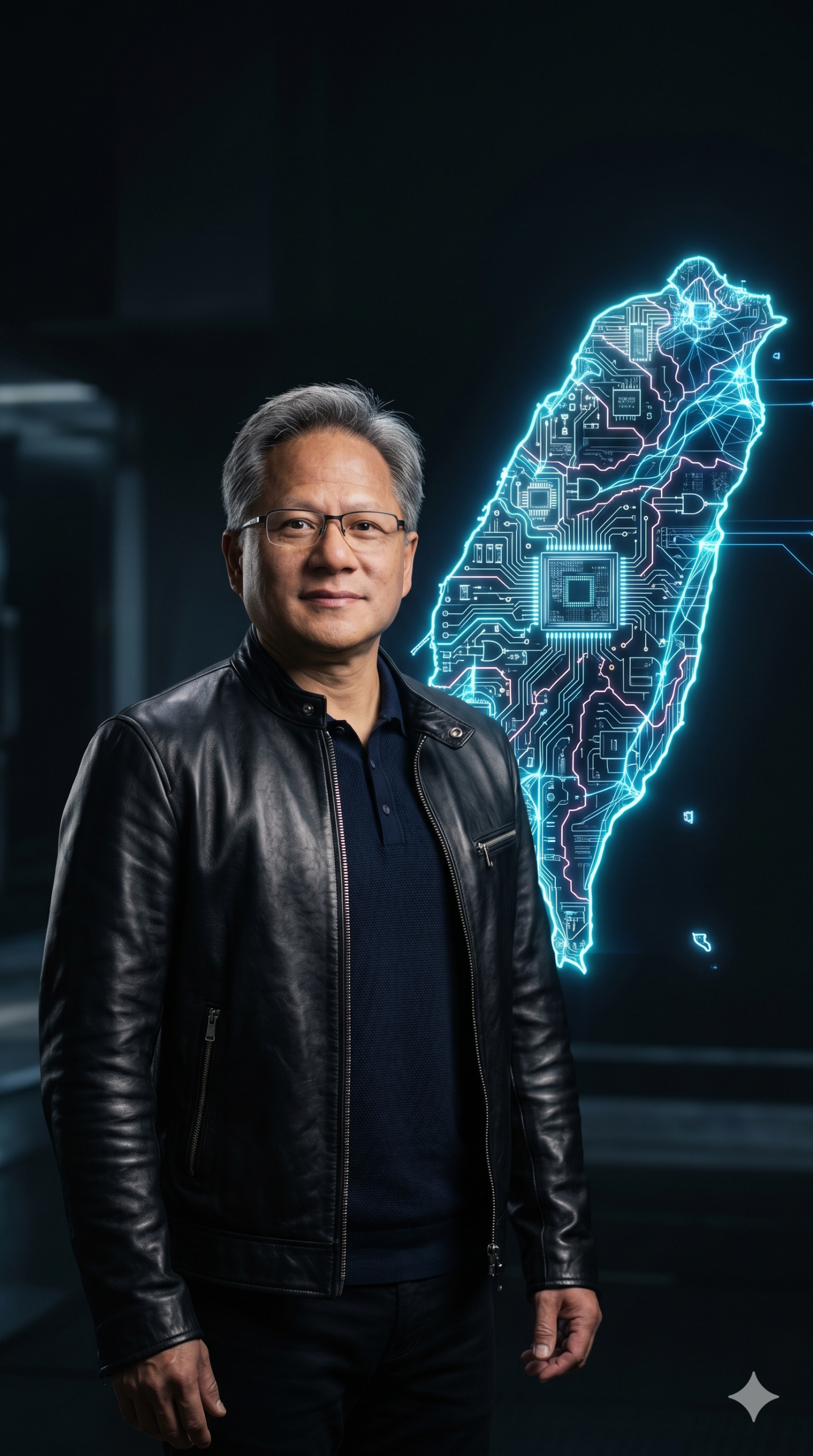
By TUNG Chen-Yuan, Taiwan’s Representative to Singapore. AI illustration image.
When the world asks where the future of AI will land, Nvidia CEO Jensen Huang gives a definitive answer: Taiwan.
On May 29, Singaporean media outlet CNA aired an exclusive interview with Jensen Huang. As the tech leader who guided Nvidia from a graphics chip company to the world’s reigning AI hegemon, he spoke very little about market cap, stock prices, his latest chips, or Singapore. Instead, his focus remained squarely on Taiwan—the place that nurtured his childhood memories, his industrial partners, and his cultural character.
Throughout the nearly half-hour interview, Huang used his signature blend of humor and sincerity to discuss Taiwan’s industrial prowess, his deep revolutionary friendship with TSMC founder Morris Chang, and the Taiwanese cultural traits deeply embedded in his own personality. Together, these elements sketch out a definitive fact: on the global AI battlefield, Taiwan is far more than just a link in the supply chain; it is the core hub powering this technological revolution.
“Taiwan Has the Letters AI in It”
When addressing Taiwan’s role in the global AI race, Huang opened with a touch of his trademark humor: “Well, Taiwan has the letters “A” and “I” in it, and so AI is at the center of Taiwan!”
While the pun drew laughter from the room, it encapsulated his true assessment of Taiwan’s strategic position. Huang said that Taiwan admittedly faces challenges like energy pressure and land pressure. However, the capabilities and experience it has accumulated in advanced manufacturing remain incredibly difficult for any other region to replicate. Even as the world actively pushes for supply chain diversification and a broader dispersion of manufacturing plants, Taiwan retains an irreplaceable advantage in terms of manufacturing excellence, talent density, and a complete industrial ecosystem required by the AI industry.
In his eyes, no region is better prepared for the continued growth of AI and the next wave of technological revolutions than Taiwan.
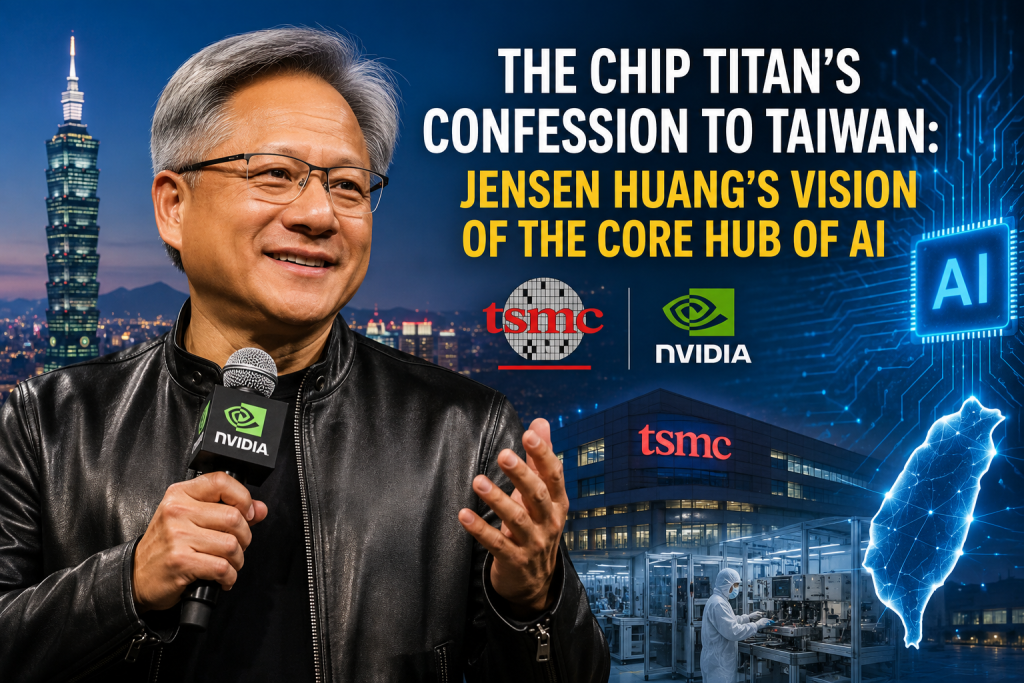
A Hundred-Billion-Dollar Bet on Taiwan
Huang’s confidence in Taiwan extends far beyond verbal praise; it is directly reflected in Nvidia’s financial footprint. He revealed that four or five years ago, Nvidia was spending about 10 to 15 billion a year in Taiwan. “Now we’re spending 100, going to $150 billion in Taiwan each year,” Huang disclosed.
In just a few short years, the scale of investment has grown nearly tenfold. More importantly, this massive expenditure is dedicated to AI infrastructure—including advanced chips, server systems, and supply chain collaborations—with the vast majority of this spend tightly linked to Taiwanese enterprises.
As global tech giants aggressively plunge into the AI arms race, Huang is demonstrating his absolute trust in Taiwan’s supply chain in the most direct way possible. For Taiwan, this represents much more than large-scale procurement from a single corporation; it is a major signal that the global AI value chain is continuously concentrating in Taiwan.
“Without TSMC and Morris, Nvidia Wouldn’t Be Here Today”
To trace the source of Nvidia’s meteoric rise, one cannot bypass TSMC. When speaking of TSMC founder Morris Chang, Huang’s tone became visibly sentimental. He recalled that after leaving Taiwan at the age of five, his very first trip back as an adult was specifically to see Morris. Just the night before this interview, the two families had gathered for an intimate dinner.
“Without TSMC and Morris, Nvidia wouldn’t be here today,” Huang stated plainly. This was no mere pleasantry. In the 1990s, Nvidia was an obscure startup with severely limited capital and market resources. It was TSMC that chose to back this young company and share the risks of innovation. From early GPUs to the cutting-edge chips powering global AI computation today, the two companies have grown in lockstep, co-authoring the very foundations of the modern AI industry.
Huang shared that every time he meets with Morris, they always treasure their time together over a nice glass of whiskey, discussing life and how technology shapes the world. In the history of global technology, this bond has long transcended the cold reality of a client-supplier dynamic; it is a story of two pioneers building an era together.
Running a Company Like a Taiwanese Parent
Beyond industrial partnerships, Huang spoke candidly about his management philosophy. Over the years, he has been famously known as a tough boss, once noted for his stance that he would rather “torture people to greatness” than fire them. He laughed off the phrase, clarifying that it stems from typical Taiwanese family parenting.
“It’s torture the same way that Taiwanese parents torture people, you know? In a Taiwanese parent, nothing is ever good enough. Nothing is ever good enough, and you can’t go a day without some criticism. And that’s the Taiwanese way!” Huang explained. He admitted that he is wired the same way—whenever employees show him their work, he cannot resist offering immediate criticism and feedback. This rigidity does not stem from dissatisfaction, but from a profound belief that they can achieve something even better.
In his view, true leadership does not mean lowering the bar, but constantly empowering talent to shatter their own limits. Yet, behind the strictness lies the unique warmth of an Asian household: “Once the feedback is given, just like a Taiwanese parent, once the feedback is given, you’re back to loving the person again.”
This combination of relentless high standards and deep care has become Nvidia’s vital competitive advantage, yielding a retention rate that is exceptionally rare in Silicon Valley. Huang believes that a leader’s ultimate purpose is to create conditions where top talents can transform their professions and crafts into their true life’s work.
From an Immigrant’s Son to an AI Visionary
As the interview drew to a close, the conversation pivoted back to Huang himself. Reflecting on why he constantly maintains a sense of crisis and humility, he pointed to the immense sacrifices his parents made when leaving Taiwan for overseas. The family first moved to Thailand with very little, and eventually arrived in the United States with absolutely nothing. Struggling to find a place in a strange world taught him from a young age to treasure opportunities and respect the steep cost of failure.
Nvidia’s early history, marked by several brushes with near-bankruptcy, further cemented this character. To him, technologies will iterate and markets will fluctuate, but what ultimately dictates how far a person or a company can go is the resilience and character forged through adversity.
Consequently, when asked if he ever contemplates retirement, the tech titan didn’t hesitate: “I would like to work as long as I can, you know. I hope to die on the job. That would be—that would be a dream come true.”
From a five-year-old immigrant boy leaving Taiwan to the global tech titan steering the AI revolution today, Huang’s trajectory is, in many ways, a microcosm of Taiwan’s own story. When the world looks toward the future of artificial intelligence, what Huang sees is not merely silicon chips and algorithms. He sees an entire innovation ecosystem built upon talent, trust, industrial clusters, and cultural resilience. This is precisely Taiwan’s core value—the most difficult to replicate, and the most impossible to replace on the global stage.
About the Author:
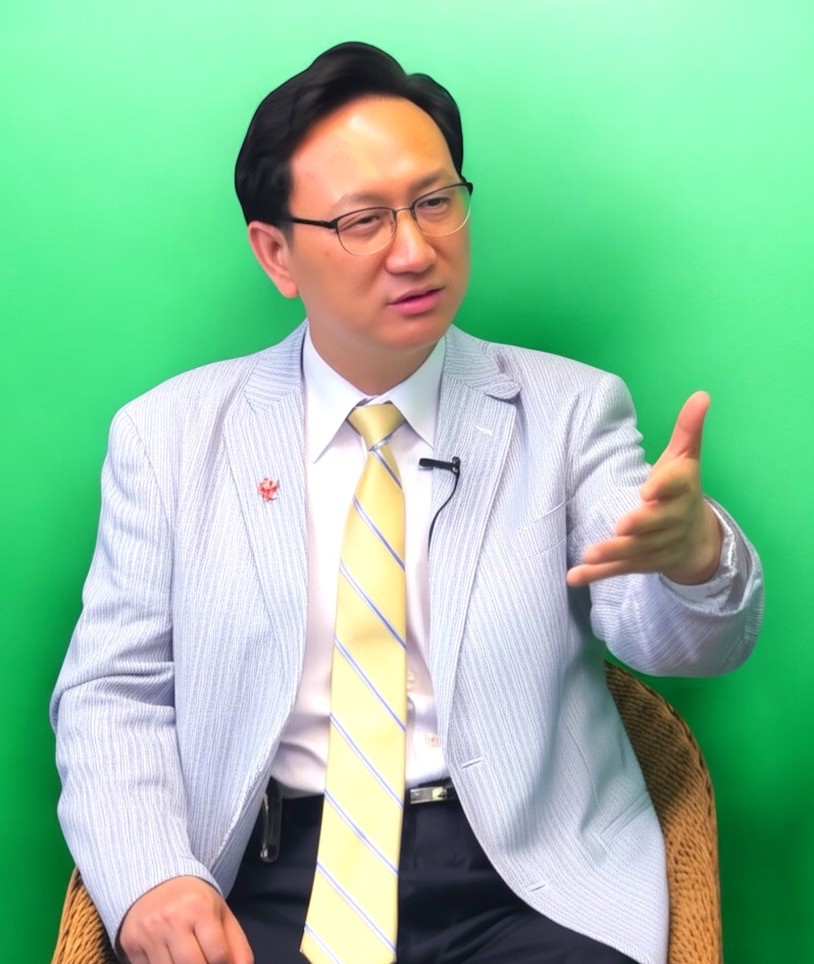
Dr. Tung Chen-Yuan is currently Taiwan’s Representative to Singapore. He was Minister of the Overseas Community Affairs Council of the Republic of China (Taiwan) from June 2020 till January 2023. He was Taiwan’s ambassador to Thailand from July 2017 until May 2020, senior advisor at the National Security Council from October 2016 until July 2017, and Spokesman of the Executive Yuan from May to September 2016. Before taking office, Dr. Tung was a distinguished professor at the Graduate Institute of Development Studies, National Chengchi University (Taiwan). He received his Ph.D. degree in international affairs from the School of Advanced International Studies (SAIS), Johns Hopkins University. From September 2006 to May 2008, he was vice chairman of the Mainland Affairs Council, Executive Yuan. His areas of expertise include international political economy, China’s economic development, and prediction markets.