
By KHT Staff. Image via 我是屏東人.
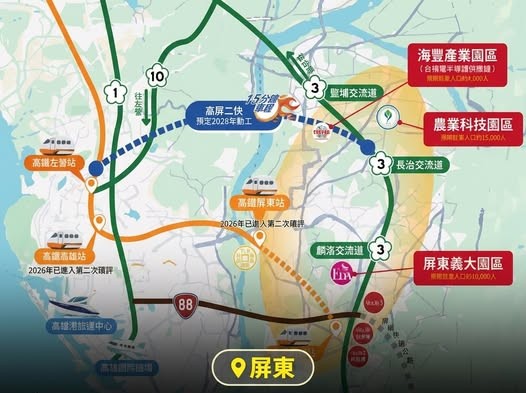
PINGTUNG — A cluster of planned industrial, medical, and transport projects is drawing renewed attention to northern Pingtung, as local officials and developers frame the area around National Freeway No. 3 as an emerging growth corridor for southern Taiwan.
The projects include the planned Haifeng Industrial Park (海豐產業園區), the Pingtung Agricultural Biotechnology Park (屏東農業生物科技園區), Pingtung E-Da Hospital (屏東義大醫院) and the Kaohsiung-Pingtung Second Expressway (高屏第二快速道路).
Liberty Times reported that Haifeng Industrial Park has been identified under the Executive Yuan’s “Great Southern Silicon Valley” plan as potential land for Taiwan’s semiconductor S-corridor. The first phase is expected to add 53.77 hectares of industrial land and 35.82 hectares of public facilities, with local officials estimating NT$150 billion in output and 4,092 jobs.
The park is expected to focus on advanced semiconductor packaging and testing, although officials have also said further central review and investment decisions are still needed.
Pingtung’s existing Agricultural Biotechnology Park has also become a major local industry base. The park has attracted food, biotech, and animal-health companies, including French animal-health group Virbac, which established a research center in the park.
Another major project is Pingtung E-Da Hospital, located in the Pingtung Health Industrial Park near National Freeway No. 3’s Linluo Interchange (麟洛交流道). E-Da’s project information says the health park covers about 23 hectares and is expected to create about 3,000 direct and indirect jobs after opening.
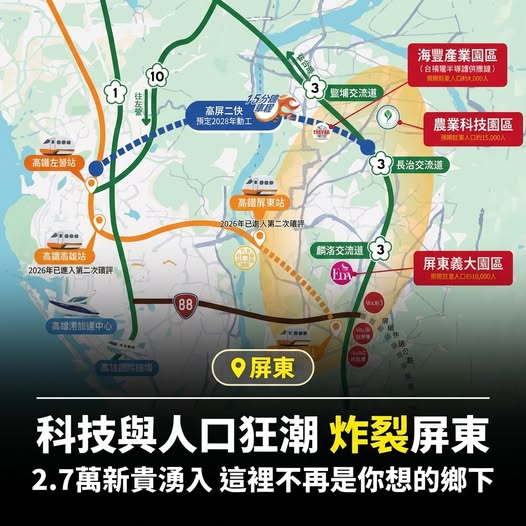
Transport links are also central to the development narrative. UDN reported that the first section of the Kaohsiung-Pingtung Second Expressway is expected to begin construction in September 2026. Once the full route is completed, travel time between Kaohsiung’s Zuoying (左營) and Pingtung’s Changjhih (長治) is expected to fall from about 50 minutes to 30 minutes.
Supporters say the combination of industry, healthcare, and transport investment could help Pingtung retain workers and attract higher-value jobs.
However, some figures circulating online, including claims that more than 27,000 people could be drawn into the area, appear to come from real estate or promotional estimates rather than official population forecasts. The actual impact will depend on construction schedules, confirmed investors, hiring, housing supply, and whether transport projects are completed on time.
For Pingtung, the broader shift is still significant: long discussed as a county dependent on agriculture and tourism, it is increasingly being positioned as part of southern Taiwan’s technology and health-care development map.