
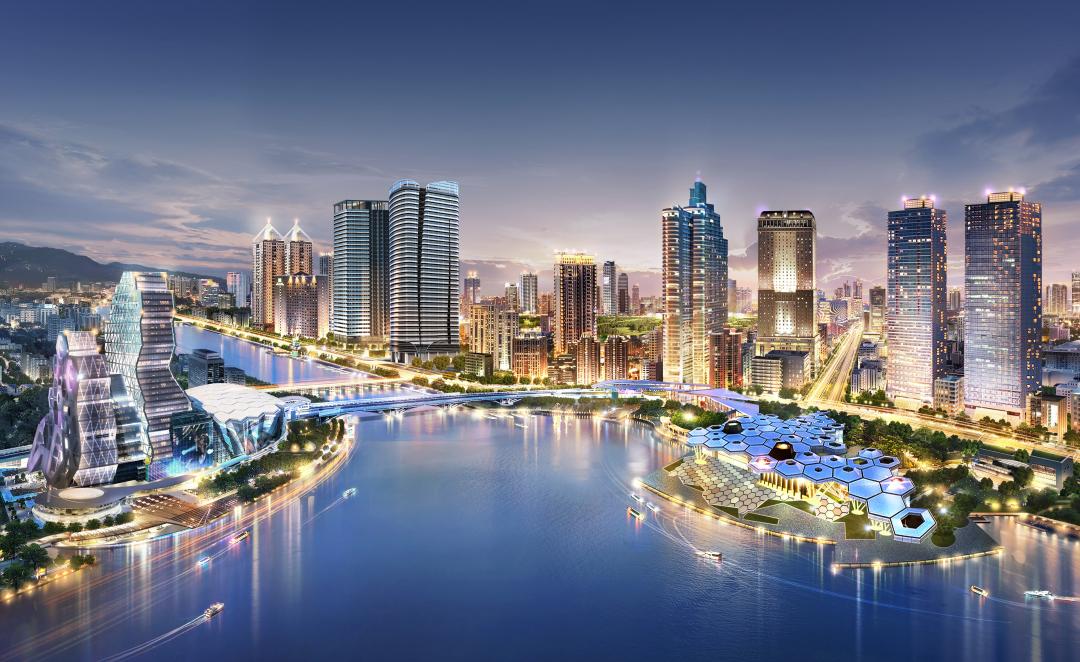
By KHT Staff. Image of a future Asia New Bay Area via KH City Govt.
KAOHSIUNG — Kaohsiung’s Asia New Bay Area (亞洲新灣區) is gaining a larger role in Taiwan’s push to develop a homegrown wealth-management industry. The financial activity is real. Whether it will substantially reshape the area’s housing market is a separate question.
CNA reported that, as of the end of May, 21 banks were operating in the Asia New Bay Area zone, serving nearly 5,000 high-net-worth clients and managing about NT$602 billion in assets.
The special zone was created as part of the Financial Supervisory Commission’s wider plan to turn Taiwan into an Asian asset-management center. City and central-government figures say 57 financial institutions have been approved to test new services there, while banks in the zone have served 172 family offices and managed nearly NT$80 billion for them.
A family office is a private team or company that manages the finances of one very wealthy family, sometimes several families. It can handle investments, taxes, inheritance planning, trusts, charitable giving, insurance, and even practical matters such as property or hiring staff. In this context, it generally means a bank in the special zone is providing family-office services to that family.
Supporters say Kaohsiung has an advantage over a conventional finance center: it is close to the city’s growing semiconductor, artificial-intelligence and advanced-manufacturing industries. The theory is that financial services, corporate investment and industrial growth can reinforce one another.
That argument is increasingly being used to market nearby office and residential projects. Developers have pointed to expected demand from finance professionals, technology executives and wealthy clients as a reason to build in the Asia New Bay Area, near Love River Bay and the Special Trade Zone No. 3 development.
However, the available figures establish the growth of financial services, not a direct change in property demand or prices. The number of new jobs, the salaries attached to them and whether employees choose to live in the district will matter more than the presence of private-banking offices.
A separate source of enthusiasm is Taiwan’s expanding pool of wealthy households. A China Trust-BCG report estimated that people with at least NT$100 million in assets held about NT$40 trillion in 2025, and forecast that figure could reach NT$59 trillion by 2029. That is a measure of wealth held by the group, though, not proof that NT$40 trillion is about to be transferred between generations or invested in Kaohsiung property. A separate KPMG-E.SUN Bank estimate put the 2026 total higher, at NT$46.1 trillion.
For now, the more concrete story is institutional: banks, securities firms and insurers are building new high-asset services in Kaohsiung under a national policy experiment. The property market may benefit, but that part remains a bet on what follows.
Source: Liberty Times real-estate report