
By KHT Staff. AI-generated image.
TAIPEI — A poll giving Democratic Progressive Party challenger Puma Shen (沈伯洋) a 17-percentage-point lead over Taipei Mayor Chiang Wan-an (蔣萬安) has drawn scrutiny over its sample’s political makeup. The headline result also differs considerably from the survey’s own turnout-based projections.
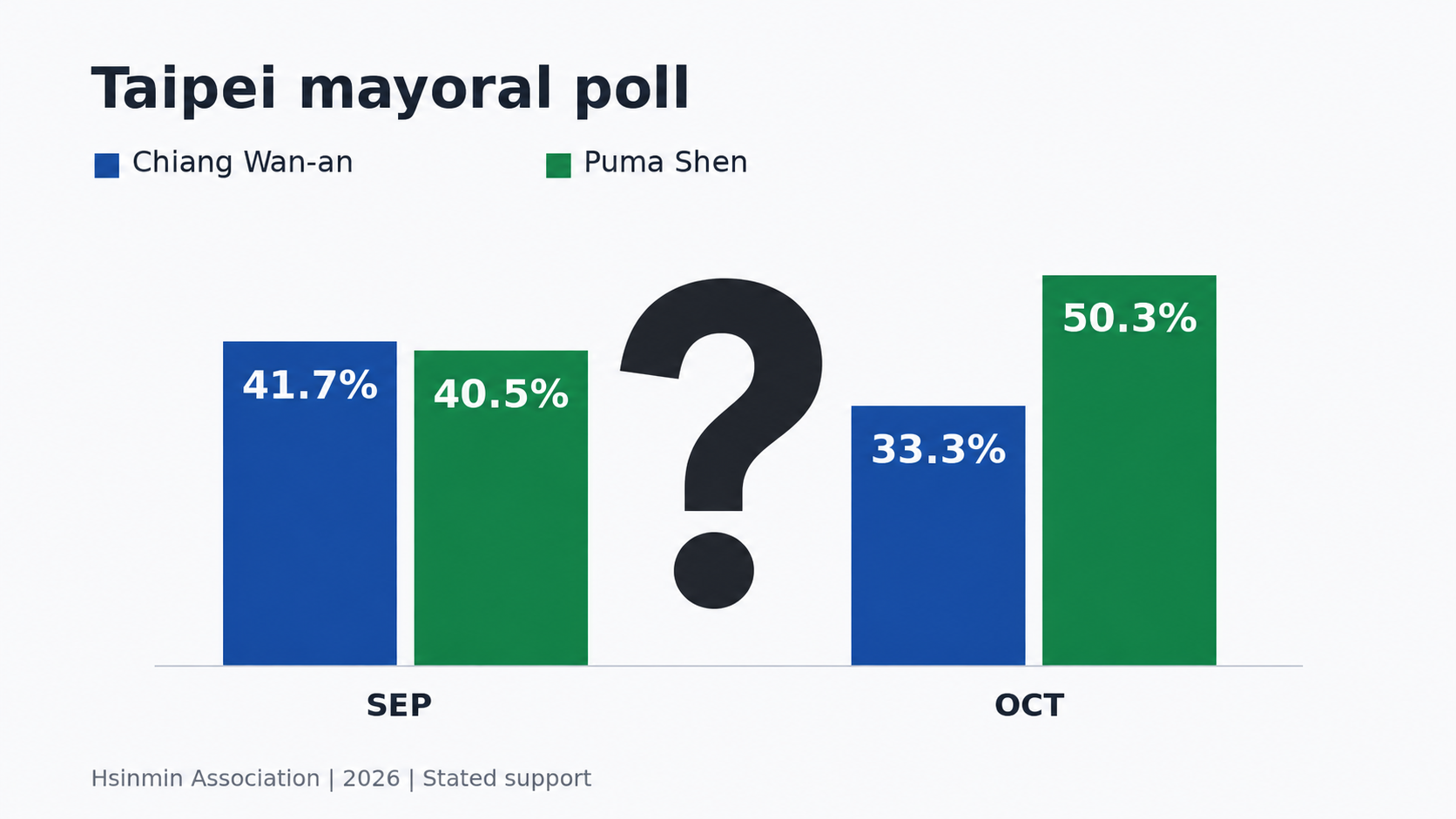
Released Oct. 20 by the Hsinmin Association (信民協會), the survey recorded support of 50.3% for Shen and 33.3% for the Kuomintang incumbent. That represents a sharp reversal from the association’s September poll, when Chiang led by 41.7% to 40.5%, according to Mirror Daily.
But the 17-point gap should not be confused with a forecast of the election result.
The poll’s separate calculations incorporating turnout intentions, past voting and other factors produced much closer scenarios: Shen’s projected vote share ranged from 49.2% to 52.9%, while Chiang’s ranged from 46.9% to 49.9%. Depending on the scenario, Shen led by up to six points or Chiang by up to 0.7 points, Newtalk reported.
The sample’s political composition has become another point of contention. Some 42.2% of respondents identified with the pan-green camp, compared with 26.6% identifying as pan-blue. Taiwan People’s Party supporters accounted for 4%, and 25.5% were neutral.
Commentator Huang Yang-ming (黃揚明) questioned whether that mix resembled Taipei’s electorate, suggesting it looked more like Kaohsiung or Tainan, according to TVBS.
Pollster Tai Li-an (戴立安), who designed and analyzed the survey, defended the decision not to weight responses by party identification. He said the results should reflect the political preferences people expressed, NOWnews reported.
The imbalance alone does not establish that the poll is wrong: current party identification and previous election results measure different things. It does, however, make the sampling and weighting methods central to assessing the headline lead.
Respondents themselves were less certain of a Shen victory. Asked who they expected to win, 39.5% chose Chiang, and 37.7% chose Shen, according to TVBS’s report on the results.
Conducted Oct. 14–16, the survey interviewed 1,075 Taipei residents aged 20 and older, using 753 landline and 322 mobile-phone interviews. Its stated maximum sampling error was plus or minus three percentage points at a 95% confidence level. That sampling-error figure does not account for every possible source of polling error.
Earlier surveys in Kaohsiung showed a closely contested mayoral race. An ETtoday survey released Sept. 11, conducted in late August, put the KMT’s Ko Chih-en at 43.8% and the DPP’s Lai Jui-lung at 43.5%. A separate Pearson Data survey released in August gave Lai 47.78% to Ko’s 46.14%. Both were online surveys conducted months before election day, offering snapshots of the race rather than firm predictions of its outcome.