
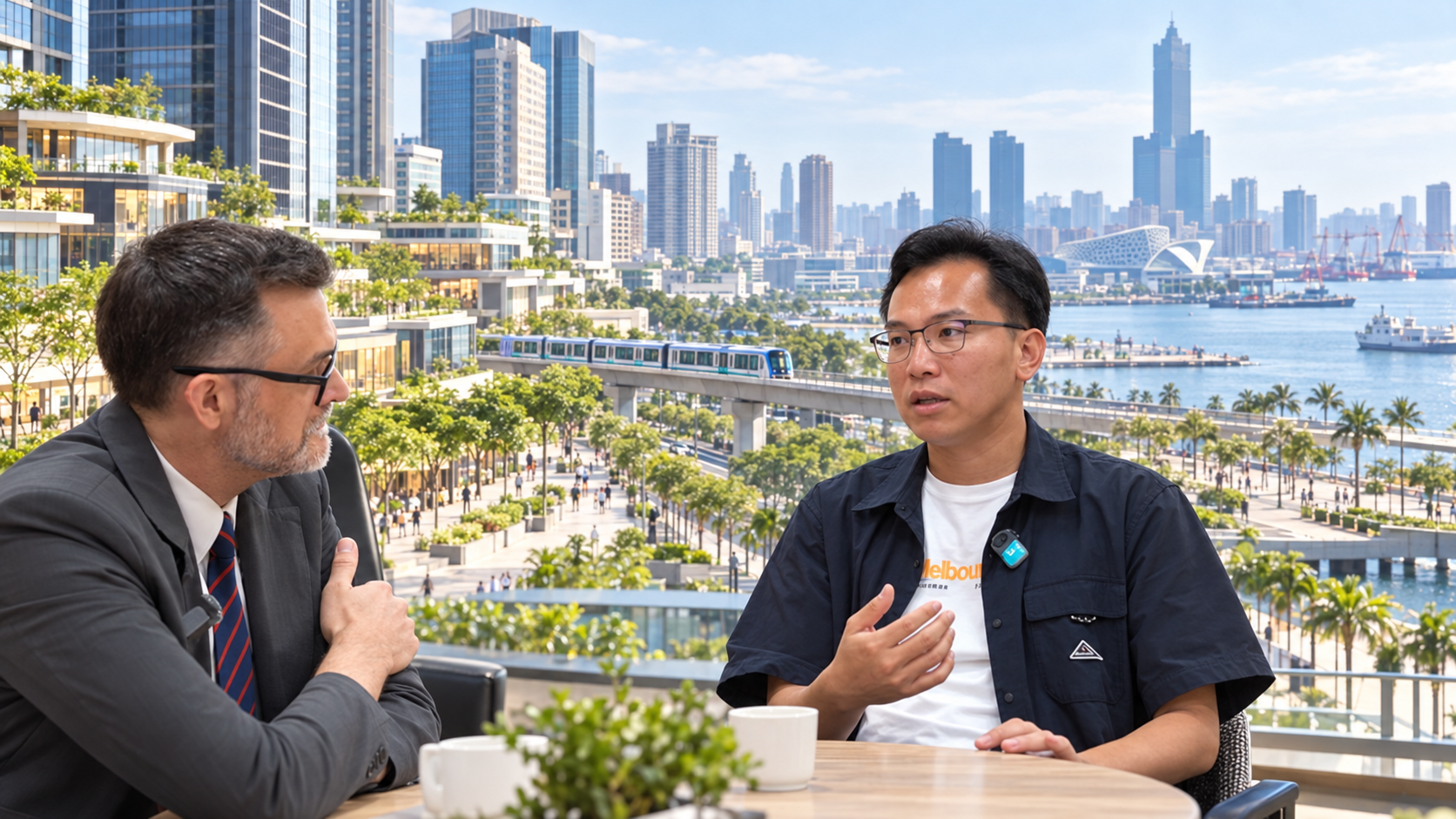
By Eryk Michael Smith. AI-generated “future Kaohsiung” behind image of Smith and Lin in conversation.
KAOHSIUNG — Having first put down roots in Kaohsiung way back in 1997, I don’t need much convincing that the city has changed. The harder question is what comes next, especially for young people deciding whether to build their lives here.
City Councilor Lin Chih-hung (林智鴻) is optimistic. Speaking exclusively to Kaohsiung Times, he argued that investment in technology, expanding supply chains and the development of financial services would eventually reverse the city’s population decline.
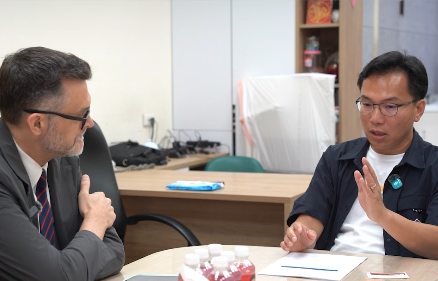
“Kaohsiung’s population is declining now, but industrial investment has only just begun,” said Lin. “It will reverse in the future.”
Lin, a Democratic Progressive Party councilor representing Fongshan District (鳳山區), is seeking a third term in the Nov. 28 elections. Fongshan is the city’s most populous district (home to about 352,000 people), but Lin’s vision extends beyond his district, from semiconductor manufacturing in the north to offices, design businesses and corporate headquarters near the southern waterfront.
Our conversation moved between that future and the city people experience today: salaries that encourage some young residents to look elsewhere, businesses facing technological change, and English signs that can still leave newcomers scratching their heads.
Can investment bring people back?
Kaohsiung’s registered population fell by 12,567 in 2025, according to a United Daily News report citing city figures. The numbers will be — if reports hold — worse for 2026.
These declines do not simply represent people moving away. A city council hearing brief noted that arrivals slightly exceeded departures in the first half of 2025. Deaths outnumbering births, however, more than offset that gain.
Lin expects industrial investment to attract workers and encourage more young adults to settle down and raise families.
He pointed to Taichung, which overtook Kaohsiung in population in 2017. He attributed its growth to years of industrial development, including the Central Taiwan Science Park, which attracted semiconductor and electronics businesses.
People followed the jobs, he said. They made homes, educated their children and spent their earnings there.
Lin believes Kaohsiung is at an earlier stage of a similar process, with suppliers gradually gathering around its semiconductor industry.
TSMC’s (台積電) expansion has already moved beyond construction. In its April 2026 earnings call, the company said its two-nanometer technology had entered high-volume manufacturing in the fourth quarter of 2025, with production ramping up at both its Hsinchu and Kaohsiung sites.
The wider effects will take longer, Lin said, as businesses establish themselves and more employment becomes available.
Asked about the time needed for Kaohsiung to catch up with Taichung, he described an economic transformation extending over the next 20 years. He sees the current investments as the beginning of that process.
“Where will the salaries come from?”
Jobs are one thing. Jobs that pay enough to persuade someone to stay are another.
I asked Lin whether the emerging technology economy would provide enough opportunities for young people, particularly as artificial intelligence changes the work businesses need people to do.
He sees AI as a tool that can help people across industries, from medicine and manufacturing to office administration. Engineers know the technology, he said, but need to work with people who understand the everyday demands of each profession.
His example came from his own team. An article or press release that once took hours could be drafted rapidly with AI, leaving more time to meet people, discuss ideas and check whether the work was heading in the right direction.
I was less convinced about the link between saving time and earning a living.
Speaking in Chinese, I asked what could be translated roughly as: “But if I don’t have money, I cannot make those connections or do those things. So, where does the salary come from?”
Lin argued that learning to use AI could create opportunities to earn more. He urged workers to make it their tool and businesses to find places in developing supply chains.
Those opportunities would extend beyond chipmaking, he said. Building factories requires steel structures, equipment, and labor. Manufacturing requires components and suppliers. Established industries, including screw makers, could find customers among the businesses arriving here.
His answer described how companies might become more productive and win new work. We did not get to figures for the jobs that would be created, the salaries they would offer, or the training needed to qualify for them.
For someone weighing a position in Kaohsiung against one in Taipei or Taoyuan, those details will help determine whether staying is affordable.
A business district beyond the factories
Lin’s plans for southern Kaohsiung involve a different kind of workplace.
Around Shihdai Boulevard (時代大道), the Asia New Bay Area (亞洲新灣區) and the former 205th Arsenal (第205兵工廠), he envisages financial institutions, design businesses and corporate headquarters in high-grade office buildings.
He drew comparisons with Taipei’s Xinyi district and Tokyo’s Marunouchi business district.
“It will be a center for talent,” said Lin.
He argued that proximity to the airport and harbor would appeal to companies doing international business, complementing the manufacturing clusters developing farther north.
The city is already pursuing financial services through its asset management zone. The Economic Development Bureau describes a nine-square-kilometer area connecting established financial districts with the Asia New Bay Area. It says 58 financial institutions had received approval to conduct pilot business by the end of July 2026.
Lin has proposed expanding the zone southward to include the former arsenal site and surrounding areas. His council proposal calls for an additional 3.37 square kilometers toward Yisin Road (一心路) and Kaisyuan Road (凱旋路). It was referred to the city government for study and handling on Feb. 5, 2026.
Lin believes the wider commercial district could take shape within about 10 years. Corporate headquarters would strengthen the city’s economy and bring more revenue to support public investment, he argued.
He also raised the possibility of relocating city hall and building an arena in the area, describing Shihdai Boulevard as a future central axis for Kaohsiung.
An international city, down to the signs
The conversation about international business brought us to something considerably smaller than a corporate headquarters: the spelling on a road sign.
For foreigners learning Mandarin, Hanyu Pinyin is usually the system taught in class. Encountering a different romanization locally can make a familiar name unexpectedly difficult to recognize.
I asked Lin about that inconsistency, mistakes in English signs, and whether the city could take a more organized approach to helping people who do not speak Chinese get around.
He said changing romanization was an administrative matter.
“It’s not that hard. It comes down to whether the mayor wants to change it,” said Lin.
Kaohsiung has long been international through its port and trade, he argued. As multinational businesses and overseas professionals arrive, he expects neighborhoods and services to adapt.
Some foreign residents, however, wonder whether their concerns receive less attention because they cannot vote. I put that concern to him.
Lin said accommodating international residents should be part of the city’s development, regardless of their voting rights. The mayor needed to understand what kind of environment Kaohsiung’s next stage would require.
I also asked whether that warranted a team responsible for practical improvements, from checking English signs to making public information easier to understand.
Lin returned to the changes he expects international businesses and their employees to bring. As more people arrive, he said, demand for better services will grow.
Getting things done
Asked about the city government’s achievements, Lin returned to TSMC and the work needed to attract it.
He credited Mayor Chen Chi-mai (陳其邁), the administration and cooperation within the council with resolving problems involving land, water, electricity and infrastructure.
Lin acknowledged the traffic disruption, dust and complaints that accompanied construction. He argued that residents had been willing to endure inconvenience for longer-term benefits.
“They understood that the hardships would pass, and the beauty would remain,” said Lin.
He credited successive DPP administrations with earning public support through their work. Lin said Mayor Chen Chi-mai’s central government experience had helped him secure resources and overcome administrative obstacles; an assessment from a councilor defending his party’s record as he prepares to face voters himself.
In Fongshan, Lin described priorities that have moved from infrastructure and transport toward safety, education, care and living conditions.
He called the district a microcosm of Taiwan, home to workers, business owners, Indigenous people, Hakka communities and families associated with military dependents’ villages. Its temples, older buildings and military sites preserve traces of different periods of Taiwan’s history alongside newer public facilities.
His argument was that the next stage of development should make that a better place to live.
By the end of our conversation, Lin’s optimism was clear. He sees investment bringing people, businesses, and opportunities, with a stronger economy allowing the city to do more for its residents.
Kaohsiung has changed enormously during my years here. I hope its next transformation gives more young people the option I took in 2015 after a near-10-year stretch in Taipei: to return, and to stay.