
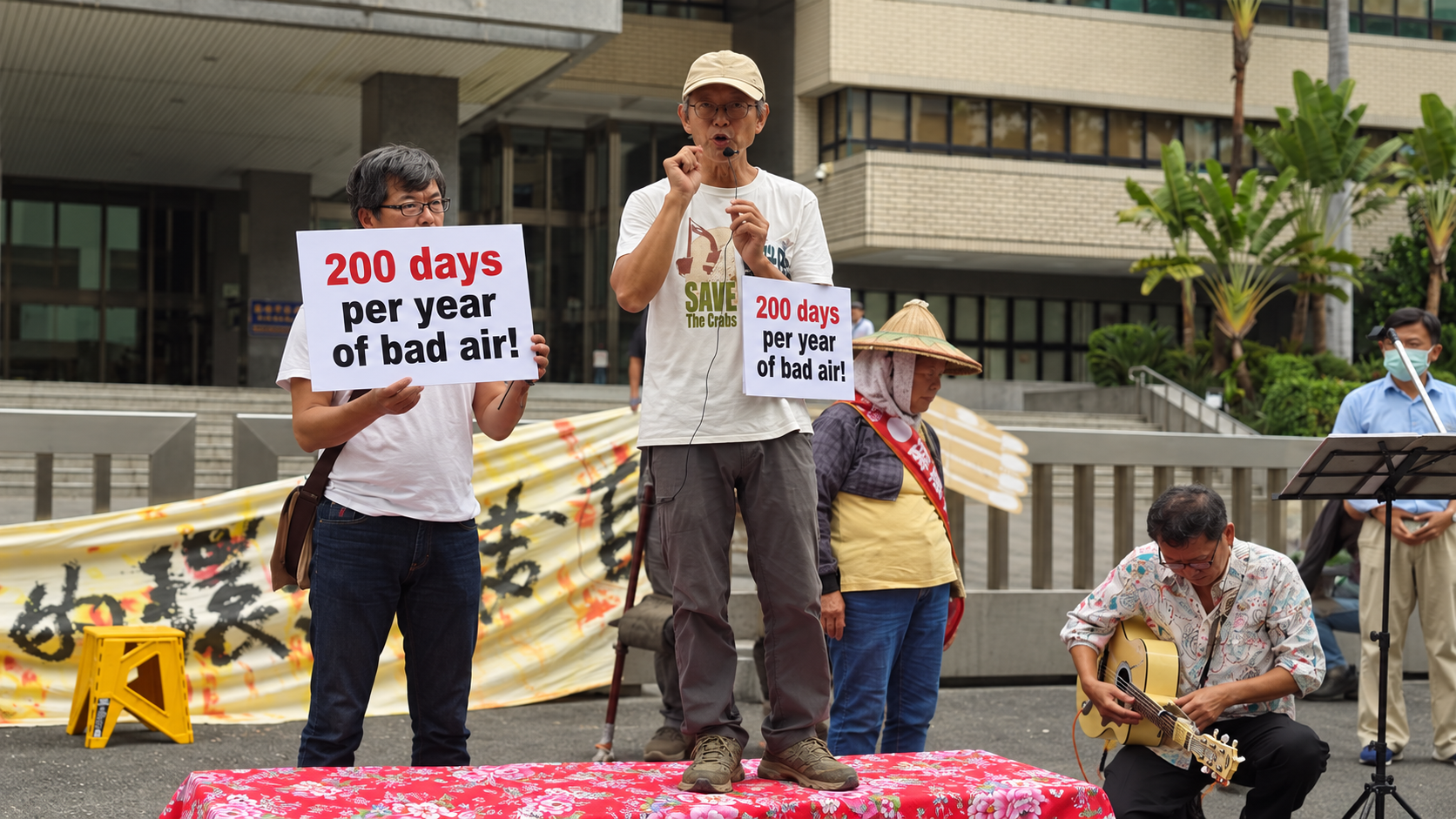
By KHT Staff. AI-regenerated image with translation added.
KAOHSIUNG — Environmental groups gathered outside Kaohsiung City Government’s Sihwei Administrative Center on Sunday, Oct. 25, urging mayoral candidates to sign a pledge to bring the city’s annual average PM2.5 concentration within Taiwan’s national standard during their first year in office or not seek reelection, according to the China Times.
The demonstration included representatives of the Southern Taiwan Anti-Air Pollution Alliance and the Forest City Association, along with physician Su Wei-shuo (蘇偉碩) and Kaohsiung City Council candidate Chiang Huang-nu (蔣黃女). Participants displayed signs calling for action against air pollution and the protection of urban forests.
Alliance representative Hung Hui-hsiang (洪輝祥) said Kaohsiung’s average PM2.5 concentration was 17 micrograms per cubic meter from October 2025 through September 2026. He said daily concentrations exceeded the World Health Organization’s 24-hour guideline of 15 micrograms per cubic meter on 210 days during that period.
The figures were presented by the activists. The Ministry of Environment sets Taiwan’s PM2.5 standards at an annual average of 12 micrograms per cubic meter and a 24-hour value of 30. The World Health Organization recommends lower guideline levels of 5 for the annual average and 15 for a 24-hour period.
The groups’ proposed pledge calls on the next mayor to reduce Kaohsiung’s annual average to no more than 12 micrograms per cubic meter within one year. A mayor who failed to meet that target would promise not to campaign for another term.
The activists said they would publish a list of candidates who had signed the pledge on Nov. 8. Su said air pollution had not received sufficient attention in the mayoral campaigns despite Kaohsiung’s concentration of heavy industry.
A second demand concerns the wooded land around the Ciaotou Sugar Refinery (橋仔頭糖廠) in Ciaotou District (橋頭區). The groups want authorities to preserve the area and reroute planned Road 1-1, which is intended to serve the Ciaotou Science Park and nearby development zones.
Forest City Association representative Chuang Chieh-jen (莊傑任) argued that Kaohsiung should retain the area as an urban green space, citing large forested areas preserved within cities such as New York and Tokyo.
In a July 21 statement, the Kaohsiung City Government said the third phase of the Ciaotou New Town plan had passed central urban-planning review and that Roads 1-1 and 1-2 were needed to connect development areas and industrial parks.
The city said the plan included about 21 hectares for a park and detention basin, as well as future tree surveys, preservation assessments and planting. Citing Taiwan Sugar Corp. and the Ministry of Agriculture, it described the disputed land as short-rotation commercial planting rather than natural forest. The activists dispute the planned use of the area and are seeking a different route for Road 1-1.