
By KHT Staff. AI translations and re-renderings of government images may not be 100% accurate. Double-check before making decisions.
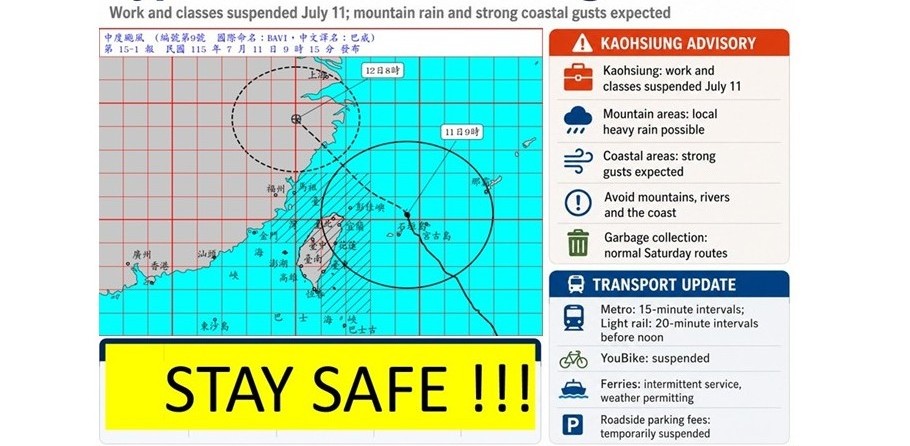
KAOHSIUNG — Kaohsiung suspended work and classes citywide Saturday as Typhoon Bavi brought the risk of strong coastal winds, heavy mountain rain, flooding, and landslides.
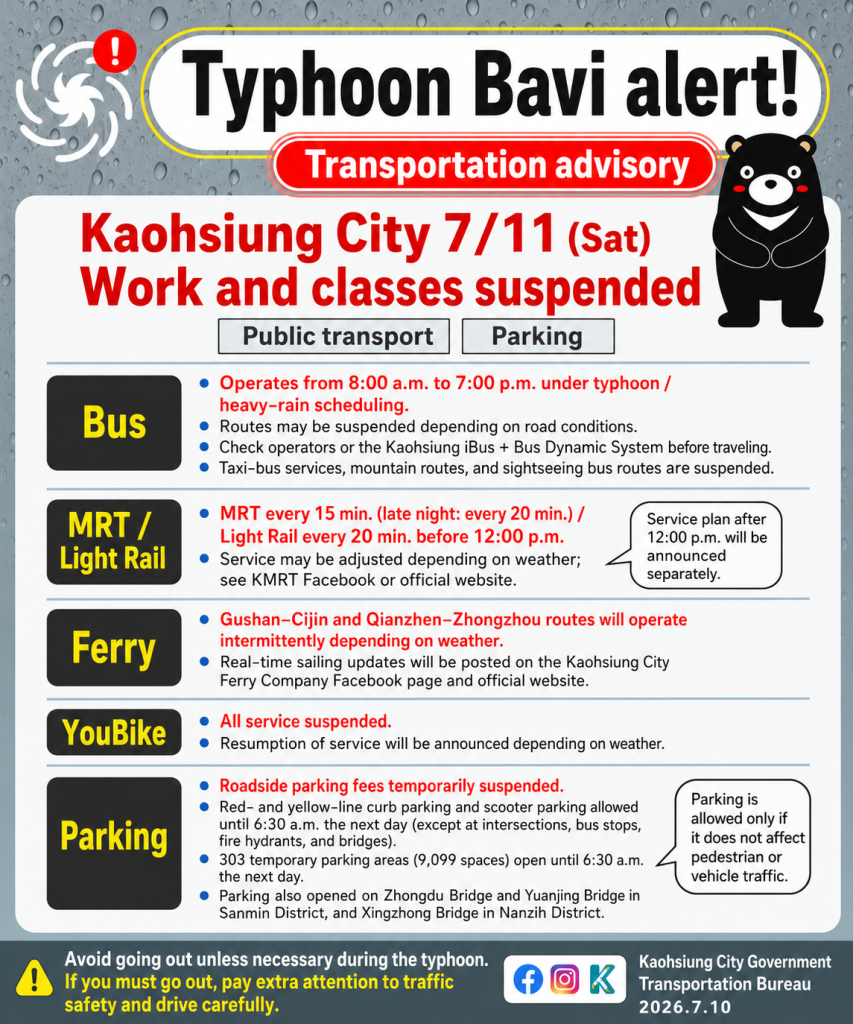
The Kaohsiung City Government announced the closure on Friday night after forecasts showed wind and rainfall reaching official suspension thresholds.
The city said maximum gusts were expected to reach Beaufort force 8 to 9 across Kaohsiung, with gusts above force 10 possible in exposed coastal areas. Mountain districts could receive up to 340 millimeters of rain.
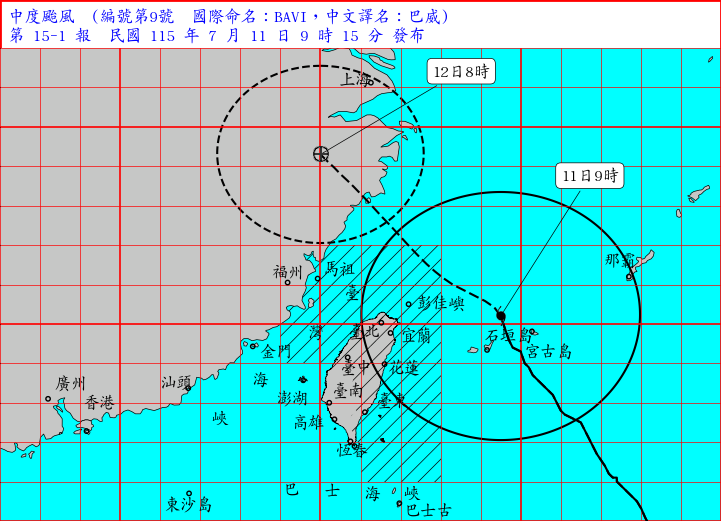
As of 9 a.m, Saturday, Bavi was centered about 300 kilometers east of Taipei and moving northwest at between 25 and 28 kilometers per hour, according to the Central Weather Administration (中央氣象署).

The storm had maximum sustained winds of 144 kph and gusts reaching 180 kph. Its average gale-force wind radius extended 350 kilometers from the center.
Kaohsiung was not included in the typhoon’s land-warning area as of 9:15 a.m., but the CWA had issued heavy-rain and strong-wind alerts for parts of the city.
The agency warned that Kaohsiung’s mountain districts could experience localized heavy or torrential rain on Saturday. It said short periods of intense rainfall could trigger landslides, falling rocks, debris flows, and flash flooding.
Parts of Kaohsiung were also under a yellow strong-wind alert, indicating the possibility of sustained winds of force 6 or gusts reaching force 8 or higher.
Mayor Chen Chi-mai (陳其邁) urged residents to avoid mountain areas, rivers, and the coast, including camping, hiking, fishing, surfing, “wave watching,” and water activities.
The city warned that coastal areas could experience strong gusts and long-period waves, while already saturated soil in the mountains had increased the risk of slope failures.
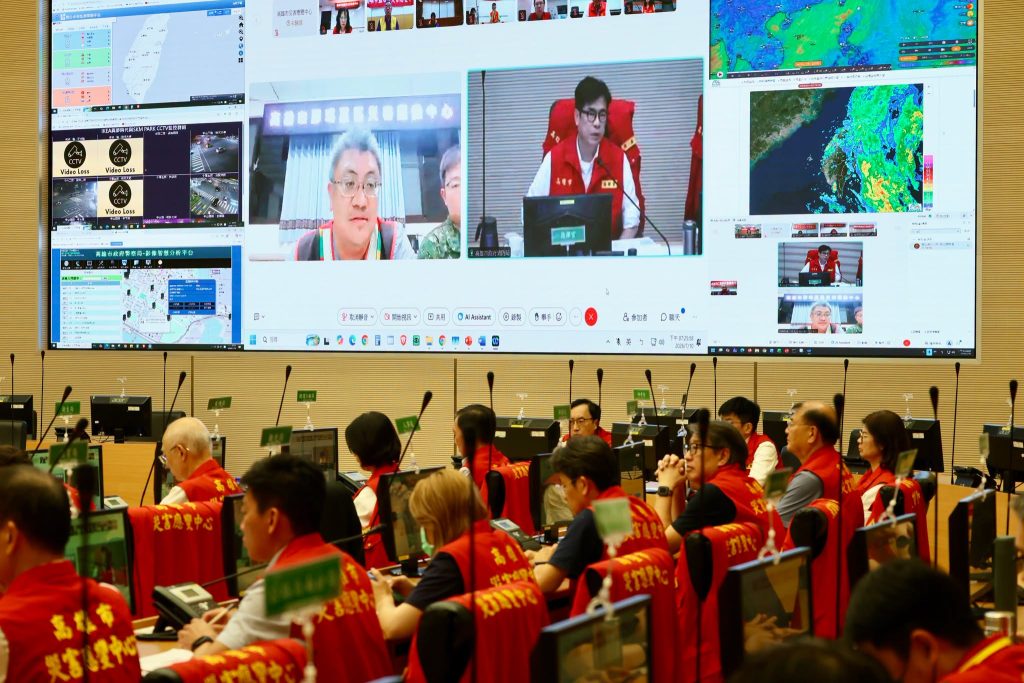
Chen visited Taoyuan (桃源), Liouguei (六龜), and Meinong (美濃) on Friday to inspect preparations before returning to the city’s disaster response center for an evening meeting.
The city said 1,184 people had been evacuated as a precaution from areas vulnerable to landslides, slope failures, or isolation. The evacuations included residents with chronic illnesses and others considered at higher risk.
District offices were instructed to carry out mandatory evacuations of designated households and vulnerable residents when landslide warnings were issued. Military personnel, police, and firefighters were placed on standby to assist.
Officials were also ordered to monitor Provincial Highway 20 through Taoyuan, Liouguei, and Jiasian (甲仙), Provincial Highway 27A in Liouguei, and Provincial Highway 29 through Namasia (那瑪夏) and Jiasian.
The roads could be closed in advance if weather or slope conditions deteriorate.
Mobile pumps were positioned in low-lying areas affected by heavy rain on June 25. District offices were told to clear drains, prepare sandbags, and check floodgates, pumping stations, interception facilities, and vehicle underpasses.
The city said sandbags were available through district offices for residents of flood-prone areas and buildings with basements.
Residents were advised to secure signs, hanging objects, potted plants, and rooftop water tanks, clear household drains, and prepare food and emergency supplies.
Construction sites were instructed to reinforce scaffolding, fences, and other equipment that could be damaged or blown loose.
The Transportation Bureau and Mass Rapid Transit Bureau were told to prepare for possible disruptions to ferries, the MRT, and light rail. Service suspensions would be announced if wind conditions made operations unsafe. Additional parking areas were also being opened for residents who needed to move vehicles away from low-lying or flood-prone locations.
The Environmental Protection Bureau (環境保護局) said garbage collection would continue normally on Saturday, following regular Saturday routes. Residents can contact their district cleaning team for collection locations and times.
The CWA said seas around Taiwan were rough, with waves exceeding 3 meters generally and waves above 6 meters possible along northern and eastern coastal areas. Long-period waves were also expected around the Hengchun Peninsula (恆春半島).
Residents were advised to continue monitoring official weather, transportation, and emergency announcements.