
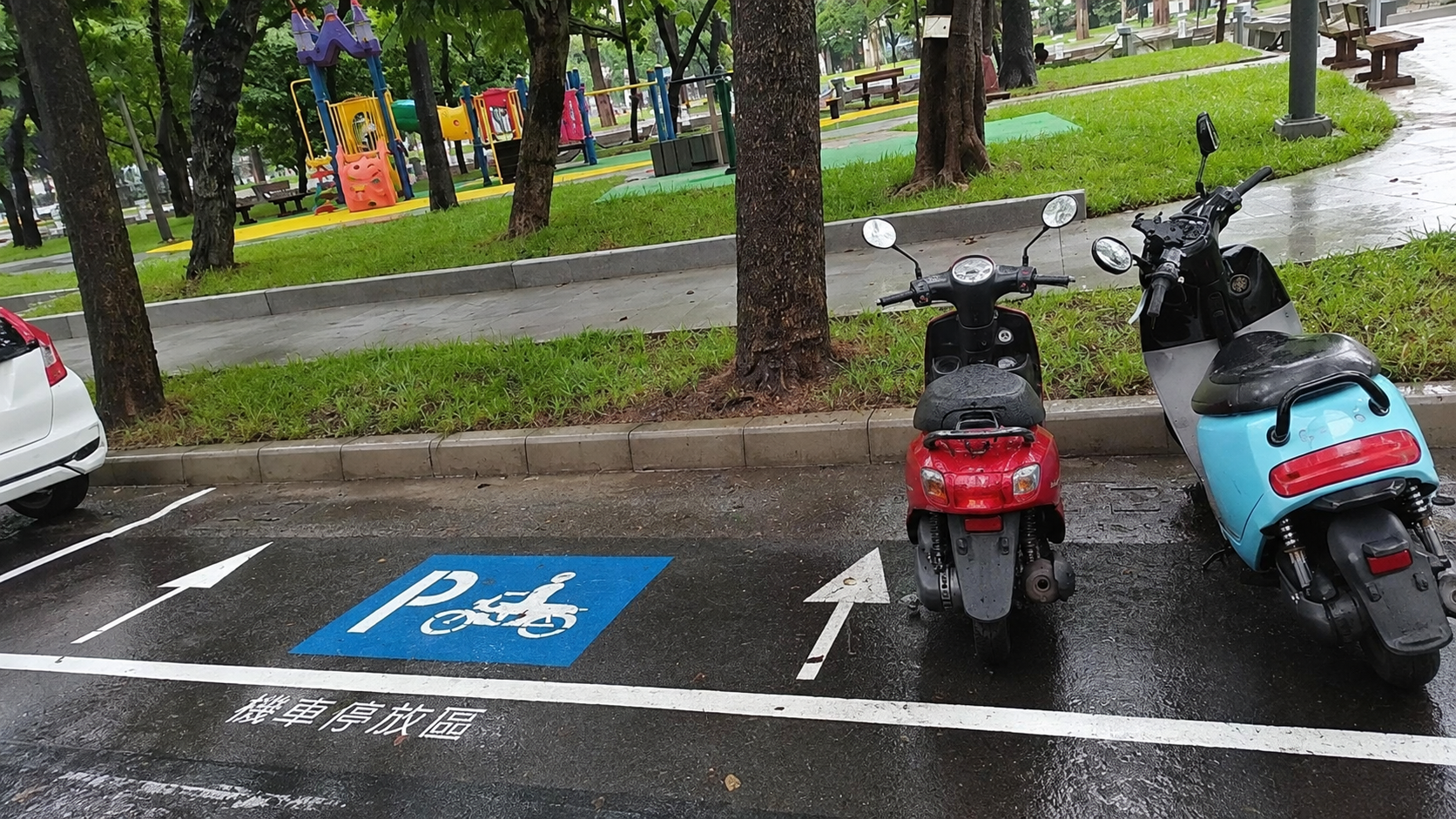
By RK Shih/KHT Staff. AI illustration image from reference picture.
KAOHSIUNG — Kaohsiung has begun marking some roadside scooter parking areas without individual spaces, a change officials say will make better use of limited space but that some riders fear could create a parking free-for-all.
The new design retains a white boundary around the parking area but removes the lines separating one scooter from another. Chinese markings identify it as a scooter parking area, while arrows direct riders to park with their front wheels facing inward.
The first such area was introduced at Kaohsiung Golf Course Natural Park (高雄果嶺自然公園) in March. Another was added along Heti Road (河堤路) in Sanmin District (三民區) in July.
The Kaohsiung Transportation Bureau (高雄市政府交通局) said the arrangement allows riders to use the available space more flexibly and can accommodate scooters of different sizes more efficiently than traditional one-vehicle, one-space markings.
The bureau has asked riders to use their center stands. Cars are prohibited from parking in the areas, while large heavy motorcycles are not yet allowed.
The design has received a skeptical response from some riders commenting on the bureau’s Facebook page.
Several said that without individual lines, riders could squeeze scooters too closely together, leaving insufficient room to pull them out and increasing the risk of scratched body panels. Others worried that scooters could be moved by strangers trying to create additional space.
Some residents suggested retaining individual spaces but marking them diagonally, which they said would make it easier and safer to enter and leave the parking area.
Others questioned the instruction to park facing inward, arguing that scooters facing the road would give riders a better view of approaching traffic when leaving. One opposing argument was that riders could accidentally accelerate directly into traffic if scooters were parked facing outward.
The bureau said the line-free areas are intended to respond to changing vehicle designs and parking needs. It plans to introduce them gradually on city roads where local conditions warrant.
The change is not currently a citywide replacement for conventional scooter spaces. Whether the more flexible arrangement works will largely depend on how much space riders leave for the next person.