
By KHT Staff
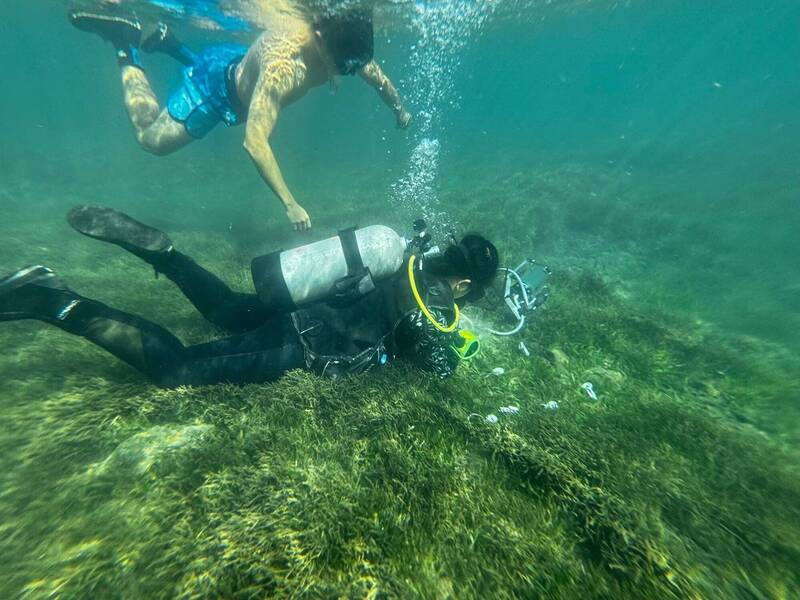
KAOSHIUNG — A research team led by the National Kaohsiung University of Science and Technology has proposed a new method to assess how seagrass beds store carbon, arguing that current methods may underestimate their climate value.
The team was led by Chen Chien-chih (陳建志), a professor in NKUST’s Department of Marine Environmental Engineering (海洋環境工程系). The research was published in a Nature Portfolio journal, the university said.
Seagrass beds are considered an important “blue carbon” ecosystem because they can absorb and store carbon dioxide in coastal and marine environments.
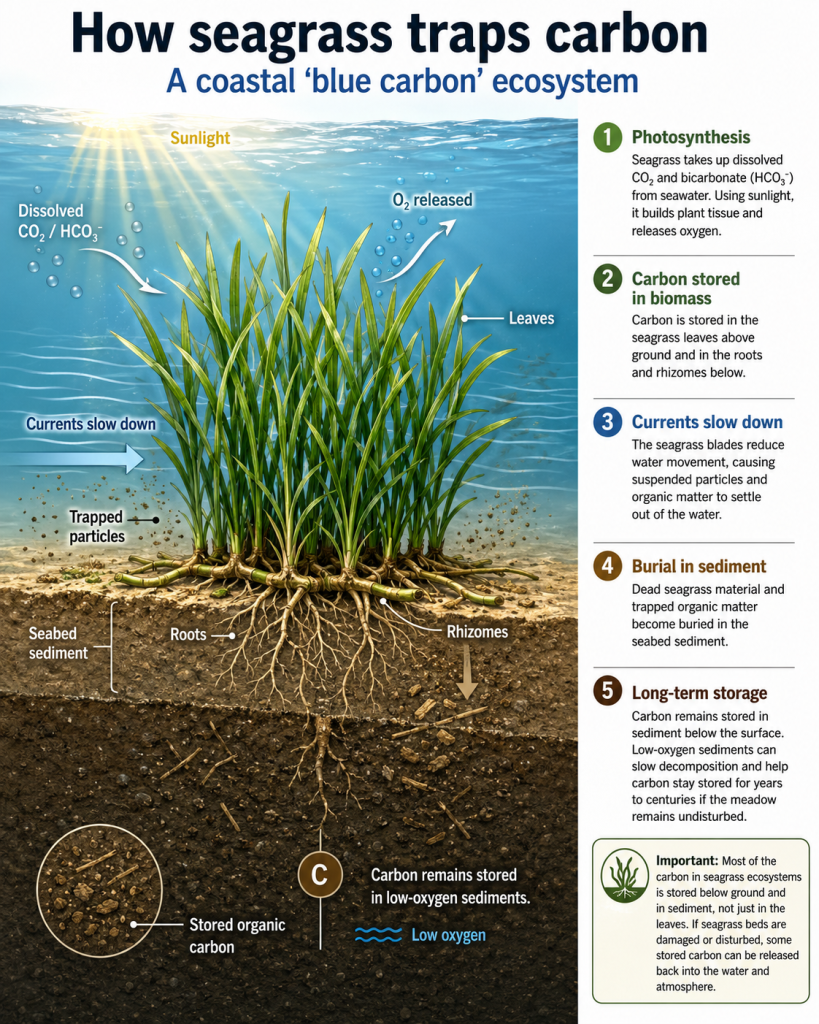
However, Chen’s team noted that previous blue carbon studies have primarily focused on the organic carbon stored in seagrass plants and sediments. That approach may miss other processes that affect whether a seagrass bed functions as a carbon sink or a carbon source.
The study examined what the researchers call “invisible blue carbon,” including the interaction between organic carbon, inorganic carbon, carbonate chemistry, total alkalinity and sediment biogeochemical reactions.
Chen said these processes influence how much carbon dioxide the ocean can absorb from the atmosphere.
The research team said the key finding is that seagrass carbon storage cannot be measured simply by calculating how much carbon is fixed by plants.
Instead, assessments should include the full carbon cycle, including organic carbon metabolism, calcium carbonate formation and dissolution, and chemical reactions in sediments.
The university said the findings could provide a new framework for evaluating seagrass beds in blue carbon research, net-zero policy, and future carbon-credit systems.
Seagrass beds, Chen said, remain one of the most promising blue carbon ecosystems, but their actual climate benefits need to be measured more completely.