
By KHT Staff. AI illustration cover image.
KAOHSIUNG — Kaohsiung’s government says changes to Taiwan’s revenue-sharing law have produced an unwelcome result: the city expects to receive more shared tax revenue next year, but its overall budget will still be almost NT$5 billion smaller.
The opposition Kuomintang (KMT) disputes that explanation, arguing that the law increased Kaohsiung’s share of national tax revenue and that the reduction in project grants was a separate decision by the central government.
Mayor Chen Chi-mai (陳其邁) presented the proposed 2027 budget to the Kaohsiung City Council on Tuesday, arguing that increased tax allocations had failed to compensate for a much larger reduction in project-specific grants from the central government.
The city placed its overall budget at about NT$199 billion, down almost NT$5 billion, or 2.4 percent, from 2026.
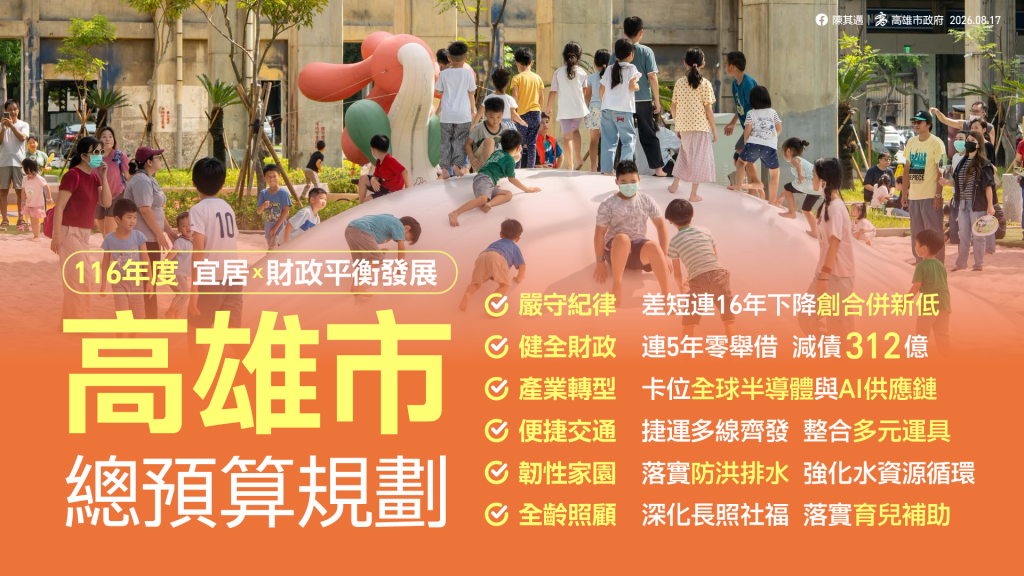
It expects close to NT$188 billion in revenue against roughly NT$193 billion in expenditure, leaving a gap of nearly NT$5 billion. An additional NT$6.2 billion in debt repayments brings the city’s total financing requirement to NT$10.964 billion, according to the City Council’s account of the briefing.
The dispute centers on the Act Governing the Allocation of Government Revenues and Expenditures, commonly shortened in Chinese to the Tsaihuafa (財劃法).
The law determines how national tax revenue is divided between the central and local governments. Amendments passed by the legislature increased the proportion distributed directly to cities and counties.
Kaohsiung acknowledges that its allocation of shared tax revenue will increase. However, City Hall says central government grants for specific projects will fall by just over NT$12 billion, more than wiping out the additional tax income.
Unlike shared tax revenue, which local governments have greater freedom to spend, project grants are tied to specific undertakings such as MRT construction, flood-control works and other infrastructure.
City Hall therefore argues that the revised law cannot be judged by the increase in shared taxes alone. It says the three main sources of central funding for local governments, shared tax revenue, general grants and project grants, must be considered together.
Chen endorsed an Executive Yuan proposal to revise the law again. The Cabinet’s version would use a different distribution formula and is intended to prevent the three funding streams combined from falling below their 2025 level.
The city’s explanation is disputed by Kuomintang politicians.
KMT City Councilor Chiou Yu-shiuan (邱于軒) said the amended law had increased Kaohsiung’s shared tax allocation and argued that reductions in project grants were separate decisions made by the central government.
KMT Legislator Ko Chih-en (柯志恩) made a similar argument, saying that project-grant amounts remain under the Executive Yuan’s control and that City Hall was directing its criticism at the wrong target.
“If responsibility is to be pursued over these funds, the city government should identify the correct party,” Ko said in a statement reported by local media.
The disagreement is more than an accounting quarrel. Councilor Kuo Chien-meng (郭建盟) said the city’s MRT construction budget had been reduced by just over NT$6 billion.
Chen said MRT subsidies had fallen by a combined NT$13.6 billion over 2026 and 2027. The city could temporarily use borrowing through its MRT development fund to keep work moving, he said, but a prolonged shortfall could eventually affect the awarding of construction contracts.
The proposed budget still includes almost NT$19 billion for older residents, people with disabilities, children and social assistance; just shy of NT$10 billion for long-term care; and about NT$9 billion for tuition support, free school lunches and measures addressing Taiwan’s falling birthrate.
Another NT$4 billion is allocated to drainage, flood control and related maintenance, while close to NT$4 billion is earmarked for water recycling and wastewater reuse.
Chen said Kaohsiung had completed five consecutive years without net new borrowing beginning in 2021 and had reduced debt subject to statutory limits by just over NT$31 billion.
Councilors nevertheless raised questions about the city’s self-liquidating debt, which has risen as MRT construction has accelerated. Chen said that borrowing was tied to projects expected to generate future revenue through joint development and publicly led urban renewal.
The 2027 budget must still be reviewed and approved by the City Council. The larger political dispute, whether Kaohsiung’s smaller budget is a consequence of the revised law or the Cabinet’s grant decisions, is unlikely to be settled quite so neatly.