
By Dr. TUNG Chen-Yuan, Taiwan’s Representative to Singapore.
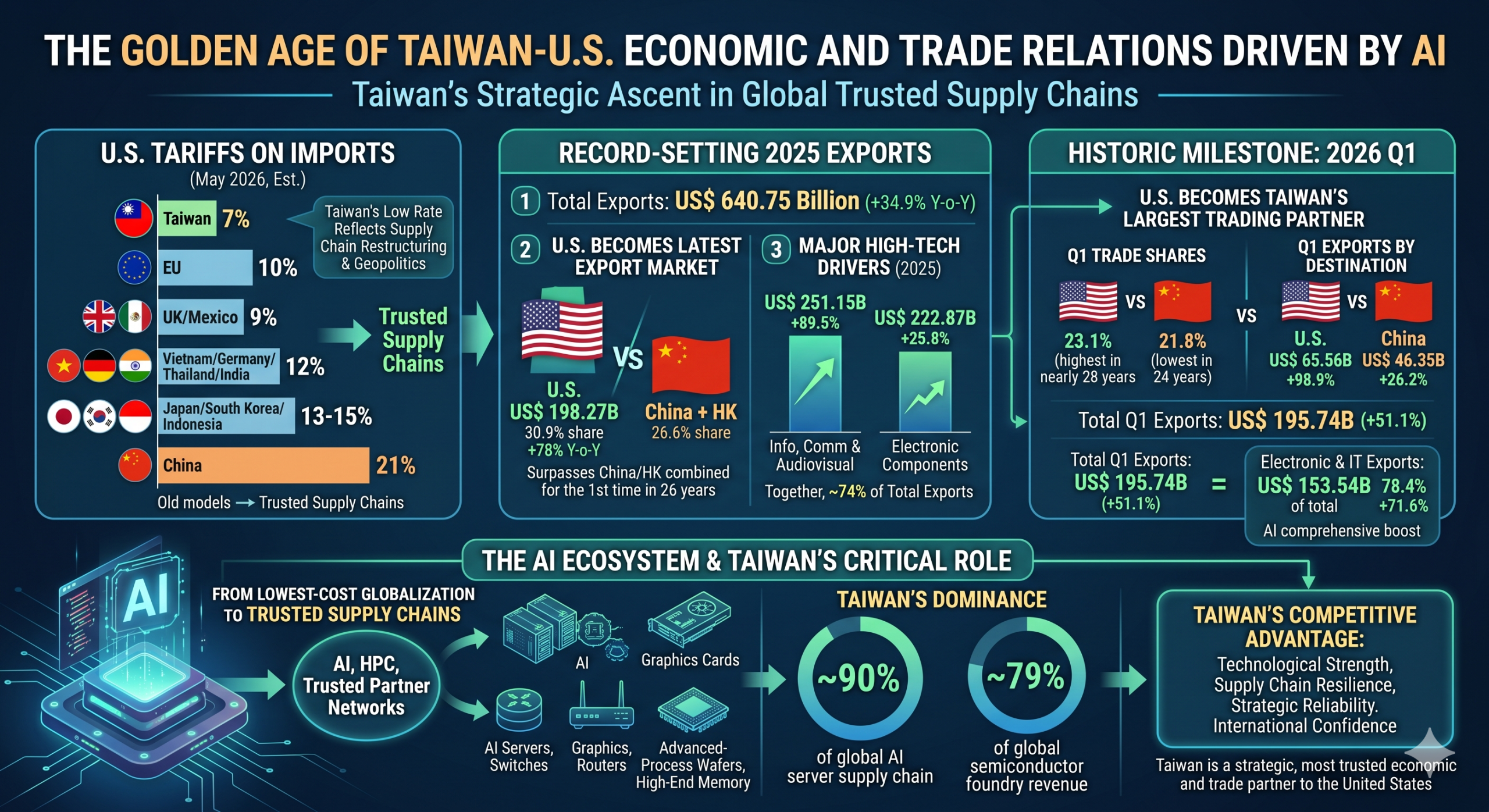
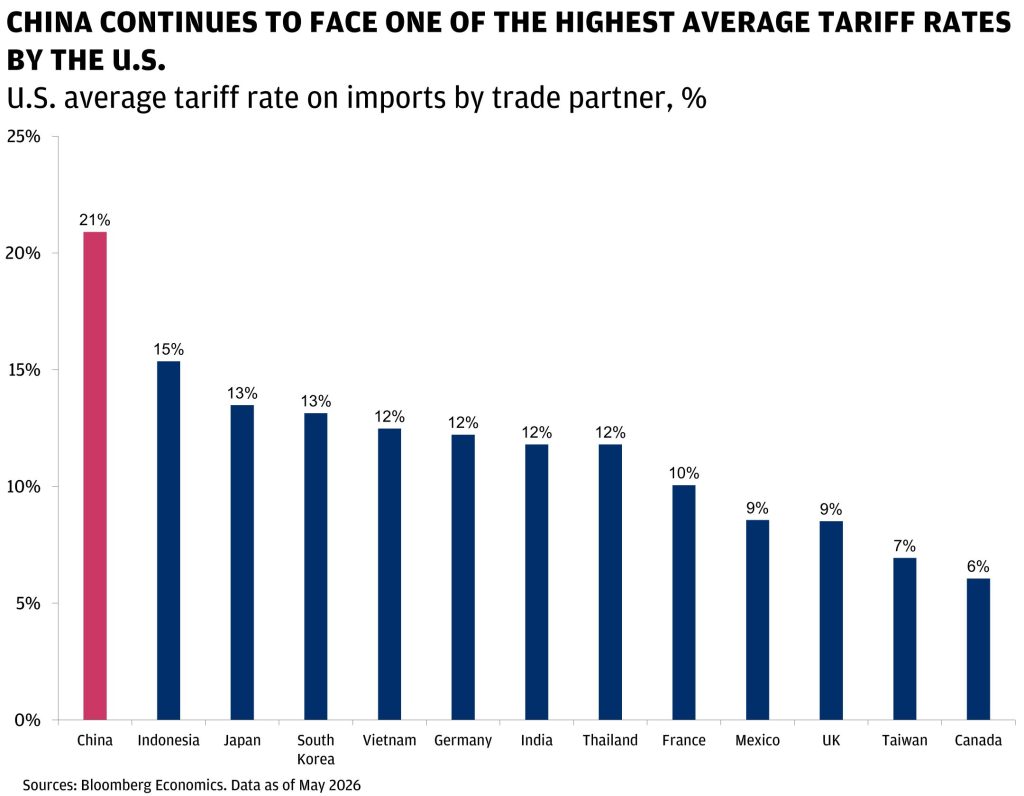
According to the latest estimates by Bloomberg Economics, as of May 2026, the average tariff imposed by the United States on imports from Taiwan stands at only 7%, lower than the 10% applied to the European Union, the 9% imposed on the United Kingdom and Mexico, the 12% levied on Vietnam, Germany, Thailand, and India, as well as the 13% and 15% imposed on Japan, South Korea, and Indonesia respectively. In contrast, tariffs on Chinese imports remain as high as 21%.
These figures reflect far more than differences in tariff rates. They signal the rapid restructuring of global supply chains and the geopolitical economic landscape, with Taiwan positioned at the very center of this transformation.
In 2025, Taiwan’s total exports reached US$ 640.75 billion, marking a year-on-year increase of 34.9% and setting a new historical record. Exports to the United States amounted to US$ 198.27 billion, soaring by 78% year-on-year and accounting for 30.9% of Taiwan’s total exports. For the first time in 26 years, this surpassed the combined share of exports to mainland China and Hong Kong, which stood at 26.6%, officially making the United States Taiwan’s largest export market.
Particularly noteworthy is that the major drivers behind this export surge were concentrated in two high-tech industries. In 2025, exports of information, communications, and audiovisual products surged by 89.5% to US$ 251.15 billion, setting another historical record. Exports of electronic components also increased by 25.8% to US$ 222.87 billion. Together, these two categories accounted for approximately 74% of Taiwan’s total annual exports, with the most remarkable growth coming from information and communications products, which have become the primary engine of Taiwan’s export expansion in recent years.
Entering 2026, Taiwan-U.S. economic and trade relations reached yet another historic milestone. In the first quarter, bilateral trade between Taiwan and the United States totaled US$ 78.25 billion, enabling the United States, after a gap of 25 years, to officially surpass mainland China and Hong Kong as Taiwan’s largest trading partner.
During the first quarter, Taiwan-U.S. trade accounted for 23.1% of Taiwan’s total trade, the highest level for the same period in nearly 28 years. By contrast, the share of trade with mainland China and Hong Kong declined to 21.8%, the lowest level for the same period in 24 years.
On the export front, Taiwan’s total exports in the first quarter of 2026 reached US$ 195.74 billion, representing an impressive annual growth rate of 51.1% and establishing a new quarterly record. Among them, exports of electronic and information technology products totaled US$ 153.54 billion, accounting for 78.4% of total exports, while posting a remarkable growth rate of 71.6%. This demonstrates how the AI wave is comprehensively boosting the export momentum of Taiwan’s high-tech industries.
Exports to the United States reached US$ 65.56 billion, accounting for 33.5% of Taiwan’s total exports and firmly maintaining America’s position as Taiwan’s largest export market. The annual growth rate was an astonishing 98.9%, nearly doubling from the previous year. In comparison, exports to China amounted to US$ 46.35 billion, representing 23.7% of total exports, with annual growth of 26.2%.
This shifting trend reflects the accelerating reorganization of global supply chains around artificial intelligence, high-performance computing (HPC), and trusted partner networks, with Taiwan emerging as one of the most critical hubs in this new ecosystem.
In particular, Taiwan’s exports to the United States reached US$ 28.54 billion in March 2026 alone, not only setting a new monthly record but also registering a remarkable annual growth rate of 120%. Driven by booming exports to the United States, Taiwan’s overall exports in the first quarter simultaneously reached an all-time high.
The core momentum behind this wave of growth comes from rapidly rising demand for AI servers, graphics cards, switches, routers, advanced-process wafers, and high-end memory products. Taiwan currently controls approximately 90% of the global AI server supply chain and around 79% of global semiconductor foundry revenue, making it an indispensable pillar of the global technology industry.
As the world gradually shifts away from pursuing “lowest-cost globalization” toward prioritizing “trusted supply chains,” Taiwan’s greatest advantage no longer lies solely in its exceptional manufacturing capabilities. More importantly, it stems from the international community’s deep confidence in Taiwan’s technological strength, supply chain resilience, and strategic reliability.
In the AI era, Taiwan is not merely an important participant in the global supply chain—it is steadily becoming one of the United States’ most important and most trusted economic and trade partners.
About the Author:
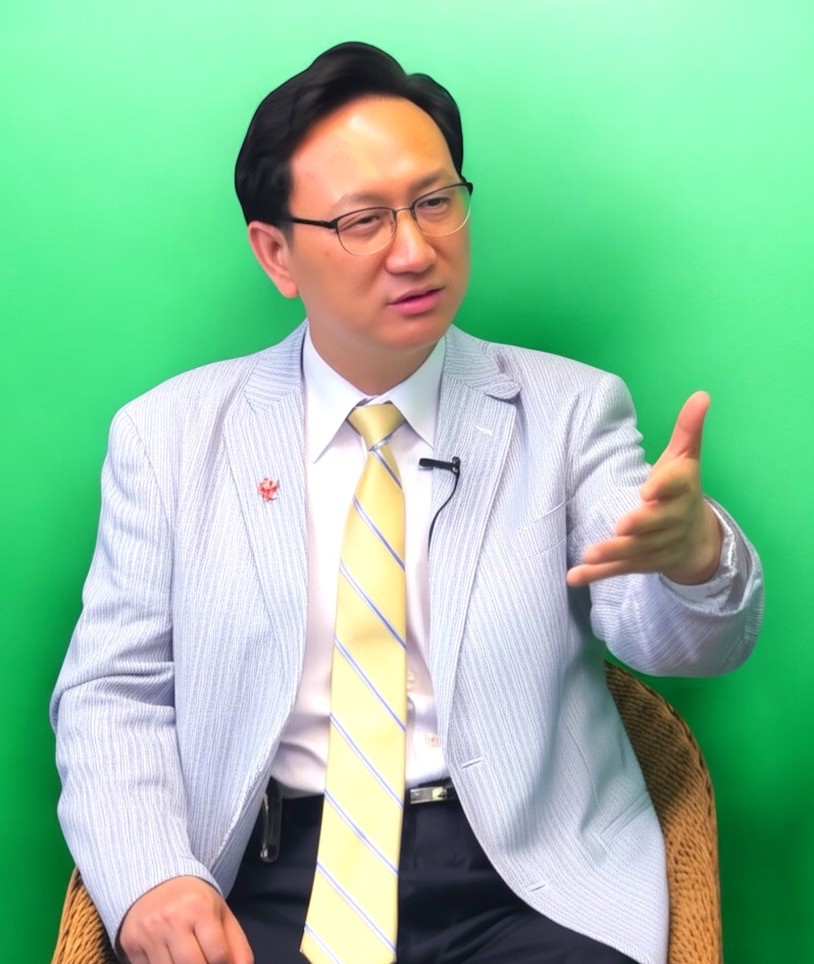
Dr. Tung Chen-Yuan is currently Taiwan’s Representative to Singapore. He was Minister of the Overseas Community Affairs Council of the Republic of China (Taiwan) from June 2020 till January 2023. He was Taiwan’s ambassador to Thailand from July 2017 until May 2020, senior advisor at the National Security Council from October 2016 until July 2017, and Spokesman of the Executive Yuan from May to September 2016. Before taking office, Dr. Tung was a distinguished professor at the Graduate Institute of Development Studies, National Chengchi University (Taiwan). He received his Ph.D. degree in international affairs from the School of Advanced International Studies (SAIS), Johns Hopkins University. From September 2006 to May 2008, he was vice chairman of the Mainland Affairs Council, Executive Yuan. His areas of expertise include international political economy, China’s economic development, and prediction markets.