
By Chris Clifford
Contributing writer. Image via Taiwan Security Monitor.
The People’s Liberation Army has not stopped operating around Taiwan. What has disappeared in 2026 is much of the accompanying propaganda spectacle.
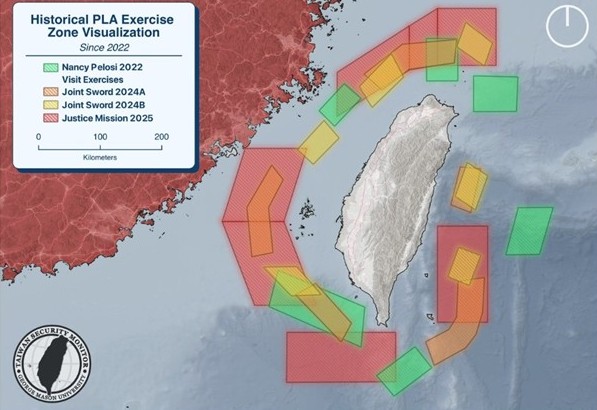
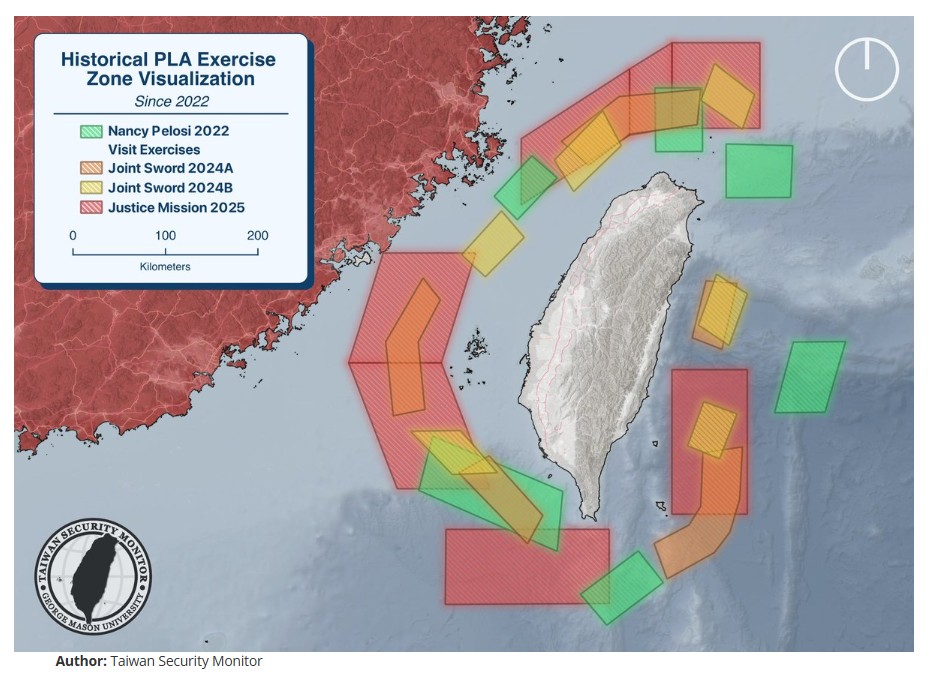
Since 2023, the pattern was familiar. The PLA Eastern Theater Command would announce a major named exercise, Joint Sword, Strait Thunder, or Justice Mission, release exclusion-zone maps that boxed in Taiwan, run joint air-naval-rocket activity, and flood official channels with videos, posters, and political cartoons.
These were typically timed to a political trigger such as President Lai Ching-te’s (賴清德) 2024 inauguration or the December 2025 U.S. arms package to Taiwan. The messaging was dual-use: intimidate Taiwan, reassure a domestic audience, and generate international headlines.
Some of the imagery became unusually personal. During the April 2025 Strait Thunder exercise, the PLA published cartoons that caricatured Taiwan’s President Lai as a green parasite being held over a fire.
The last major exercise in that style was Justice Mission-2025, held at the end of December. As of mid-August 2026, Beijing has not repeated that combination of a large Taiwan-focused operation, a formal name, and an extensive propaganda campaign.
PLA activity around Taiwan has also declined. The ROC Ministry of National Defense publishes daily reports on PLA aircraft and ships near ROC territory. Those reports show 1,334 PLA aircraft sorties in the first half of 2026, less than half the total recorded in the same period of 2025 and the lowest first-half figure since 2023. Taiwan also recorded more days without detecting PLA aircraft, and large single-day surges became less frequent after Justice Mission-2025.
The capability remains. The decision to brand those surges has changed.
This does not mean the PLA has gone quiet. A nuclear-powered ballistic-missile submarine conducted China’s first publicly acknowledged long-range SLBM test into international waters in July. The Liaoning carrier strike group completed a 40-day open-sea deployment in the South China Sea and Western Pacific. Frigates have continued training east of Taiwan.
Routine combat-readiness patrols and gray-zone pressure continue.
PLA-named exercises have not completely stopped this year, but they have only been joint drills with other countries: Joint Sea-2026 with Russia and Swift Eagle 2026 with Belarus. They have not been unilateral, Taiwan-centric operations of the Joint Sword or Justice Mission style.
Beijing is highly secretive, so we can only guess as to why there’s a change in 2026. A leading explanation is the latest wave of aggressive purges within senior PLA leadership. A new wave of senior officer purges began in late 2025, including the removal of the former PLA Eastern Theater commander (responsible for the area around Taiwan) in October.
The most high-profile case came in January 2026 with the investigation and disappearance of Zhang Youxia (張又俠), the senior Central Military Commission (CMC) vice chairman and China’s highest-ranking uniformed officer.
The purges have been so extensive that the seven-member CMC has been reduced to just two people: Xi Jinping (習近平) and Zhang Shengmin (張升民), a career political commissar with no real operational command experience. The world’s largest military has had its top leadership hollowed out by the political party it is sworn to protect.
The purges may be affecting the PLA in more than one way. Vacancies at the top can slow approvals and complicate coordination. A major named exercise involving air, naval, rocket, and propaganda units requires extensive planning, especially when it is meant to send a political message.
There is likely also a more personal incentive problem.
Being a senior leader in the PLA has become a hazardous occupation. The incentive is no longer to excel but to avoid standing out. Naming an exercise turns it into a political product. Someone has to own the planning, the execution, and the messaging. A high-profile success can look like ambition, and in this system ambition is dangerous. It can be read as building personal influence or competing for recognition, both of which make an officer a potential target. Likewise, any shortfalls create a stain on the record that can later be used against them. The safer path is to meet operational requirements through routine, lower-profile activity that generates neither headlines nor personal exposure.
For many in the senior ranks, going unnoticed has become a matter of both political and personal survival.
Another explanation is that 2026 simply lacked a political trigger. However, that argument seems less convincing. The year has had several potential triggers, especially Taiwan’s approval of a large special defense budget in May. The biggest day of PLA air activity in 2026 was 42 aircraft on February 12, possibly a response to Japan’s snap election. During the Trump-Xi summit and at the start of the US-Iran war, PLA flights around Taiwan actually fell to zero for several days.
This is still all inference. Even China experts can’t be certain. The timing, however, lines up with the leadership disruption, and the change has been specific. Named joint exercises with partners continue. The old style of unilateral, Taiwan-centric packaged exercises has not appeared so far this year.
Nothing in the available evidence suggests Taiwan has become less important to Beijing. Substantial activity continues. Selective high-end demonstrations still occur. Gray-zone pressure remains.
What has been set aside, at least for now, is the flashy media and propaganda layer that previously turned military exercises into branded political events. For Taiwan, the immediate lesson is not to treat the absence of a catchy exercise name as reassurance. An unannounced surge can be as operationally significant as a heavily promoted one, and routine pressure may reveal more about PLA readiness than its cartoons do.
The spectacle has faded for now. The capability has not.
About the Author

Christopher Clifford is a contributing writer for the Kaohsiung Times and the creator of the YouTube channel Uncle Topher 美國叔叔”