
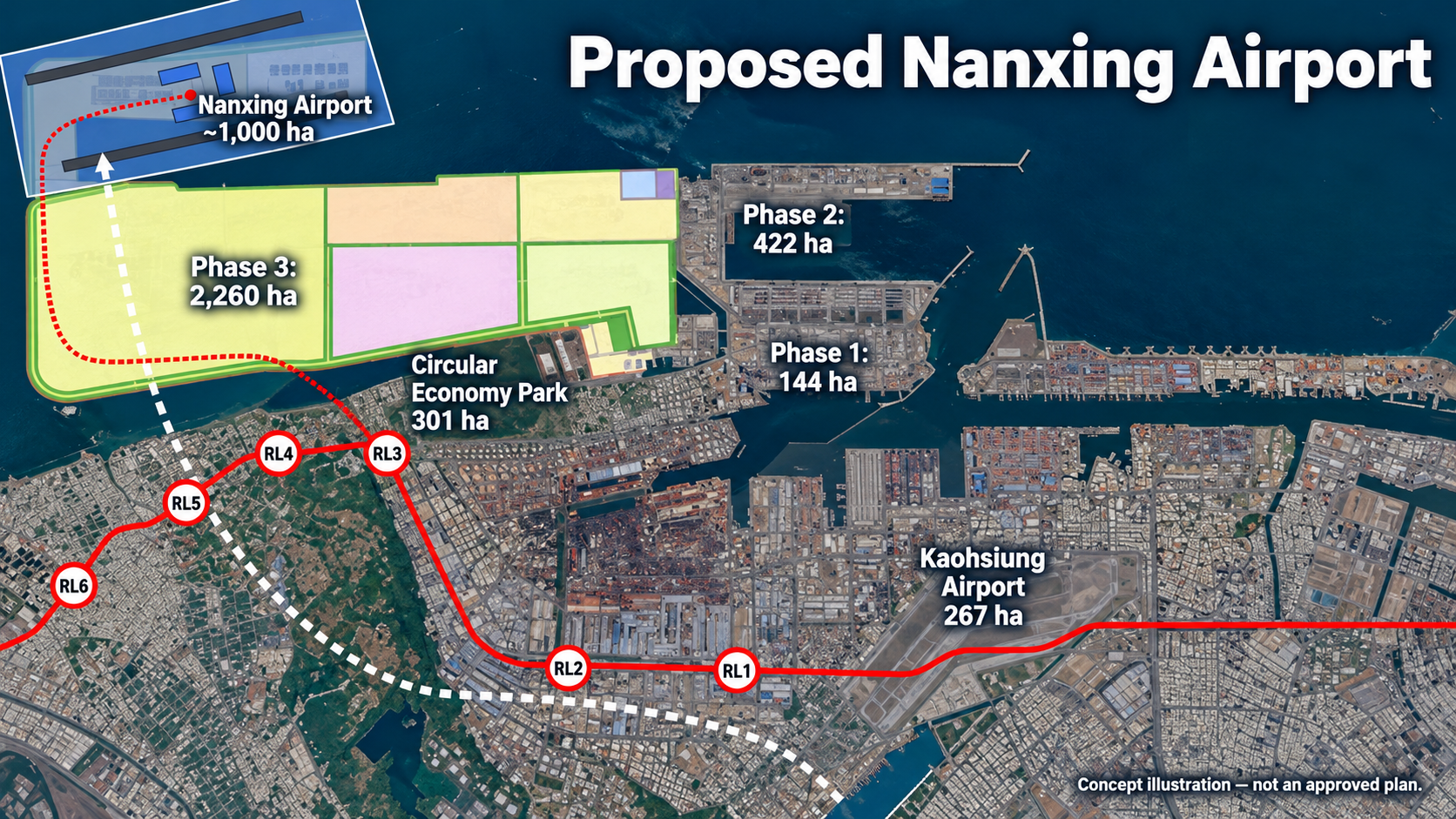
By KHT Staff. AI-generated English adaptation of concept illustration.
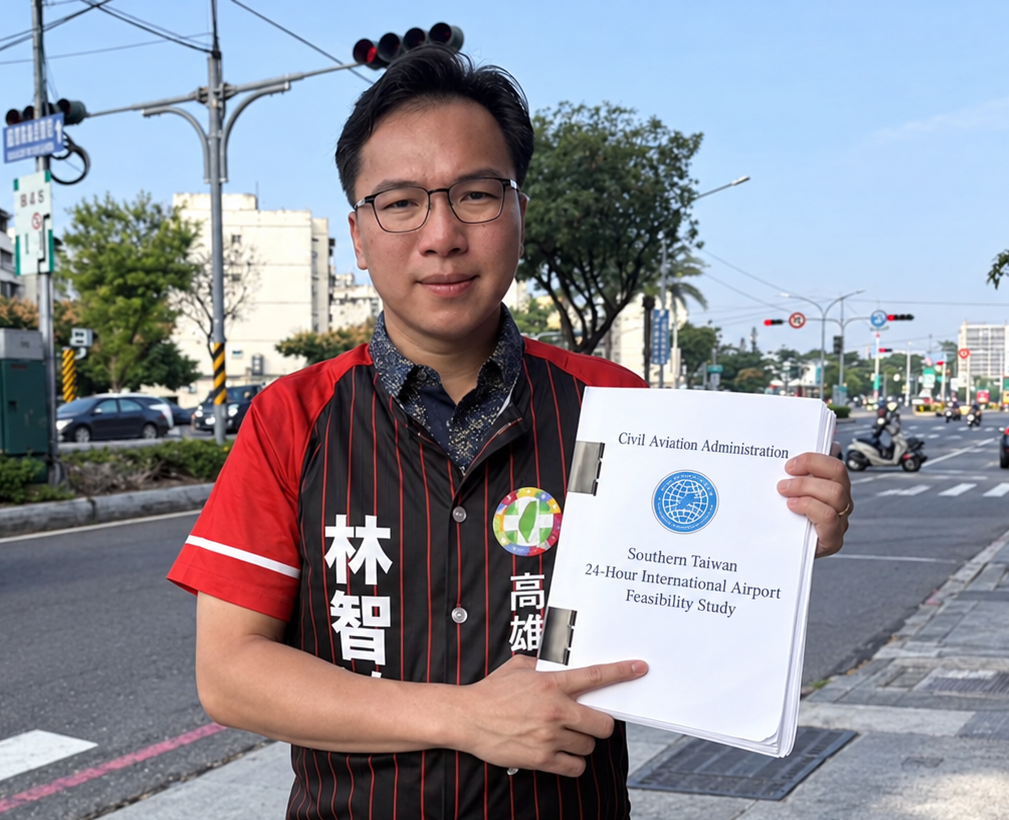
KAOHSIUNG — Democratic Progressive Party city councilor Lin Chih-hung (林智鴻) has called for a renewed assessment of the proposed Nanxing airport (南星機場), arguing that Kaohsiung needs an international airport capable of operating around the clock without a nighttime curfew.
During council questioning, Lin cited a 2015 Civil Aviation Administration (民航局) feasibility study conducted under the Kuomintang government of President Ma Ying-jeou (馬英九), according to Liberty Times.
Taiwan’s aviation policy at the time designated Taoyuan as the main international hub, with other airports serving supporting roles. Kaohsiung was classified as a regional international airport for southern Taiwan.
Lin argued that this framework constrained Kaohsiung’s potential before authorities assessed whether demand justified a new airport. He accused the former KMT administration of favoring northern Taiwan over the south.
He also cited a 2012 legislative exchange in which then-Transportation Minister Mao Chi-kuo (毛治國), responding to legislator Lee Kun-tse (李昆澤), opposed developing an airport to compete with Taoyuan and questioned the need to extend Kaohsiung’s runway.
The 2015 study found that a new southern airport was infeasible, on grounds including airspace and financial constraints, according to the report. Lin said it nevertheless recommended reviewing the broader planning framework and acknowledged a possible relationship between restricted capacity and insufficient demand.
An engineering review published by CECI separately records the study’s conclusion that southern Taiwan then lacked land and airspace meeting the requirements for a new large international airport. It recommended continuing development at the existing Kaohsiung airport and reviewing its overall plan.
Calls to revisit the proposal have also appeared in city council motions, including a request for updated feasibility research reflecting southern Taiwan’s semiconductor industry and cargo needs. The proposal remains subject to assessment rather than approval for construction.